The lazy take is that the Societas Europaea proved Europe can create a single company form. That's the wrong lesson. A legal form that exists on paper and a legal form founders use are two different things, and the SE's adoption tells you which side won.
The SE was built for cross-border business. It was meant to make expansion easier across the EU, not harder. Yet researchers have described it as a practical failure, because uptake stayed far below expectations after the regime arrived through EU regulation in 2004 and took effect in 2004 and 2005 Cambridge Judge Business School working paper.
That gap is the whole story. When a form designed for the single market ends up used like a niche wrapper, founders should pay attention.
The Societas Europaea, or SE, was sold as a clean answer to a messy problem. One European company form. One legal identity. Less friction for firms that operate across borders.
The political path tells you a lot about why the promise never matched the product. The idea first surfaced in 1965, the first Commission draft came in 1970, and the final package was adopted as Council Regulation 2157/2001 together with Directive 2001/86, which entered into force on 8 October 2004 LinkedIn post summarizing the timeline. That long delay was not a sign of careful polish. It was the result of political compromise after decades of deadlock.
The hard truth is simpler. A Cambridge Judge Business School working paper found that a substantial number of the 112 SEs it reviewed were non-operational, so registration did not translate into active cross-border corporate integration Cambridge Judge Business School working paper. In plain terms, a lot of these entities existed as legal wrappers, not working operating structures.
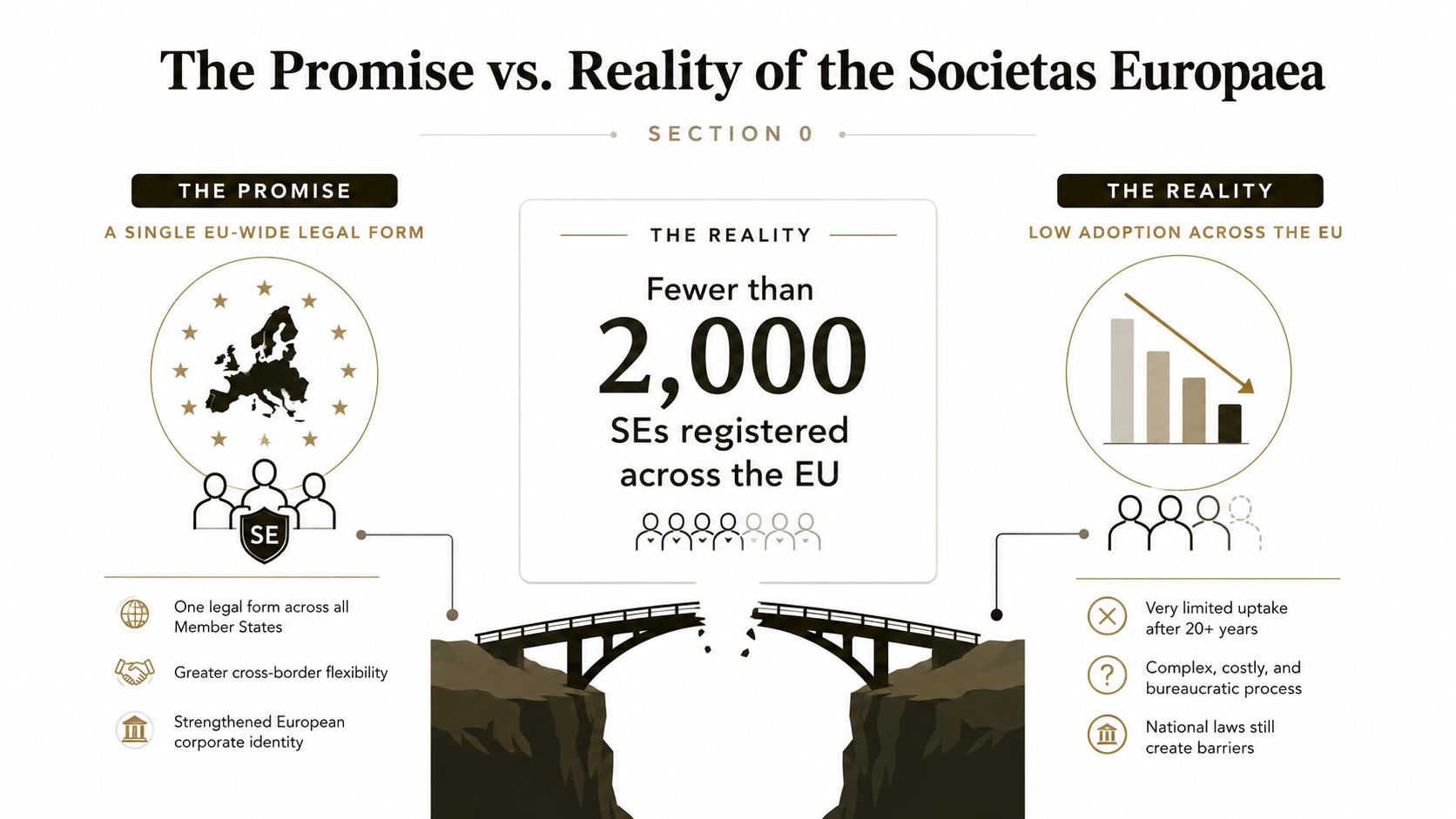
That is why societas europaea failure keeps showing up in serious conversations. The SE did not flop because the idea was obscure. It flopped because the design never became attractive enough for broad use, especially once founders compared it with the simpler, more practical options already on the table.
Practical rule: a company form that only suits a narrow group of large, already international firms is not a general solution. It is a specialist instrument.
The founder lesson is blunt. Europe can pass a cross-border company form. That does not mean it built one people want to use. The SE is a cautionary tale for founders who care about the incoming EU Inc. digital framework, because it shows exactly what happens when legal ambition outruns day-to-day usability.
The SE looked unified from a distance, but the entry conditions were tight. That is the first reason adoption stayed narrow. The form was created by EU legislation in October 2004, but it is available only to public limited companies in the European Economic Area, and it carries a minimum share capital of at least €120,000.
For a founder, that threshold is not just a number. It signals who the structure was meant for. The SE was never aimed at the average startup or the typical small operator trying to expand into one neighboring market. It was built for firms that already had size, legal budget, and cross-border complexity.
The legal form also required companies to be active in at least two EU countries, while the registered office and head office had to stay in the same member state under EU guidance. That combination sounds orderly. In practice, it keeps the same boundary lines in place just when founders are trying to reduce them.
The broader problem is that the legislation did not fully harmonize company law. Most governance and insolvency rules stayed with national law, so the supposed pan-European form never delivered a single legal operating system. The SE gave companies a European label, but much of the legal substance remained local.
A clean way to read the structure is this:
The old form also had a structural mismatch. It was supposed to make Europe feel like one market, but it still forced founders to deal with several legal systems. That is complexity in a new wrapper, not simplification.
The straightforward lesson is clear. If a system begins with stringent requirements, keeps national divisions, and leaves most rules unchanged, adoption will stay limited. That is exactly what happened here.
The SE was built for companies that already had cross-border scale. Everyone else was left looking at a form that sounded useful and worked like a compromise.
The most overlooked reason the SE struggled is the one founders hate most, time. The framework requires an agreement on employee involvement before registration, and in many cases that means negotiation through a special negotiating body WilmerHale commentary.
For a startup or scale-up, that's a serious problem. Leadership teams want speed, clean governance, and a predictable close. The SE introduces a labor-governance conversation before the company can even exist in its chosen form. That is not a minor admin step. It can become the deal-breaker.
Think about a founder who wants to shift into a pan-European structure while raising capital, hiring, and closing sales in parallel. The financing process already has legal review. The employment team is already handling local contracts. Add employee participation negotiations, and the incorporation timeline stretches. The company now has another party, another process, and another point of failure.
That's exactly why recent EU startup-policy discussions have treated employee participation as one of the areas a new EU-wide company form must simplify, alongside fully digital incorporation and standardized documents. The message is plain. The current SE-style approach is too cumbersome for modern scaling companies.
The hidden cost is not just delay. It's uncertainty. Founders can price legal fees. They can budget for capital. They can't easily price a negotiation that depends on labor arrangements, timing, and the appetite of multiple stakeholders. That uncertainty pushes teams toward simpler national setups, even when they want cross-border reach.
So the question isn't whether employee participation is theoretically important. It is. The question is whether the rule design fits the companies that need a fast EU structure. On that point, the SE is weak.
For founders, the hard truth is this. A company form can look elegant in policy papers and still fail in practice if it slows down registration. In venture-backed settings, slowness is a cost. In some cases, it's fatal.
The SE was sold as a single EU-wide company form. The registration experience never matched that pitch. In practice, the form still runs through national registration procedures, and there is no central register. The result is a European label sitting on top of a fragmented filing system.
A real unified form would let a founder incorporate once and then keep moving through one clear legal workflow across borders. The SE never delivered that. It gave companies a European wrapper while leaving the core mechanics in national hands.
That distinction matters because a legal label is not the same thing as a working process. A cross-border structure does little for you if filing, governance, and insolvency still need local handling. As the EU guidance on setting up a European company makes clear, the framework exists, but the practical route still runs through member state systems.
The registration gap is easy to see in plain terms.
A comparison from an infographic comparing the simplified European SE registration process to the complex reality of national business filings. captures the point well. The promise looks clean on paper. The filing reality is messier, slower, and tied to different national steps that do not collapse into one EU-wide process.
That is why the SE became a cautionary tale. It offered a European brand, but not a unified registration system. For founders, that is the lesson that matters. A form can sound modern and still leave you doing old-world paperwork in multiple places.
If you are comparing company forms, ignore the branding. Count the filing steps, the local approvals, and the number of places where the process can stall.
The SE's failure leaves a useful checklist for founders who need cross-border operations now. Don't start with the legal label. Start with the friction points. Then choose the structure that removes the most friction, not the one that looks best in a memo.
First, map where the business really operates. That means customers, hiring, invoicing, and management. If the footprint is still thin, a heavy cross-border form may be unnecessary overhead.
Second, separate formation from ongoing compliance. A structure that is cheap to set up but expensive to maintain can still hurt you later. The SE taught that lesson the hard way. Form alone doesn't solve administration.
Third, get tax and legal coordination in the same room early. Cross-border setups fail when company law, payroll, VAT, and governance are handled by different advisors who don't compare notes.
Practical rule: if you need a legal structure to move faster, don't pick one that introduces extra approval layers before you've even opened the first account.
For non-EU and remote founders, the key issue is access. You want a setup that doesn't force unnecessary local presence, local directors, or in-person steps. The SE was never built with that user in mind. That's why many modern founders should look for simpler, digital-first alternatives rather than trying to bend an old regime into a startup workflow.
A useful decision checklist:
The founders who avoid expensive mistakes are the ones who treat incorporation as a system design problem. The SE shows what happens when the system is too heavy for the use case.
The new wave of EU company design is trying to fix the SE's worst habits, and that is the right target. The incoming EU Inc. framework is being built around digital onboarding, lighter formation, and simpler cross-border use, with an expected launch in Q1 2027 while the legislation is still moving. Treat that timing as a projection, not a live regime. For the current outline, see the publisher overview.
The point of the redesign is obvious once you compare the two systems. The framework is built around €1 minimum capital instead of the SE's €120,000 threshold. It is meant to be 100% digital, with no notary, and a target incorporation window of 48 hours once registrations open. It also removes the need for a local director or physical presence, which is where many modern founders get stuck.
The fix is not faster paperwork on its own. The framework also coordinates TIN and VAT assignment during registration, so founders do not have to piece together identity and tax setup after the fact. And because it is built as a single entity for the whole EU, it aims to support hiring, invoicing, and operations across all 27 member states through one company.
That is the lesson from the SE failure. The SE asked companies to adapt to a fragmented legal environment and then charged them for the privilege. The new model tries to remove the obvious blockers before the company ever exists.
It also matters that the new design is being discussed alongside EU-FAST and EU-ESOP. Standardized investment docs, like a European SAFE note, cut negotiation drag. A shared employee equity framework reduces the mess around stock plans. Those adjacent tools are what make a company form usable in real life, not just attractive on paper.
The honest part is simple. Nothing is final until the legislation is final. But the direction is clear, and it is the right one. Europe has learned that a company form will not win on symbolism. It has to win on speed, clarity, and low-friction execution.
Don't sit still if you're planning an EU expansion. Use the time before the new framework arrives to clean up the parts that slow founders down. Write down where you will hire, where you will invoice, and which entity will own the relationship with customers and staff.
If you are a non-EU resident, prepare for remote incorporation as the default path. The point of the proposed model is to remove citizenship, residency, notary, and local director requirements from the opening checklist. That is a far cleaner starting point for founders building from outside Europe.
A sensible preparation list looks like this: