You're probably here because the old setup is already getting messy. Maybe you're selling in Germany, France, and Spain, and every new market means another entity, another registration, another tax headache, and another round of legal bills.
That's the question behind should I use EU Inc. Not “what is it?” but “does it make my life easier, or is it just a new label on old friction?”
My answer is blunt. If you're planning to build across several EU markets, EU Inc is worth watching closely. If you're staying local, it's probably not worth waiting for. And if you need to launch today, you should not sit on your hands for a regime that's still in legislative process and is only expected in Q1 2027.
A founder with customers in Germany, France, and Spain usually starts with one simple goal, sell, hire, and invoice without friction. Then the legal structure fights back. Each country adds its own incorporation path, and the company ends up with separate entities or heavy local workarounds.
That's where the cost shows up. Not just in fees, but in time, coordination, and mismatched paperwork. One country wants one format. Another wants another. Someone asks for local presence. Someone else wants a different filing trail. You spend weeks getting to the point where you can do normal business.
The market size makes that pain worth taking seriously. The EU single market covers 27 member states, and the European Commission describes it as the world's largest integrated market, which is exactly why even small reductions in incorporation friction matter for cross-border startups and scale-ups (European Commission Q&A on EU Inc).
Practical rule: if every new country forces a new legal entity, your company is already paying an expansion tax.
The other hidden cost is operational delay. Incorporation is often the gate to hiring, invoicing, and tax registration. So the structure problem isn't academic. It slows revenue, payroll, and market entry.
EU Inc enters as the proposed answer to that mess. It is not magic. But it is the first serious attempt to give founders one company form that works across the EU without rebuilding the legal stack every time they enter a new market.
EU Inc is a proposed optional company form. It does not replace national company forms. You can still use a local structure if that fits your setup better. If you want one standardized company across the EU, this is the model being proposed.
It is built around a single EU-level interface linked to national business registers. In plain English, you file once through a central digital system, and the company data is designed to flow through the relevant registers instead of being retyped everywhere. The proposal's headline target is 48-hour registration, with maximum cost of €100, no minimum share capital, and a 100% digital process based on eIDAS identification and signature (European Commission news release).
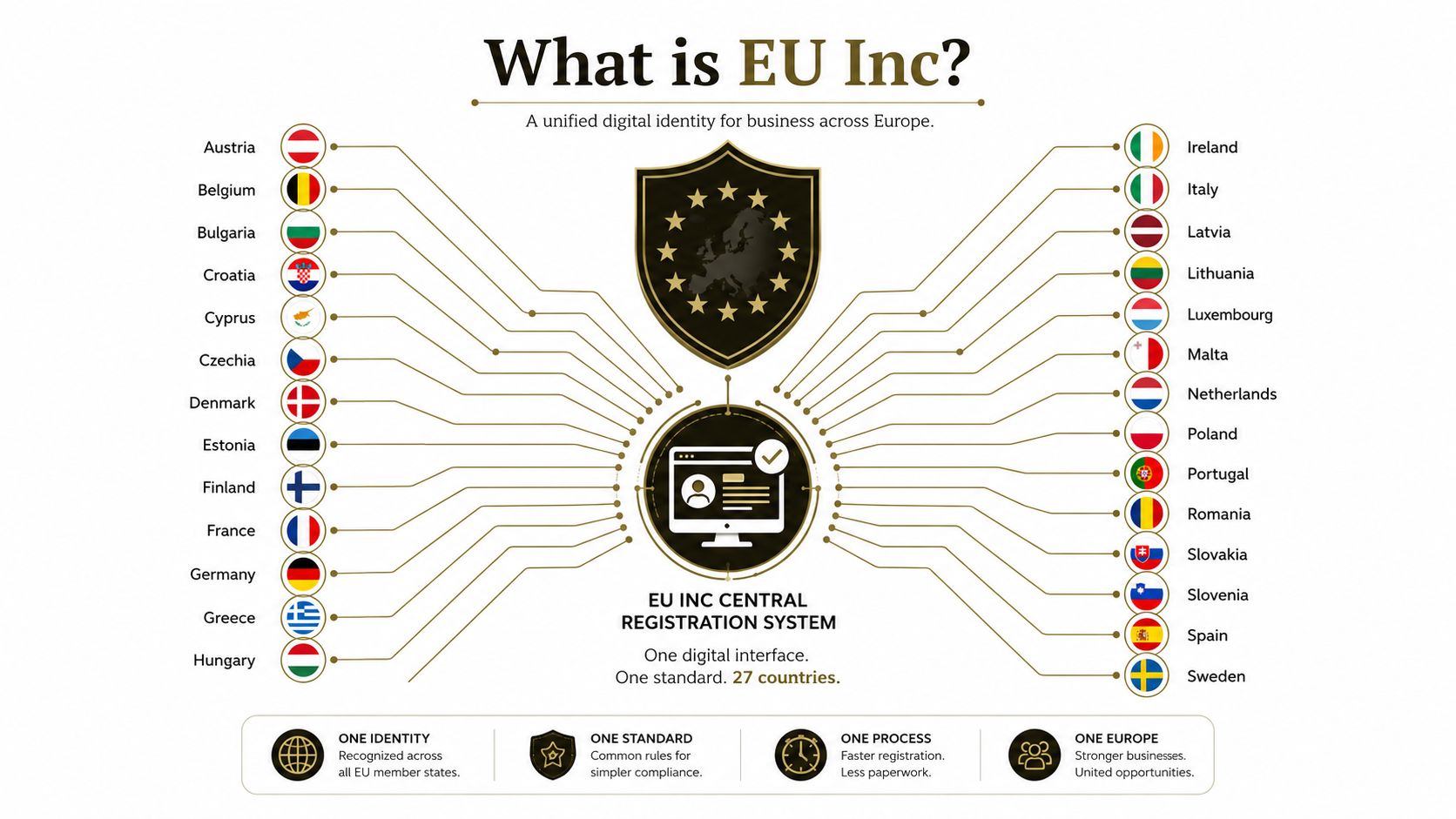
Here's the clean version of the mechanics.
The timing still matters. This is a pre-launch regime, and the launch window is still being framed as a projection rather than a settled fact. Treat it as planning input, not operational certainty.
Bottom line: EU Inc is a standardized legal wrapper, not a promise that every country's business rules suddenly become identical.
The strongest case for EU Inc is practical. It gives one company a single legal wrapper for cross-border activity in the EU, so you do not have to keep adding separate entities every time you enter a new market. That matters most when you are hiring, invoicing, and dealing with compliance in several countries at once.
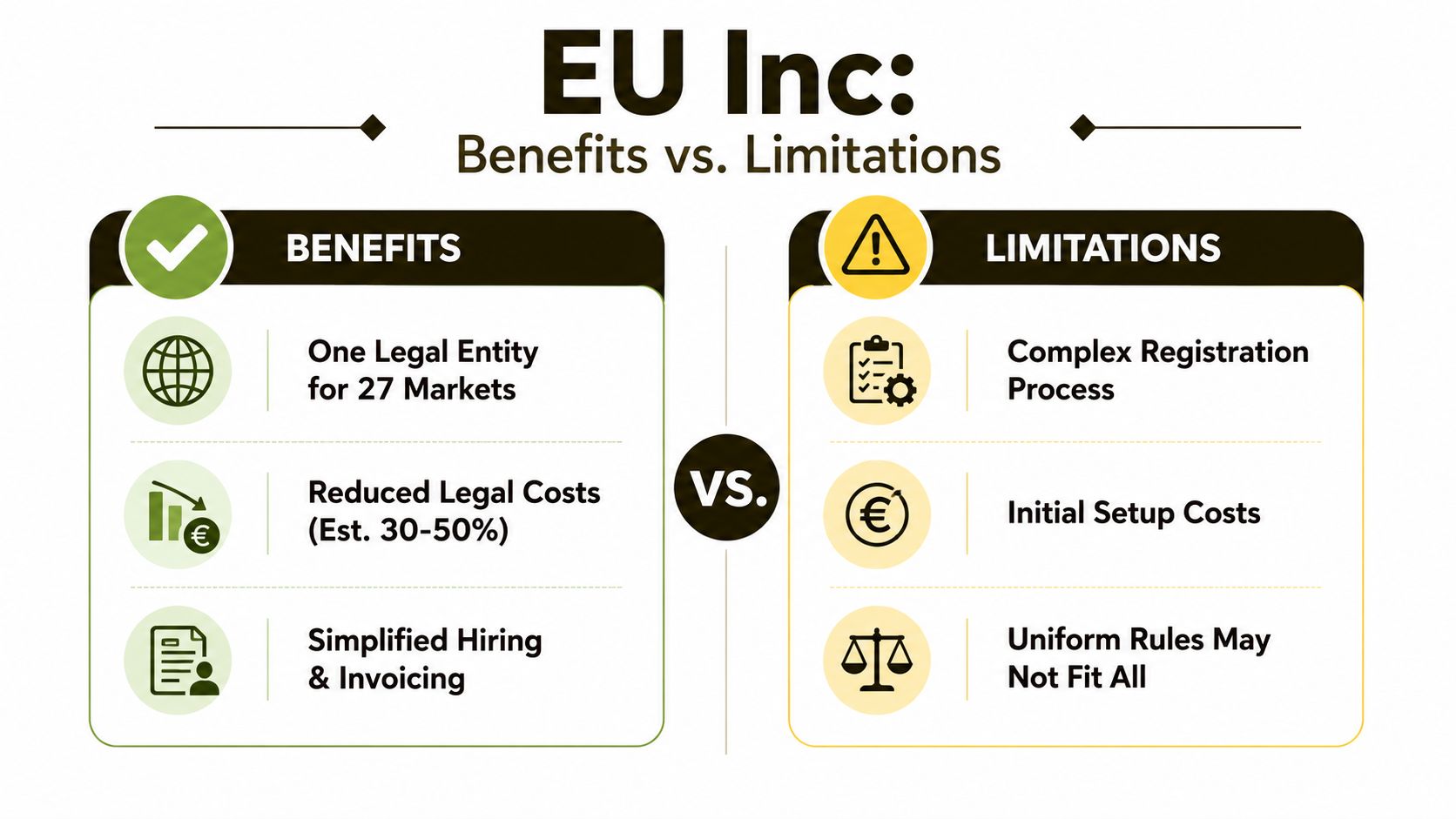
EU Inc is not a full compliance solution. That is the trap. Taxes stay national. Employment law stays national. VAT still follows national rules. Social security still follows national rules.
European rules still leave plenty of friction in place, especially once you move beyond company formation and into day-to-day operations. One source notes that a large share of EU services trade is still affected by restrictions, which is a useful reminder that a company form does not erase operating friction (StreetWallStreet coverage). EU Inc can reduce the company-law layer. It does not flatten the whole market.
Treat EU Inc as a corporate wrapper, not a substitute for local tax, HR, or regulatory advice. If your business model touches payroll, regulated services, or cross-border hiring, you still need country-level expertise.
If you're choosing between EU Inc and the usual route, the decision is not really about ideology. It's about whether you want one legal surface area or a stack of local ones.
The old model is familiar. You incorporate in one country, then add subsidiaries as you grow. That can work. It also creates more documents, more administration, and more opportunities for mismatch between entities. EU Inc is trying to cut through that.
There's also a political and legal reality here. Critics argue EU Inc is not a true 28th regime, which means national law still matters in important areas. That's not a minor detail. It means the harmonization is real, but incomplete.
My rule of thumb: choose the structure that matches the next 24 months of growth, not the one that sounds neat in a pitch deck.
For scale-ups with investors, hiring plans, or eventual exit ambitions, national entities plus subsidiaries can still make sense. But if your plan is to sell into several EU markets from the start, the administrative simplicity of one company is hard to ignore.
Let's kill the biggest myth now. EU Inc does not give you a special tax rate. Corporate tax still applies at the national level where you operate. That's the part people keep getting wrong.
The proposal simplifies company formation and cross-border operations. It does not harmonize the whole tax code. It does not erase payroll complexity. It does not make employment rules identical across Europe. Those rules stay national, so you still deal with different VAT, labor, and social-security requirements in each market.
That's why EU Inc is best seen as a simplifier at the company structure layer. It clears the formation path. It reduces duplicate filings. It can make the legal shell cleaner. But it does not remove the need to operate correctly inside each jurisdiction.
Many founders want one answer to every compliance problem. That answer doesn't exist. EU Inc helps with the wrapper. It does not solve the operating model.
If you're selling software across Europe, that distinction may be enough. If you're hiring staff in multiple countries, it probably won't be enough on its own. And if your business is regulated, the local rules matter even more.
So the right way to think about it is this. EU Inc can reduce friction. It cannot replace the people who know the local tax, HR, and regulatory details that still govern your day-to-day business.
The answer becomes practical here. EU Inc makes sense for some founders now, and it makes no sense for others.
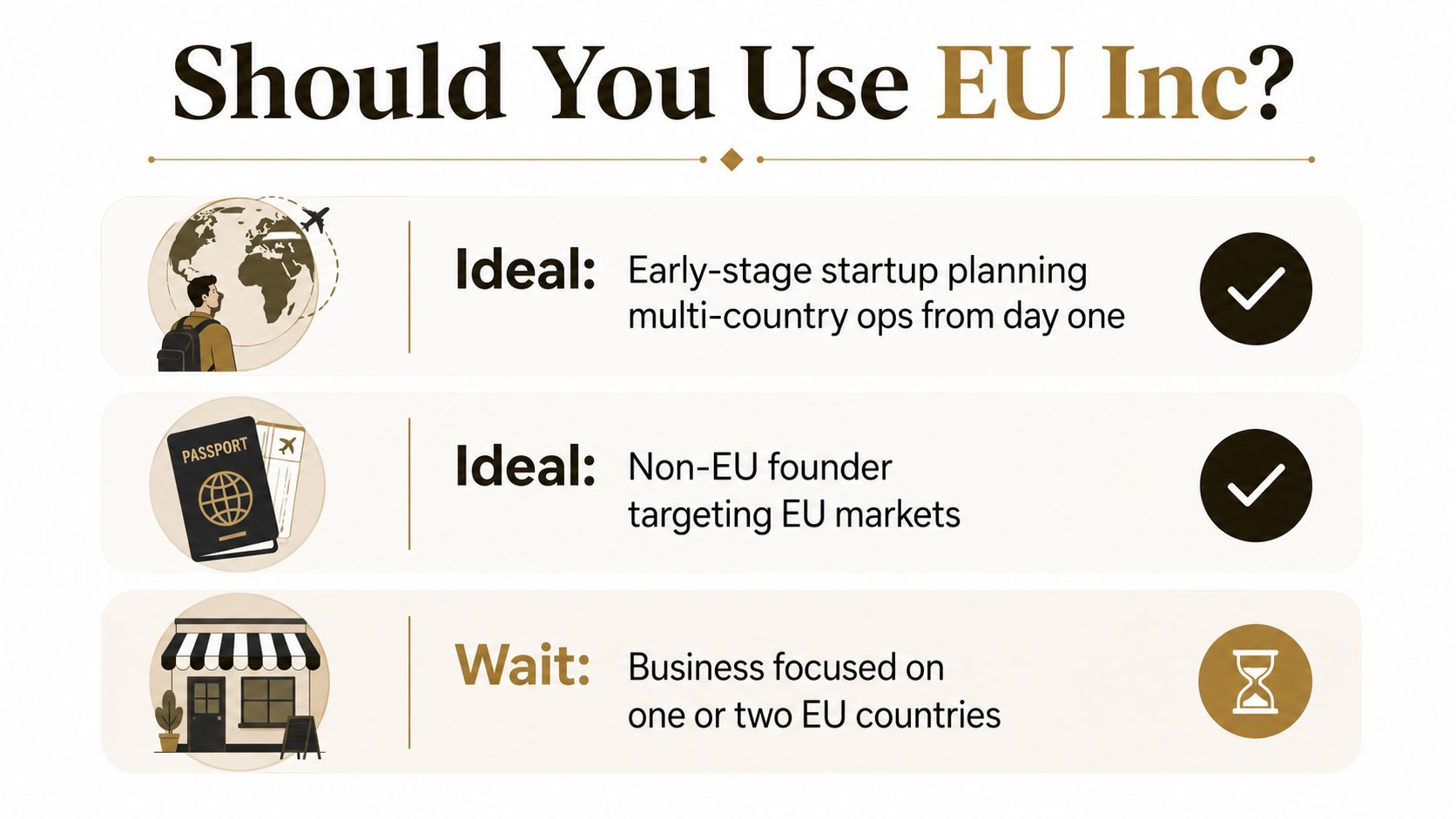
Clear read: if you're building for Europe, EU Inc belongs on your shortlist. If you're building for one country, don't force it.
The hidden trade-off is timing. Waiting for a better legal wrapper can be rational. Waiting too long can also slow the business. If your launch is urgent, use what exists now. If your growth plan is EU-wide and can align with the launch window, EU Inc is worth preparing for.
If EU Inc fits your roadmap, the smartest move is to prepare early and avoid scrambling when the registration window opens. The publisher's service is built around a waitlist intake that captures founder details and preferences ahead of launch, then submits the application automatically once national registration systems go live. That matters because the value of a digital regime disappears fast if you show up late and unprepared.
For founders planning fundraising or hiring, it also helps to think one layer ahead. EU-FAST is described as a standardized EU investment document route, and EU-ESOP is the employee equity angle to keep in mind if you expect to hire aggressively. You do not need to solve every legal question today, but you do need to know which ones will matter first.