
You cannot register an EU Inc yet. The framework is still in the legislative process, with a target launch of Q1 2027. What you can do now is prepare the file, because once national systems open the European Commission's proposal is built around forming a company within 48 hours, for less than EUR 100 in statutory fees, with no minimum share capital and a single submission through an EU-level interface (European Commission).
That is the whole opportunity. One legal entity that works across 27 member states instead of a subsidiary in every market you want to sell into.
If you want the short version, here it is.
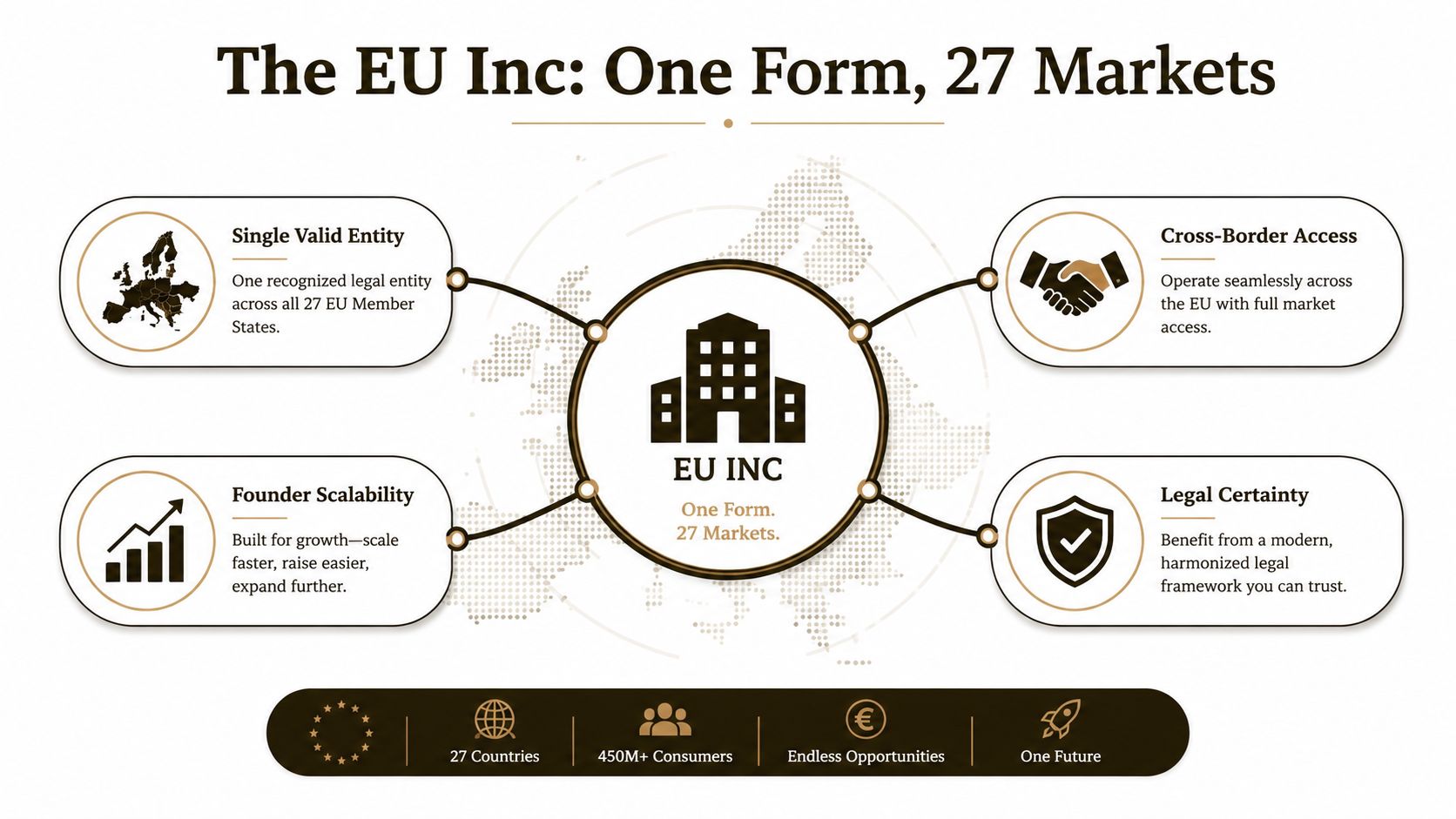
An EU Inc is a proposed single company form for founders who want one legal entity to work across the Union without building a patchwork of subsidiaries. It is the corporate law piece of what people call the 28th regime, a voluntary EU-level rulebook that sits alongside the 27 national ones rather than replacing them.
That matters because the current setup is messy. In several member states, company registration still runs through local-office filing or certified originals, with electronic submission as one channel among several, as the EU e-Justice Portal shows in its national registration guidance. An EU Inc is designed to cut through that with one digital filing, one EU-level interface, one entity.
The upside is practical.
The primary gain is speed without the usual administrative drag. If your current structure exists mostly to satisfy filing rules rather than business logic, this is worth your attention. The full case is laid out in our guide to EU Inc benefits for founders.
The proposal is still moving through the legislative process, and the expected launch is Q1 2027. So the honest answer to "how do I register an EU Inc today" is that you cannot. You prepare for launch and keep using national entities until the regime is adopted and transposed into national law.
That timing detail is the part most guides skip. Plan now without pretending the registry is already open, and keep a clear line between what can be done before launch and what only happens once filing goes live. If you want the evidence trail on where the legislation actually sits, we cover it in is EU Inc real.
The founders who win on launch day will not be the ones who read the most hype. They will be the ones who already have documents, ownership details, and governance choices lined up. The 48-hour window only helps if the application is complete when it lands.
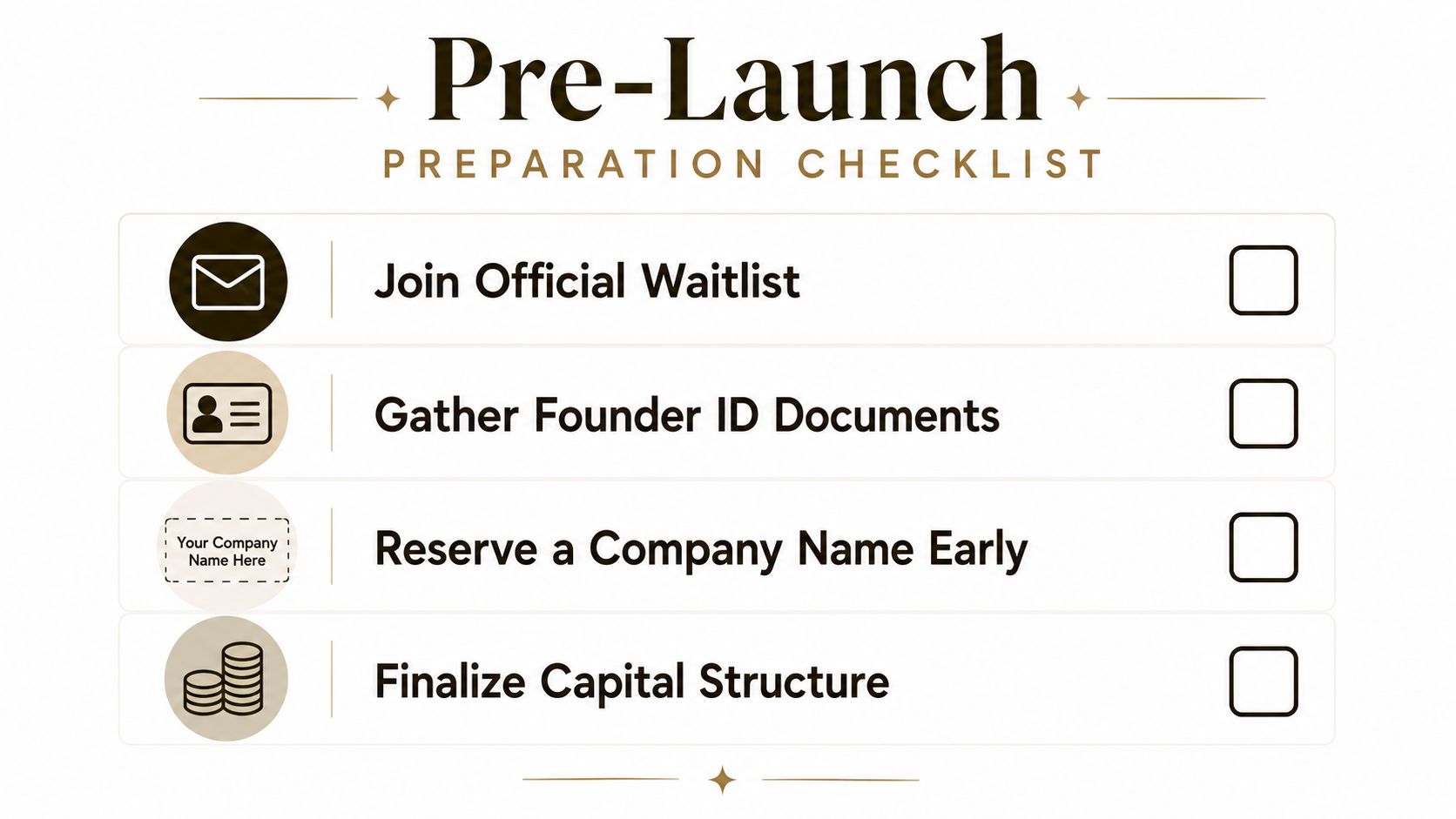
Start with the boring stuff. That is where speed comes from.
Keep the file complete enough that nobody has to chase another founder for missing information the night before launch. The full list of what the framework will ask for is in our breakdown of EU Inc registration requirements.
Law firms, formation desks, and corporate service providers should treat launch prep as an internal product rollout. Client intake needs a fixed checklist, not an email thread.
That means standardising ID collection, beneficial ownership forms, signature authority, and naming preferences before the portal opens. It also means training staff on what counts as a complete digital package, because incomplete files are the main reason an approval window stops being fast.
Once the system is live, the sequence should be straightforward. Good digital company law removes friction by front-loading the parts that cause delay: identity, name clearance, governance data, and document completeness. It does not remove judgment. It just gives you fewer chances to make a mess.
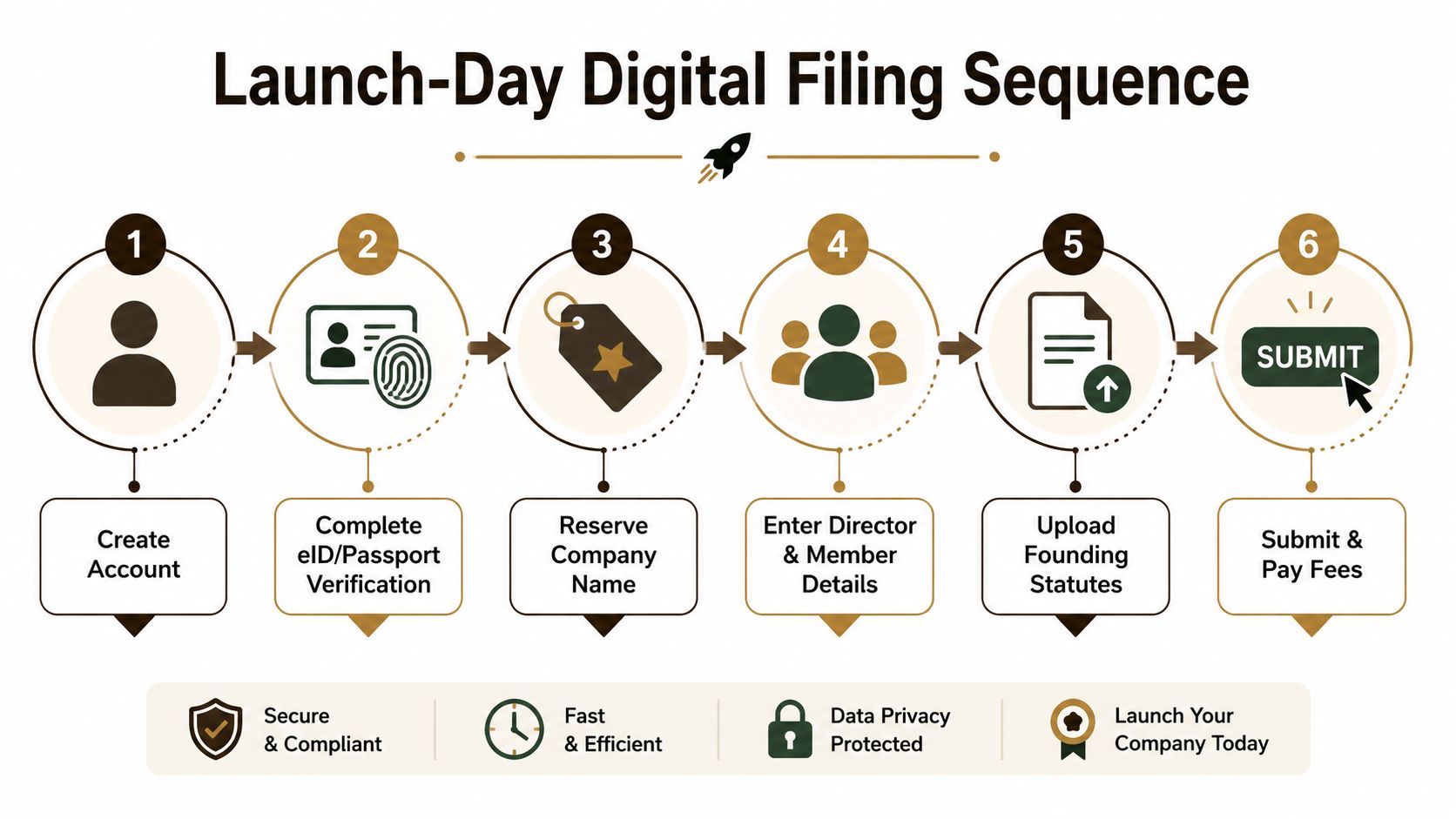
The proposed workflow is stepwise and digital from start to finish.
The platform is designed to automate the repetitive work, not your strategic choices. Identity checks can be systemised. Template-based articles reduce rework. Registry validation is fast when the file is clean.
Founder judgment still matters on governance, ownership, business activity, and office setup. A bad choice there is not a technical issue, it is a business issue. And if your documentation is inconsistent, the registry clock does not save you.
The headline numbers are simple, and they are the ones to budget against. The European Commission says an EU Inc would let founders create a company within 48 hours for less than EUR 100, with no minimum share capital, through a single submission on an EU-level interface (European Commission news release). The draft legal framework sets the capital benchmark at EUR 1.
There is a clean distinction worth keeping in mind. The statutory filing fee is not the same thing as what a service provider charges. If you use an advisor, a formation platform, or in-house legal, that cost sits on top of the fee cap.
That last point matters more than founders want it to. A cheap formation process does not mean cheap operating economics. It means cheaper entry.
If you are comparing this to the usual country-by-country approach, the economic value comes from consolidation. Fewer entities mean fewer duplicate filings, fewer legal opinions, and less overhead maintaining parallel structures. You still need to budget for banking, accounting, and local compliance once you start trading.
Build your launch budget in two layers. One covers incorporation. The other covers everything that comes after the entity exists.
A single EU-wide company form sounds like a magic trick. It is not. It removes a lot of formation friction, but it does not erase the tax and compliance rules that come with doing business in Europe.
The proposal is explicit on the structure side. An EU Inc must have its registered office in a member state and its central administration or principal place of business in the Union (European Commission proposal). Helpful, but it does not eliminate questions about where management sits, where revenue is booked, or where employees work.
An EU Inc has no special tax rate. Corporate tax still applies at national level where the company operates. Substance still matters. So do tax residency, VAT, payroll, and permanent establishment rules.
If your customers, team, and management are spread across several countries, the operational complexity does not vanish. It moves. You get a simpler company form, not a tax exemption.
The core question is not whether an EU Inc is simpler to form. It is. The core question is whether it reduces legal complexity overall, or shifts complexity from formation to ongoing cross-border tax and governance.
Founders who assume the form handles everything get surprised later, and not in a fun way.
The filing logic stays the same. The preparation does not. Different founders hit different bottlenecks, and smart prep means solving the bottleneck that belongs to your situation, not somebody else's.
If you are outside the EU, the point is simple. The proposal sets no citizenship or residency condition on founders, and the flow is designed to be fully digital. Your biggest task is document quality, not local presence.
Focus on passport verification, ownership clarity, and a clean registered-office plan. Do not waste energy looking for a local director when the framework does not require one. The full walkthrough is in registering an EU Inc as a non-resident.
If you already operate in Europe, the advantage is structural. Instead of building a multi-entity stack just to hire and invoice across borders, you can aim for a single company form from the start. That does not remove local compliance, but it does reduce entity sprawl.
The big decision here is governance. Agree on control, shares, and decision-making before filing. If the team is still arguing about basics, the portal will not fix that.
If you register clients at scale, the playbook is different again. Your work is standardising intake, repeating the same quality checks, and making sure staff do not stall on obvious missing data.
Treat a partner onboarding track like a pipeline, not a one-off service. Fixed templates, fixed review steps, and a clear rule for when a file is ready to submit.
Registration is only the beginning. The value of a single EU company form shows up when the entity has to do practical work.
First, banking. Once the company exists, you need a bank or payment setup that supports your operating countries. Banking is usually the first bottleneck after incorporation, and it rewards the same thing the registry does: a consistent, coherent file.
Second, invoicing. A single company form simplifies billing across member states, but it does not remove the need to understand VAT treatment, customer location, and local invoicing rules. Use the entity to reduce duplication, not to ignore the rules.
Third, hiring. The cross-border logic is attractive for teams that want to hire in several markets under one company. But payroll, employment law, and workplace obligations still run through local systems. The form simplifies the wrapper. It does not replace employment compliance.
The wider stack also points to EU-FAST and EU-ESOP. EU-FAST is meant to standardise investment documents in the style of a European SAFE note. EU-ESOP is aimed at employee equity. Those matter because founders do not just incorporate. They raise money and hire people.
A standardised investment instrument reduces friction in early fundraising. A harmonised employee equity framework makes hiring more competitive across borders. Neither eliminates legal review, but both make the deal architecture less awkward.
Five failure modes account for most of the delay founders will hit.
No. The framework is still in the legislative process, with a target launch of Q1 2027. Until it is adopted and transposed into national law, you register through an existing national company form and prepare your EU Inc file in parallel.
The Commission's proposal caps the statutory filing fee at under EUR 100, with a EUR 1 minimum share capital. Professional fees from a lawyer, accountant, or formation platform sit on top of that and are not covered by the cap.
No. The proposal sets no citizenship or residency condition on founders. The company itself does need a registered office in a member state and its central administration or principal place of business in the Union.
No. The flow is designed to be digital end to end, using eID or passport-based identity verification instead of in-person notarisation. That is one of the main departures from how company formation works in several member states today.
No. There is no special tax rate attached to the form. Corporate tax, VAT, payroll, and permanent establishment rules all still apply at national level wherever the company operates.
The target is 48 hours from a complete submission. The clock depends on file quality: identity documents, ownership data, and governance details all have to be consistent before automated validation will clear it.
Registration is not open yet, and anyone telling you otherwise is selling something. The target is Q1 2027, under 48 hours, under EUR 100, EUR 1 minimum capital, one submission, 27 markets.
Your job between now and then is preparation. Identity documents, name options, articles of association, beneficial ownership data, and a settled capital structure. Get those consistent and the filing is a formality. Leave them until launch week and the fast system will feel slow.
This guide is general information, not legal or tax advice. Final rules should be confirmed once the framework is adopted and transposed.