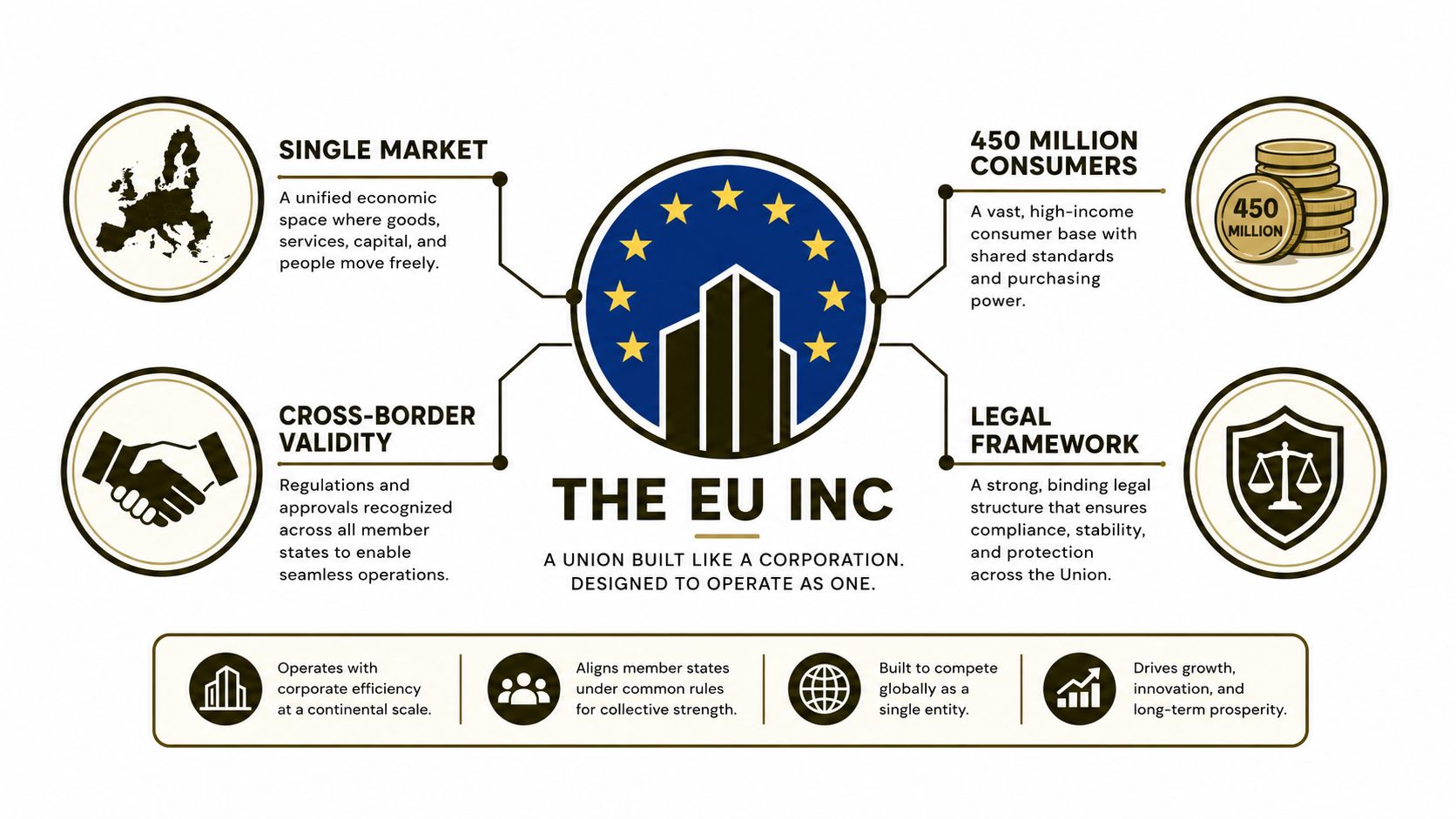
The strange thing about EU Inc terms is that the headline sounds simpler than the legal reality. Founders get the appeal immediately, one company, one digital filing, one structure that can work across the EU's 450 million consumers. But the story is more useful than the slogan, because the framework is still a proposal, and the parts it leaves untouched matter just as much as the parts it changes.
EU Inc is being framed as a single European company framework for the whole single market. That means one legal form that could be used across 27 member states, fully digitally, with a target incorporation window of 48 hours and a cost of less than €100 in the core filing path (EU Inc overview, video briefing on the proposal). That is a serious shift in how founders think about European expansion.
But the timing is the part you need to keep straight. This is still a legislative proposal, not a live company form today, and the European Commission presented the draft on 18 March 2026. It still has to move through the ordinary legislative procedure before anyone can use it, so the honest planning horizon is a projected Q1 2027 launch, not a current right (Commission announcement and status).
EU Inc is meant to sit beside national company forms, not replace them. A founder could still choose a German GmbH, a French SARL, or the existing Societas Europaea. That optional structure is exactly why people call it the “28th regime”. It is a parallel route, not a takeover of national company law (EU Inc concept and regime design).
That matters because founders rarely need a theoretical European label. They need a structure that reduces friction when they hire, invoice, and raise money across borders.
Practical rule: treat EU Inc as a future incorporation lane for cross-border growth, not as a reason to stop using national entities until the law is actually in force.
For founders who are already wrestling with entity setup and registry IDs, a useful background piece is this company identification number 2026 guide. It helps clarify the identifier side of incorporation, which is easy to overlook when people focus only on the headline form.
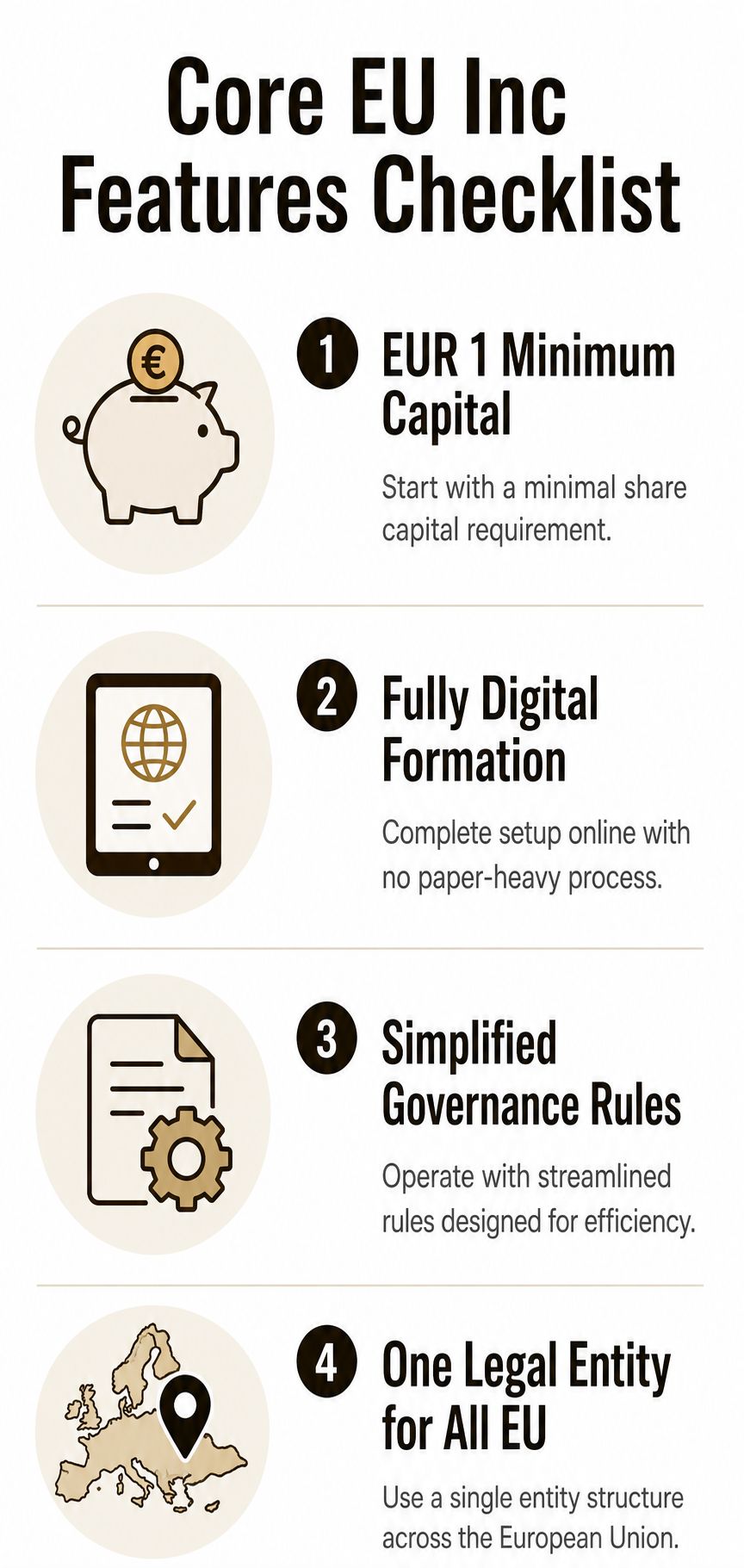
EU Inc terms are built to cut the usual friction at incorporation. The framework is designed to be fully digital, open to EU and non-EU founders, and stripped of the local setup hurdles that slow company formation in many member states. The point is simple, one entity that can operate across the single market with less paperwork and fewer repeated filings. That is the statutory appeal, and it is why founders keep paying attention to the proposal (EU Inc framework summary, proposal analysis).
These terms matter because they remove the usual gatekeeping that blocks remote founders from starting in Europe. If you are comparing this with a national incorporation, the practical difference is obvious. You are not stitching together a country-by-country setup just to get to day one.
The design also points toward a single registration path rather than separate filings in each country. That is the right direction for startups that want to raise, hire, and sell across borders without repeating incorporation work in every market. It also explains why the framework is presented as a multilingual, fully digital regime for founders operating across all 27 EU countries (EU Inc concept page).
EU Inc does not erase the rest of the compliance stack. It lowers entry barriers, but founders still need to handle data protection, local employment rules, tax, and social security as separate workstreams. A practical place to start is the 2025 GDPR compliance checklist, because cross-border data handling shows up early once the company starts operating.
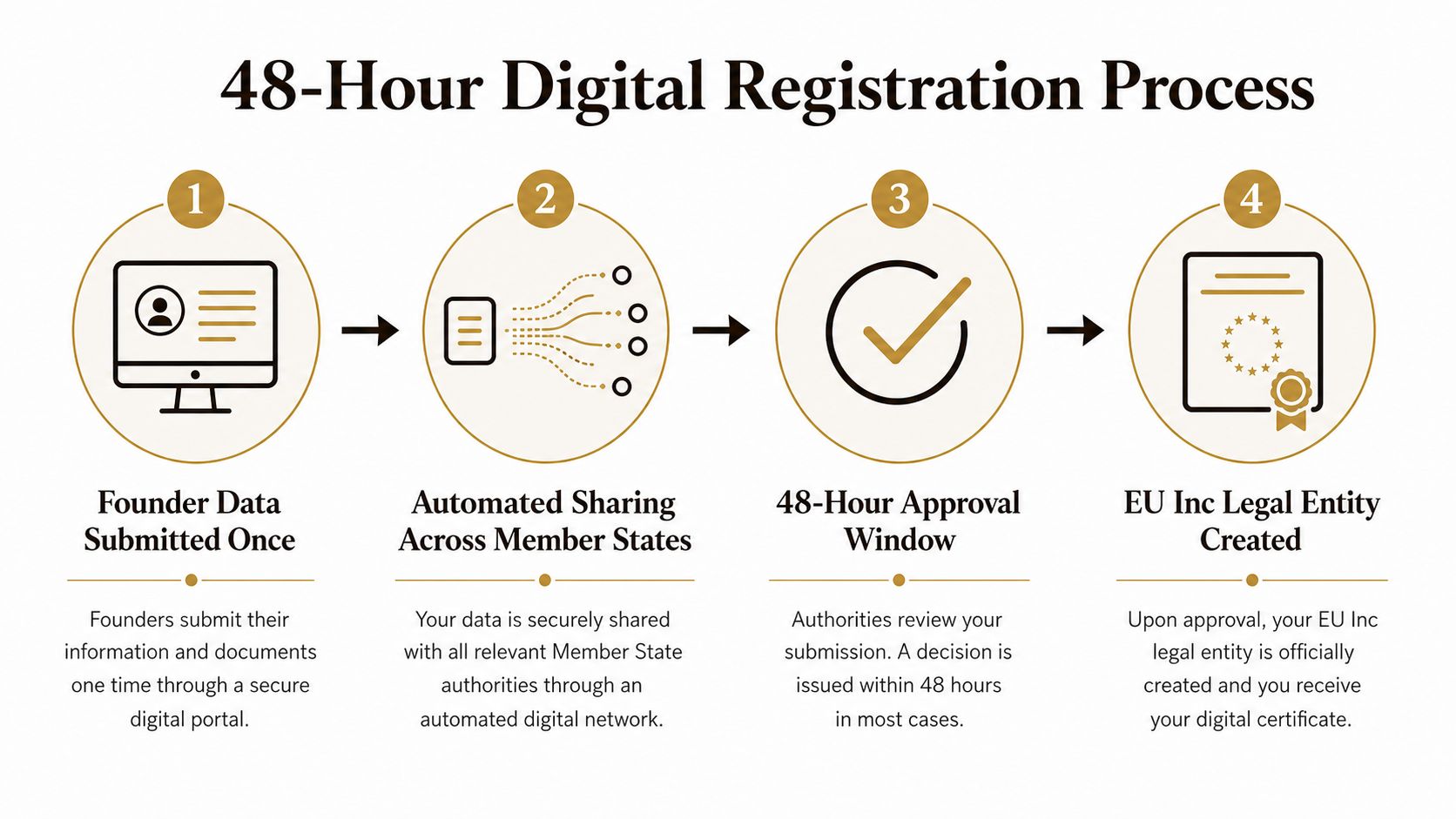
The core promise is not just speed. It is one digital filing flow that avoids the repeated admin work founders know too well. The logic behind the model is the once only principle: founders provide company data one time, and that information is then shared automatically across relevant authorities, including business registers, tax, and social security systems, instead of being re-entered in every country (video briefing on the proposal). That is the simplification.
The proposal assumes a single registration platform and a fully digital incorporation path. It also points to coordinated issuance of identifiers such as TIN and VAT numbers as part of the registration flow, which is exactly the kind of thing founders normally lose time chasing across offices and portals. In the intended model, there's no notary appointment and no in-person step required.
That's a big deal, because paperwork is rarely the true problem. Repetition is. You fill in the same facts again and again, and each extra handoff opens another delay.
Independent summaries of the proposal say incorporation should be completed within 48 hours once complete documents are submitted, with the fast-track route capped at EUR 100 (proposal analysis). That timeline only works if the digital stack performs well across all participating member states.
The standardisation angle matters here. EU rules define a technical specification as a document that sets the technical requirements a system must meet, including measurable quality, performance, interoperability, and safety features (EU standardisation explanation). In practice, that means the EU Inc filing stack has to be explicit, testable, and interoperable.
Operational rule: a 48-hour promise is only credible if the process is measured on outcomes, not intentions.
There's also a useful contracting principle here. EU procurement practice distinguishes performance or functional requirements from a single fixed technical solution, and equivalence can be accepted if the applicant proves it meets the required outcome (technical specifications and equivalence). That logic is relevant because a pan-EU filing workflow has to prove speed, completeness, and compliance acceptance, not just look modern on paper.
This is the part most headlines skip. EU Inc does not create a single EU tax rate. It does not wipe out labor law, social-security rules, or other local obligations where the company operates (Commission announcement on scope). That is the compliance gap founders need to understand before they get too excited.
So the right mental model is not “one law for everything.” It is “one incorporation wrapper with fragmented operational compliance.” That's a much more realistic way to think about it.
Corporate tax still applies at the national level where you operate. Local payroll rules still matter. Employment law still matters. Social security still matters. If you hire people in several countries, the entity structure gets simpler, but the operating burden does not disappear.
That is why the concept can be valuable and incomplete at the same time. It lowers the cost of creating the company. It does not eliminate the work of running it across borders.
Reuters notes the Commission expects about 300,000 adopters in the first decade (Reuters via Commission coverage). That number matters because a small pilot could survive ambiguity. A large user base cannot. If founders adopt at scale, the unresolved tax and labor question will become the part that creates friction in real life.
My blunt view is this. If you need a clean single-company structure for Europe, EU Inc looks promising. If you expect it to erase local compliance, you'll be disappointed.
Straight answer: EU Inc simplifies formation. It does not simplify every country where you do business.
The comparison that matters is not theory, it's whether you want one operating company or a stack of separate ones. Today, many founders still expand by setting up new entities country by country. That gives control, but it also gives you more filings, more governance overhead, and more legal friction.
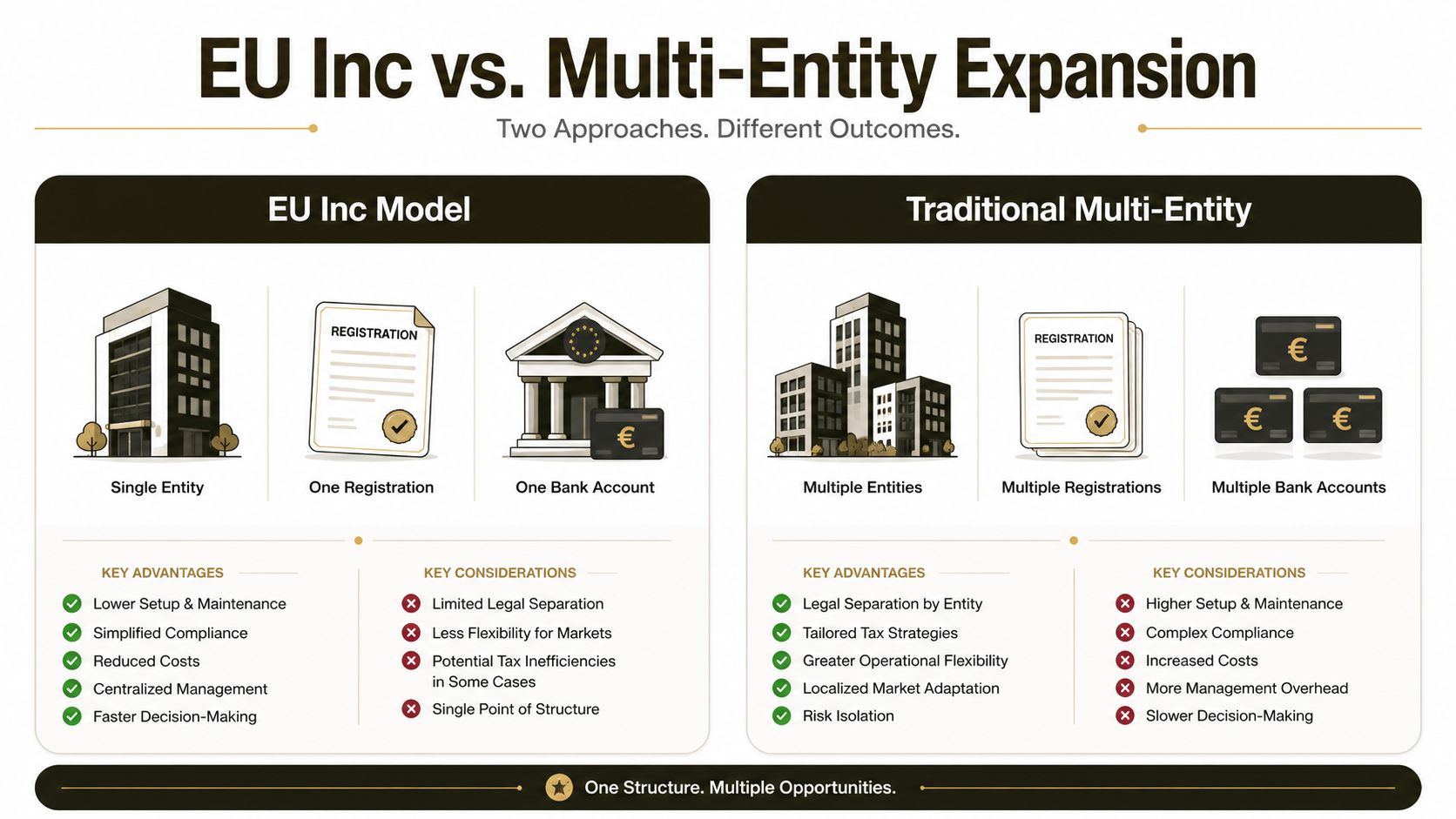
The clean way to decide is simple. If your next phase is cross-border from day one, EU Inc is worth planning around. If you only need one market for now, a national entity remains the practical choice.
Don't wait for the law to finish moving before you prepare. The founders who benefit first are the ones who have their documents, cap table logic, and internal approvals ready when registrations open. That is especially true if you want to move quickly once the launch window arrives.
Law firms and formation providers should build a launch-ready workflow now. That means intake forms, identity checks, and document collection processes that can handle volume without turning the first registrations into a bottleneck. It also means being honest about where national compliance still needs local expertise.
Good preparation beats fast disappointment. If the filing is digital but the inputs are messy, you still lose time.
If you're building for launch, the smartest move is to get on the waitlist and keep your materials organized. That gives you a better shot at a smooth filing the moment the regime becomes usable.