EU Inc registration time is built around a 48-hour processing target, but you shouldn't plan around that alone. The window is shaped by three clocks, the law's passage, the registry's processing, and your own preparation, and the current public timeline still points to availability around late 2027 or 2028 if the process moves quickly. The draft also anchors the form to EUR 1 minimum capital and a maximum fee of less than EUR 100, so this is meant to be fast and cheap once it's live, not a slow national incorporation disguised with better branding.
That's the short version. If you're a founder, the useful question isn't whether 48 hours sounds good. It's when that clock starts, what has to be ready before it starts, and whether your launch plan can survive the legislative lag that still sits in front of it.
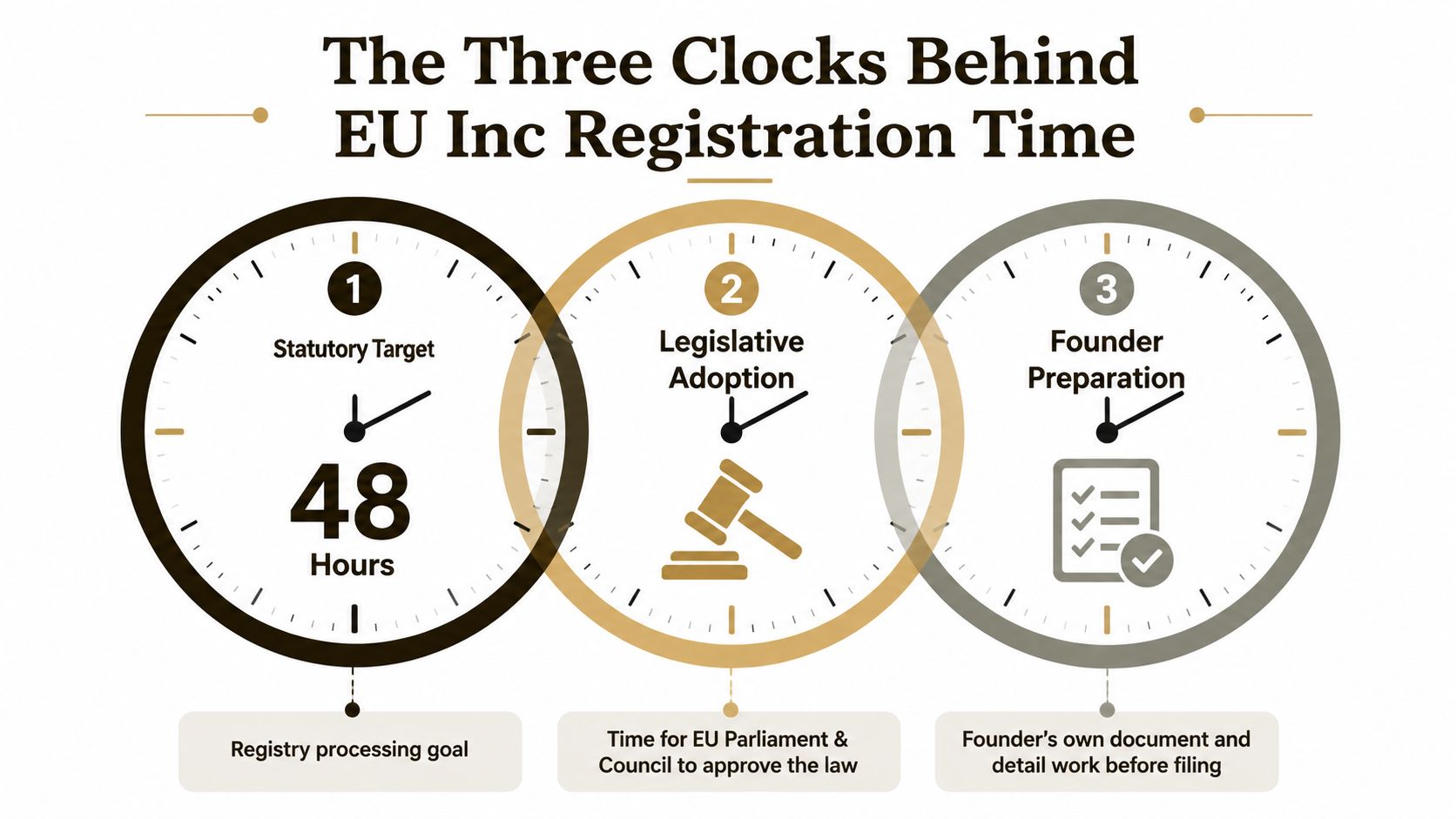
Founders often treat EU Inc registration time as a single number. The better way to read it is as three separate clocks that move at different speeds, and only one of them is the actual filing window.
The Commission's proposal sets a 48-hour incorporation target, with a fee of less than EUR 100 and no minimum share capital requirement in the policy framing published by the Commission European Commission news release. Reuters also reported that the Commission expects about 300,000 companies to use the form in its first decade Reuters coverage reflected in the proposal summary. That is broad company-formation policy, not a niche filing rule.
The point of the target is speed with standardization. Founders submit company information once, and the registration is supposed to finish within 48 hours under the proposed system European Commission news release.
Practical rule: treat the 48-hour clock as the payoff, not the starting line.
The proposal was publicly submitted on 18 March 2026 EU Inc public timeline. Parliament and Council still have to adopt it, and member states still have to wire up the national side. Until that happens, nobody is filing a live EU Inc application.
That is why a founder should read late 2027 or 2028 as the realistic opening window, with slower implementation pushing further out EU Inc registration guide. If you are building a launch plan, that is the calendar that matters.
This is the part founders control. If your documents, ownership splits, and identity checks are ready, you will be in the fast lane once filings open. If they are not, the registry will not care how fast the law promised to be.
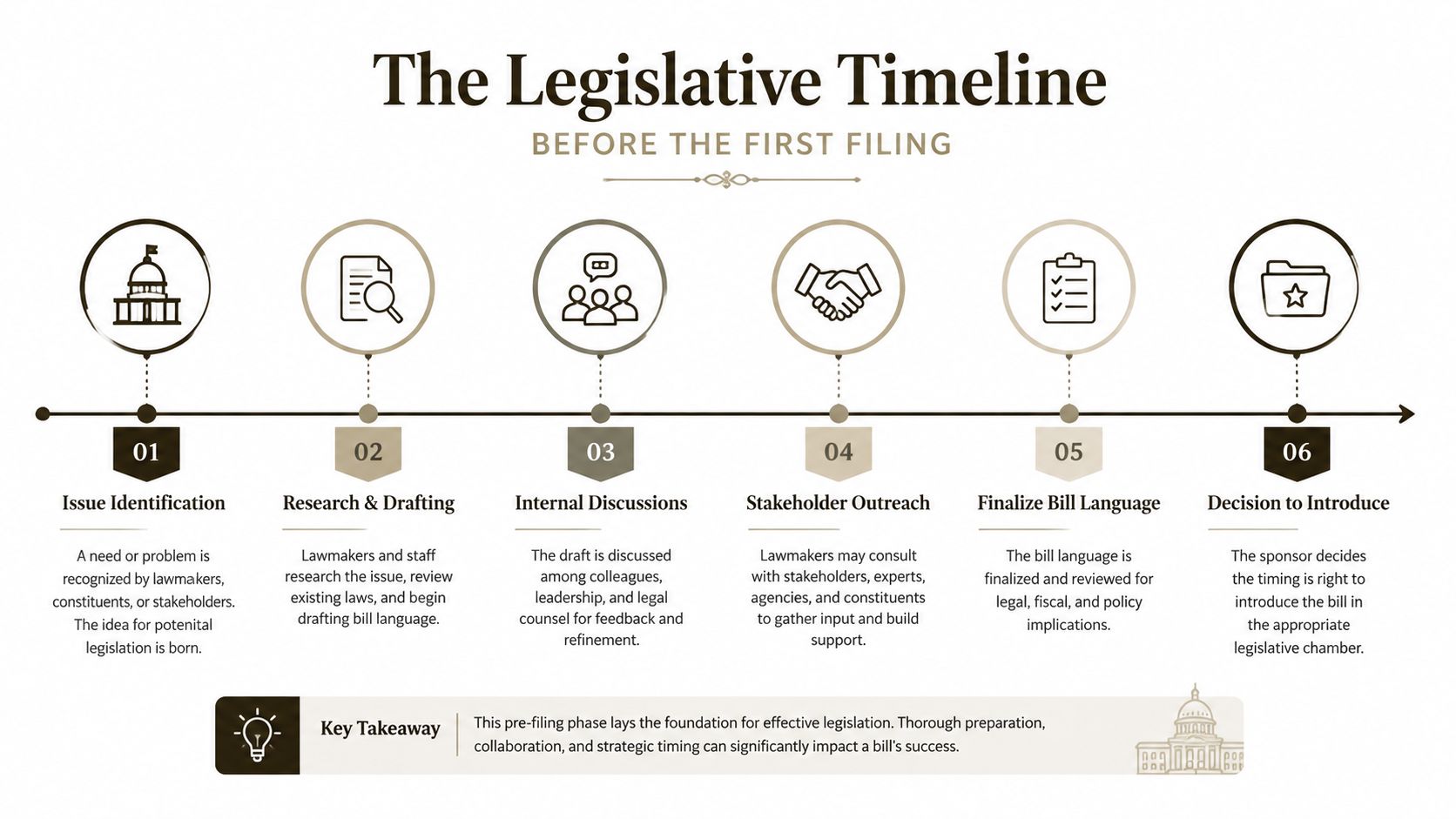
EU Inc registration time starts long before any founder clicks submit. The first filing depends on lawmaking, and lawmaking moves on its own schedule. The Commission can set the direction, but founders cannot register until the statute exists and the registry system is ready.
The draft was publicly submitted on 18 March 2026. After that, Parliament and Council still have to adopt the law, and each member state still has to transpose it and connect its registry to the EU-level interface.
That sequence is why the 48-hour promise is not a launch date. The rule has to become binding law, and the digital plumbing has to work in each participating state. Until both pieces are in place, the number is a target, not a live filing reality.
The public timeline points to practical availability at the end of 2027 or in 2028 if the legislative process keeps moving. Other guides are more cautious and push the likely start into 2029 or 2030 if implementation slows.
That spread is the key lesson. The limit is not the concept. The limit is lawmaking, then registry readiness, then rollout across member states. Founders who accept that can line up financing, product launch, and hiring around the actual calendar instead of a press release.
Build your formation calendar around the slowest moving step. The promise matters less than the bottleneck.
If you want to use EU Inc at launch, do not assume the law will save time by itself. Use 2026 to settle the decisions that shape the entity, use 2027 as the likely transposition and readiness period, and keep 2028 in view as the safer operating assumption. That is the sensible way to budget your entity timeline.
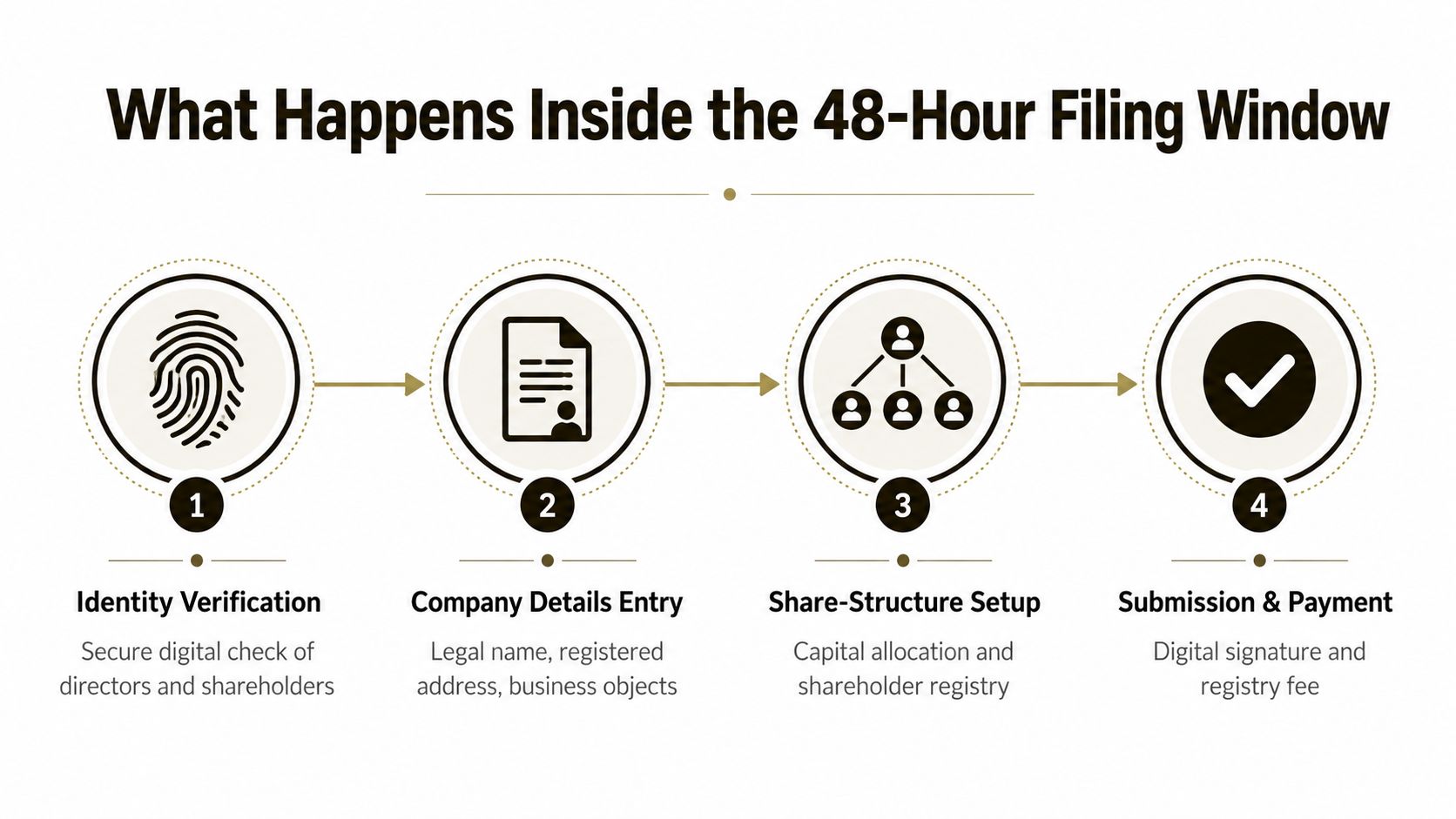
Inside the filing window, the core work is front-loaded. A clean application moves fast because the system is built to process digital submissions, not chase paperwork across offices.
The official process page says incorporation is fully digital and includes identity verification, company details entry, share-structure setup, and a minimum EUR 1 share capital deposit before automatic processing EU Inc how it works. The registry then processes the application in 24 to 48 hours after submission EU Inc how it works.
That matters because the filing clock is not being burned on notaries, paper forms, or separate back-office queues. It is spent on digital validation and registry processing, which is a much tighter setup for founders who want speed without the usual administrative drag.
A founder should treat the filing flow as four steps.
The closer the application is to complete, the more likely it is to stay inside the 24 to 48 hour processing window EU Inc how it works.
This is a processing benchmark for a clean file, not a guarantee that every submission clears on the first pass. Founders who submit sloppy information still create delay, even in a digital system that is designed to move quickly.
Founders frequently underestimate the gap between incorporation and invoicing readiness. If tax and filing steps are split, time disappears fast. For a practical reference on the tax side of operations, VAT bookkeeping for UK firms is a useful external guide to the admin load that often sits next to registration.
The advantage is not just that incorporation is fast. It is that the tax identifiers are supposed to move through the same registration flow, so founders do not have to split company formation from tax setup.
Founders often treat “we incorporated” and “we can invoice” as the same milestone. They are not. In many systems, the tax number and VAT number arrive through separate administrative steps, and that separation slows down the point where the business can begin to trade.
EU Inc is designed to fold TIN and VAT issuance into the same digital exchange as incorporation, so founders should not need separate tax-registration workflows in the normal case Twobirds legal commentary. That is the difference between forming a shell and forming a company that can start operating.
The technical backbone is the Business Registers Interconnection System, or BRIS, which supports cross-border registry cooperation and automated data transfer between company registers and tax authorities Twobirds legal commentary. The identifiers are meant to travel with the incorporation data, instead of being handled as a separate afterthought.
That is the operational gain. One filing, one data set, one digital path. If implementation matches the design, founders should be able to move from formation toward invoicing without a second bureaucratic run.
Do not build your launch plan around tax IDs showing up later. Under the EU Inc model, they belong in the same setup logic. That is why the registration window matters to founders. It is not only about getting a certificate. It is about compressing the full start-up admin stack, including the tax side of operations such as VAT bookkeeping for UK firms.
The 48-hour clock only helps founders who arrive ready. If the filing is incomplete, the registry waits for the missing pieces.
EU Inc explanations make the sequence plain. The clock starts only after a complete application is submitted, and any missing information has to be fixed before approval. That is where delay starts.
The slow part is usually not the registry. It is the founder's own document discipline. If the ownership split is still under debate, the beneficial ownership details are incomplete, or the identity verification files are unreadable, the fast filing path is already gone.
National incorporation tracks in many member states still run through notarization or multiple agency steps, so they often take far longer than the EU Inc model is meant to. EU Inc is trying to compress that process to two days. The gain only shows up when the founder side is tight.
A fast registry does not rescue a slow founder.
That is why time management matters here. If you want a practical way to block work, set decision deadlines, and protect prep windows, the founder productivity framework is useful for the weeks before launch.
Start with the decisions that create delay when they are left late. Legal name, share structure, directors, registered seat, and beneficial owners all need to be settled before filing. The more ambiguity you carry into submission day, the less likely you are to hit the expected filing window described earlier.
That is the blunt truth. The registry target is fast. Your preparation has to be faster.
The filing clock is only fast if your side is ready. The legal process can be quick, but messy founder prep still slows everything down.
Get the basics settled before the system opens. If you wait until the law is live to make these choices, you waste the very window you want to use.
A fast registry still expects clean inputs. If the name is undecided, the ownership split is still in discussion, or the identity files are unreadable, the filing path stops being fast.
The published materials say there is no EU citizenship requirement, no EU residency requirement, no local director requirement, and no physical presence needed for formation, with the process handled online from anywhere with internet access EU Inc for non-EU residents. That matters for remote founders.
If you are outside the EU, do not waste time looking for a local proxy just to satisfy a residency rule. Focus on getting the digital identity and ownership paperwork clean enough to pass verification the first time.
EU Inc does not create a special tax rate. Corporate tax still applies at the national level where you operate. The legal form changes the incorporation path, not the tax system.
EU Inc registration time only makes sense if you separate three clocks. The first is the legal clock, which depends on the EU law being adopted and then transposed into national systems. The second is your own preparation clock, which starts before any registry accepts a filing. The third is the filing clock itself, the promised 48-hour window once the process is live.
Founders should use the waiting period well. Pick the name, settle the founder group, fix the seat, agree the share structure, and decide the capital plan before the first filing opens. Leave those choices vague and the “fast” part disappears before you even submit anything.
The cleanest reading is still the cautious one. EU Inc is being designed around speed, low cost, and a digital process, with EUR 1 minimum capital and a fee capped at less than EUR 100 under the proposal. That does not mean the regime is live yet. The law still has to move through the legislative process, and national systems still have to be ready before founders can rely on a real filing date.
For a founder, the practical timeline is straightforward. Use the legal wait to prepare the company, then file only when the registry and the rules are in place. The founder who is ready on day one gets the benefit. The founder who waits for the last minute gets stuck watching the window open without a clean file to send.