
Most founders treat the EU Inc registered address like a form field. That's the wrong move. The address is the legal anchor that picks your member state, your home register, and the place where official notices land, so get it wrong and you've already made the structure harder than it needs to be.
The good news is simple. EU Inc is being built to make cross-border incorporation much easier, with a 48-hour formation target, a maximum registration cost of €100, and no minimum share capital requirement in the Commission's proposal, while still tying the company to a specific national registry through BRIS and the chosen registered office European Commission proposal. That means the address isn't a cosmetic detail. It's part of the company's legal spine.
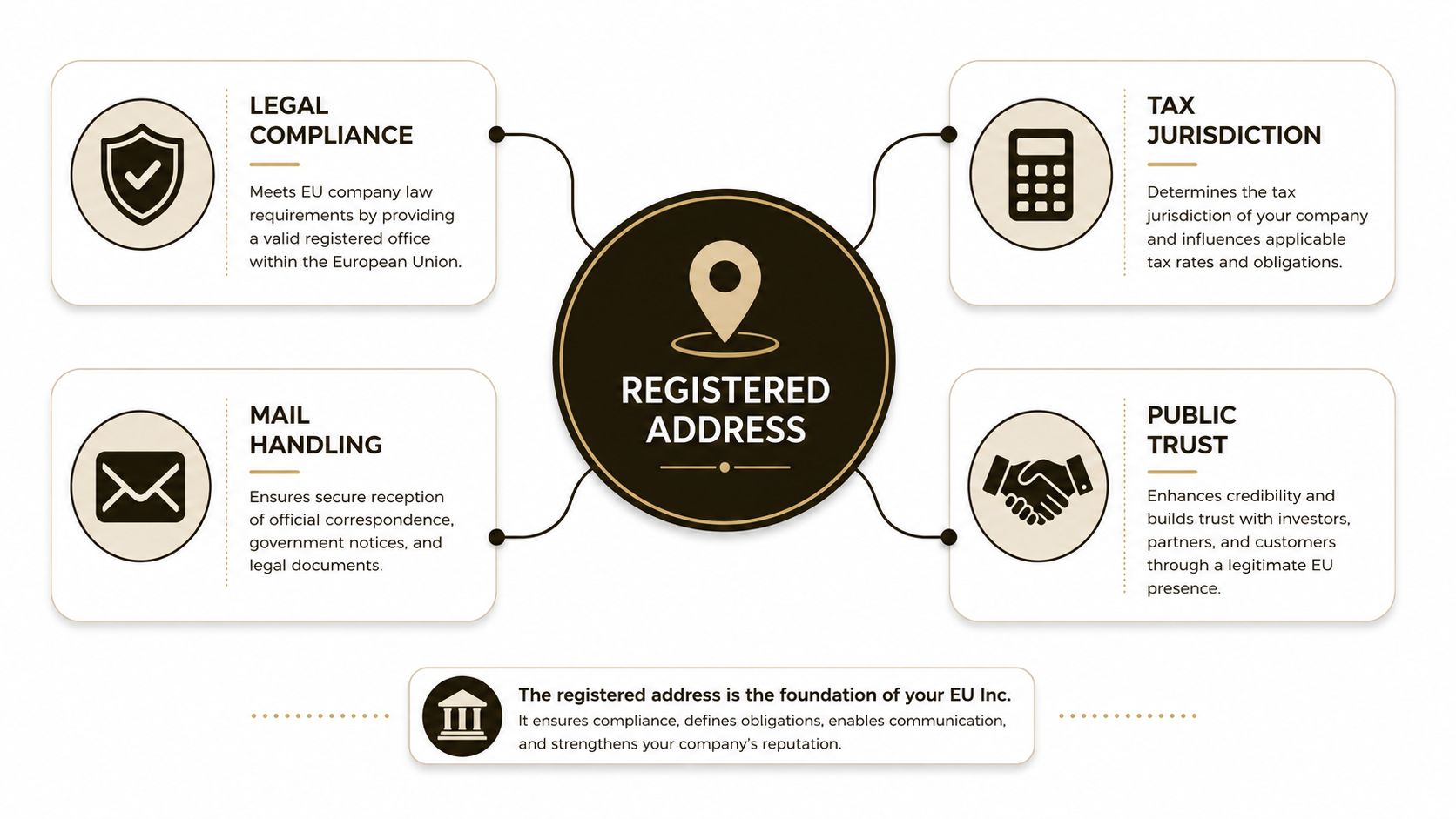
By the end, you should know four things. What the law expects, which address types are realistic, how to file the setup without tripping over the paperwork, and how to keep the address compliant after incorporation. That's the part most guides skip, and it's the part that saves founders from painful cleanup later.
A lot of people assume the registered address is just where mail goes. It isn't. For an EU Inc registered address, the address is doing three jobs at once. It anchors the company to a specific member state, points to the corporate-law venue, and becomes the official seat for registry and correspondence purposes.
That's why the address choice matters before you even think about the street name. Under the proposal, the company is meant to be recognized EU-wide through BRIS, but it still starts with one home register in one member state European Commission proposal. In plain English, you are not picking “an EU address.” You are picking the legal home of the company.
Practical rule: if the address doesn't work in the selected state's registration system, it doesn't work at all.
That's the mental model to keep. The company can operate across borders, hire across borders, and invoice across borders, but the registered address fixes the legal starting point. If you're sloppy here, you can end up with a structure that looks international on paper and behaves like a local compliance headache in practice.
The smart way to think about it is this. The address choice shapes governance, notice handling, and how comfortable banks and counterparties feel when they review the setup. It also affects tax administration, because a legal seat and an administrative centre are not the same thing. One is the registry anchor. The other is the place where the business is run.
The Commission's annex is more specific than many founders expect. It requires the articles of association to include the registered office address, including the Member State where it is or will be registered, and it also requires the amount of capital, even if that amount is EUR 0, plus the total number of shares and the founding shareholders Commission annex. So the address is not a casual field. It's written into the formation documents.
The proposal also says the company must have its registered office and its central administration or principal place of business in the Union BUSINESSEUROPE proposal summary. That matters because it closes off the lazy approach of using a random mailbox while running the business somewhere else entirely. The structure is meant to be EU-based at both the registry level and the management level.
The address is not just a legal label. It has to support actual receipt of official notices.
That is why a virtual office or registered-agent address can work, if the selected member state allows it and the provider can reliably handle legal mail open-euinc guide. The main mistake is assuming any EU address will do. It won't. The address must be valid in the chosen state, must satisfy that state's portal requirements, and must be able to receive court, tax, and registry communications without drama.
Pick the state first. Then match the address to that state's rules. Then file online. That order matters because the address is part of the incorporation logic, not a post-filing admin task. If you swap the order, you waste time comparing office products that would never qualify anyway.

There are really only three sensible paths here. Each one can work. Each one also creates a different amount of friction, especially once you start dealing with banking, mail handling, and counterparties who want to see a real corporate footprint.
If I were choosing for a founder with no local team, I'd usually start with a registered-agent setup in the right member state. It keeps the compliance burden lower and avoids pretending you need an office you don't use. If a company needs a recognizable city address for deals or hiring, a virtual office can work, but only if the provider is set up for reliable legal mail handling.
Founders love browsing addresses first. That's backwards. The street only matters after you've chosen the member state, because the state defines the registry, the rules, and the portal you'll use.
A sensible filter looks like this. Start with language comfort, because your filings and notices have to be handled somewhere you can manage. Then check digital-registration maturity, because the whole appeal of EU Inc is a fully online process. Then look at banking access and how the jurisdiction is viewed in cross-border business, because those things affect the day-to-day reality of running the company.
For a founder comparing Estonia, Ireland, and Germany, the question isn't which country sounds modern. It's which one matches the company's operating style. A solo founder who wants a lean digital setup will usually care more about registry usability and document handling than prestige. A team with cross-border staff may care more about how the seat interacts with their commercial partners. And if the company needs a stronger local business signal for contracts, the address choice gets tied to reputation very quickly.
Here's the right sequence:
This is why the EU Inc framework matters. It tries to standardize a fragmented setup across 27 member states, while still letting founders choose one state and use the company EU-wide Liedekerke analysis. You still have to respect the state-specific seat, but you don't need a separate company in every country.
The cleanest workflow is boring on purpose. First, confirm the address qualifies in the chosen state. Then get the service agreement or lease in place if you're using a registered agent or virtual office. Then prepare the formation documents with the registered office line, the capital entry, and the shareholder details. After that, submit everything through the online interface.
You should have the core documents ready before launch. That means the address proof, the provider agreement if one is needed, the articles of association, founder identity documents, and whatever the selected member state asks for in its portal flow. The proposal is designed to avoid notary-heavy, in-person incorporation, so don't build your process around old-fashioned paper steps.
A useful external reference for founders comparing multi-country setups is RNC Group's guide to global company registration, because it helps you think about jurisdiction choice before you start collecting forms. EU Inc is different, but the same basic mistake shows up everywhere. People choose administration details before they choose the legal home.
The registration flow should feel like this:
TaskWhen to do itChoose the addressBefore anything else, because it determines the home registerPrepare documentsAfter the address is confirmed and before filingSubmit incorporation onlineOnce the articles and identity documents are readyHandle TIN and VAT coordinationAs part of the registration flow once filings openConfirm completionAfter the state system issues the company record
On timing, be honest. EU Inc is still in the legislative process, and launch is being discussed as a Q1 2027 opening window, not a finished reality today. So use the pre-launch period to decide your member state, shortlist your address provider, and organize your documents. Once the systems open, the filing should be digital-first and targeted to the 48-hour formation track under the proposal European Commission proposal.
The first trap is using an address that looks fine but fails local rules. Founders see a clean street address and assume that's enough. It isn't. If the address doesn't satisfy the home state's registered-office requirements, the filing can stall or the company can be formed on shaky ground.
The second trap is treating a cheap mailbox like a legal seat. That's a bad idea. An EU Inc registered address has to receive official notices properly, and that means court letters, tax letters, and registry communication can't get lost in a generic inbox. A mailbox that can't reliably handle those notices is not a solution. It's a future problem.
The third trap is forgetting the administration requirement. The proposal expects the company's central administration or principal place of business to sit in the Union BUSINESSEUROPE proposal summary. So if the company is really managed from outside the EU, the structure starts to look inconsistent very quickly.
Best prevention: choose the address and the operating setup together. Don't separate them.
There's also the moving-target problem. A founder changes the address, but the articles of association still show the old one. That mismatch creates avoidable compliance mess. If the legal seat changes, the filing record has to change with it.
A good sanity check is simple. Ask whether the provider can prove registered-office suitability, whether it can reliably forward and scan mail, and whether the address matches the formation documents. If any one of those answers is weak, keep looking.
The address work does not stop after incorporation. That's where founders usually get lazy, and that's where the trouble starts. If the registered address changes, the home register and BRIS record need to reflect it, because the company's legal identity is tied to that seat.
You also need a mail routine that doesn't depend on luck. Someone has to receive, scan, and retain official correspondence. If a tax authority, court, or registry sends something important, you want a clear chain of custody. That means the provider or internal admin team needs a real process for forwarding, logging, and storing notices.
A practical record set is simple:
For general comparison, founders who already know how annual filings work in their own market can use Action Accountants Limited's explainer on confirmation statement rules to understand why record accuracy matters. The point is the same across systems. If the public record says one thing and your company does another, you've created a fixable mess.
The broader upside is still the same. EU Inc is built to let one company invoice, hire, and operate across 27 member states from a single structure, instead of forcing repeated incorporations in each country Liedekerke analysis. But that benefit only holds if the registered address stays clean, current, and defensible.
A few practical FAQs come up all the time.
Can founders switch the home register later?
Yes, the structure is meant to be movable in principle, but any move has to be reflected in the filing record and the governing documents.
Will banks accept a virtual address?
Some will, some won't, and the issue is whether the address is credible, documented, and tied to real mail handling.
What counts as reliable mail handling?
A setup where official notices are received, logged, and retained. That's the bar.