The strange thing about EU Inc is that the biggest draw is not the legal form. It's the feeling of finally being able to move without begging three different countries for permission. The Commission's pitch is simple, one EU-wide company, created in 48 hours for less than €100, with no minimum share capital, and fully digital from start to finish (European Commission).
For a non-EU founder, that lands hard. Today, the usual path still means notary appointments, local director rules, and repeated filings that eat time before you've sold a single unit. That's why people keep asking about what EU Inc is. It sounds like admin relief, but it's really about whether Europe can become easier to enter without giving up legal discipline.
A founder in São Paulo, Toronto, or Bangalore can already sell into Europe without setting foot there. The significant change is the idea that the company itself could be formed once, online, and then used across the single market without rebuilding the same structure country by country.
That is why attention is shifting. Founders are not reacting to a new slogan. They are reacting to the possibility of one legal setup instead of 27 separate incorporation exercises.
The current friction is easy to spot. A founder signs a customer in Germany, then another in France, then a channel partner in Spain. The primary question stops being product-market fit and turns into entity choice, director residence rules, notarization, and which filing goes to which office.
The speed gap matters too. A standard German incorporation often involves notary work and registry steps that take longer than a digital filing. In France, the process can also stretch once banking, publication, and registry checks are in the mix. Against that backdrop, a proposed 48-hour EU-wide setup feels less like a small convenience and more like a different operating model, even if the local approval process still matters.
There is also a tax angle that gets ignored in shiny comparisons. One company form does not erase VAT registration, permanent establishment questions, payroll rules, or local substance tests. It can reduce setup friction, but it does not delete the legal fragmentation that follows a business once it starts hiring, invoicing, and holding assets in different member states.
That is why founders are paying attention before launch. The regime is still in legislative process, with an expected launch in Q1 2027 as currently framed by the publisher, so nobody should treat it as a live replacement for national entities yet.
The appeal is obvious for people who want Europe without the usual administrative drag. The harder question is whether the promise survives contact with tax law, approval layers, and member-state practice. That is where the core eu inc pros and cons start to show.
EU Inc is a proposed company form built around one simple legal idea, a single entity that is recognised across the EU, with setup handled through a digital front door. The structure is meant to cut the repeat work founders usually face when they have to deal with separate national systems, while still leaving the actual approval chain inside the relevant member state.
The practical point is the interface. Founders submit company information once through an EU-level intake route instead of re-entering the same details into multiple registries. That matters because incorporation is rarely the only filing. Tax identifiers, beneficial ownership records, and company registers often force the same information to be checked, entered, and matched again.
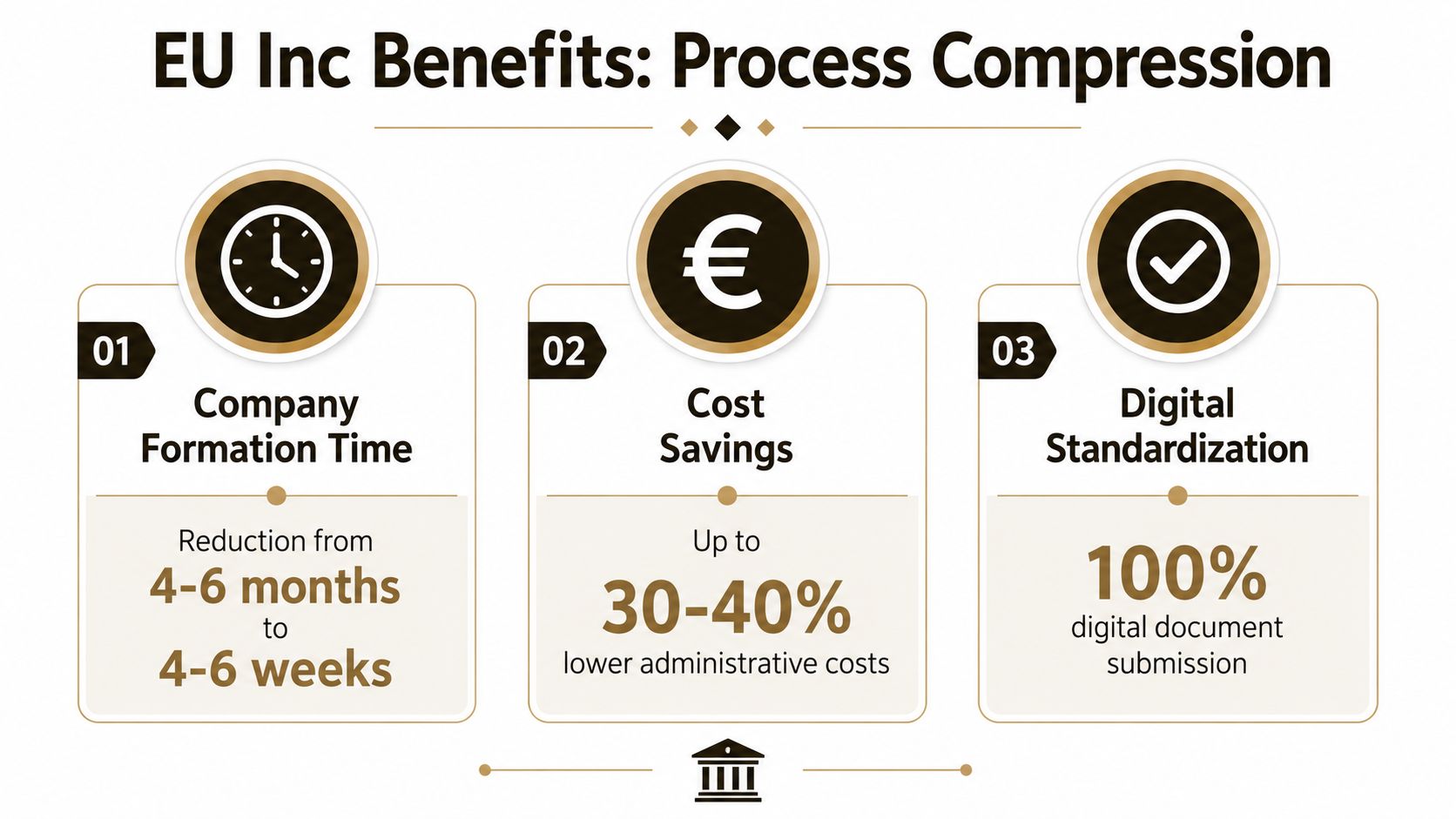
The cleanest way to read the proposal is this. The EU interface is the intake point. The actual registration decision still sits with the competent authority in the relevant member state under national law.
That distinction matters. A company form can be standardised at the entry stage while the legal approval still depends on local procedure, local filings, and local interpretation of the rules. The promise is simplification, not the removal of national legal systems.
National employment and social laws are not affected, so EU Inc does not give founders a shortcut around labour safeguards or worker rules. It is a way to make company formation lighter without pretending that one EU form can wipe out every national layer around it.
The main operational logic is process compression. A single template, a single portal, and once-only submission reduce the number of times founders and advisers have to reconcile the same corporate facts. That lowers delays and cuts avoidable data-entry mistakes.
Bruegel notes that the fast-track timing depends on template use and competent-authority review, so the headline speed can stretch in practice (Bruegel). That is not a flaw in the concept. It is the normal friction that appears when a policy promise meets real administration.
For founders, the point is practical. EU Inc tries to make the company itself feel more like a digital filing system than a stack of country-specific paperwork.
The upside starts with speed, but speed is only part of it. The stronger benefit is that one filing can replace repeated setup work across the bloc. That matters for founders who want to test several markets without building a separate legal shell for each one.
The Commission's figures are the headline point. 48 hours, under €100, and no minimum share capital on the standardized route. Those numbers explain why EU Inc looks lighter than many national incorporation systems.

A faster formation process changes founder behavior. It shortens the gap between deciding to enter Europe and having a legal vehicle ready for contracts, hiring, and invoicing. For a SaaS company testing buyers in Spain and France, that can mean the difference between waiting on paperwork and starting commercial work right away.
Non-EU residents are also part of the design. The publisher describes the form as open to both EU and non-EU founders, with no citizenship or residency preconditions, no local director requirement, no notary, and no physical presence in the framework as described on its site (The EU Inc. by renn). For remote teams, that removes a lot of friction at the point where they usually hit it first.
The main technical win is digital standardization. A central EU interface plus standardized templates means founders do not keep retyping the same company data into separate national systems. That cuts down on reconciliation work and the errors that come from it.
This also helps when you expand. One entity can support hiring, invoicing, and cross-border operations more naturally than a patchwork of local companies. A founder with contractors in Spain, France, and Germany still has to handle local labour and tax rules, but the company structure itself stays simpler.
EU Inc looks strongest for:
If your growth plan is multi-country from day one, the administrative savings are the point.
That same logic is why the form is attractive for non-EU founders. It gives them a cleaner entry point into Europe before they have a physical footprint there. For the right team, that is a practical advantage, not just a policy slogan.
EU Inc does not change the tax bill by itself. There is no special tax rate, and corporate tax still applies at the national level where you operate. That is the first misconception to drop if you are comparing it with a true federal company regime.
The legal structure also leaves member-state control in place. The EU interface works as a front door, while registration still depends on the competent authority in the relevant member state under national law. So the paperwork may look unified at the top, but the underlying process can still differ from one country to the next.
The practical limits are easy to miss if you focus only on the promise of easier incorporation.
That is the core trade-off. EU Inc reduces incorporation friction, but it does not remove legal fragmentation. If your business depends on one predictable approval pipeline, you will still feel the gap between the EU front end and the national back end.
For founders who care more about certainty than speed, that matters. A fast filing that still depends on local review is useful, but it is not the same as a single federal company law. The cleaner the market story sounds, the more important it is to ask who signs off on the entity.
A non-EU solo founder building SaaS for European customers is the clearest fit. The founder wants an entity that can invoice in the EU, hire contractors, and avoid setting up a local company just to test demand. EU Inc fits that profile because the point is remote setup with a single company and no local presence requirement, as described by The EU Inc. by renn.
A scale-up looks different. It already has traction, but it wants to hire in three markets without spinning up three companies. One entity gives finance and legal teams a simpler operating model. That means fewer bank accounts, fewer filings, and less time spent reconciling group structure.
The third case is a legal or finance team replacing parallel structures. EU Inc becomes more than founder convenience here. Consolidated filings and administration can cut legal costs sharply compared with running separate entities, which is the kind of saving multi-entity companies try to capture in practice.
The use cases tend to cluster around four things.
The more your business model spans borders, the more legal duplication starts to hurt.
EU Inc is still not the right answer for every company. If you only sell in one country, a national entity can still be the cleaner choice. The value appears when your operating footprint is already wider than your legal setup.
EU Inc is strongest when your company is built for the whole bloc, not one home market. If you want one company to hire, invoice, and expand across several EU countries, the proposal is designed for exactly that. If you need a very specific local setup, a national company still gives you tighter control.
The timing matters too. EU Inc is still in legislative process, and the currently expected launch is Q1 2027. So the right decision today is not to wait passively. It is to decide whether EU Inc belongs on your formation path once the rules are live.
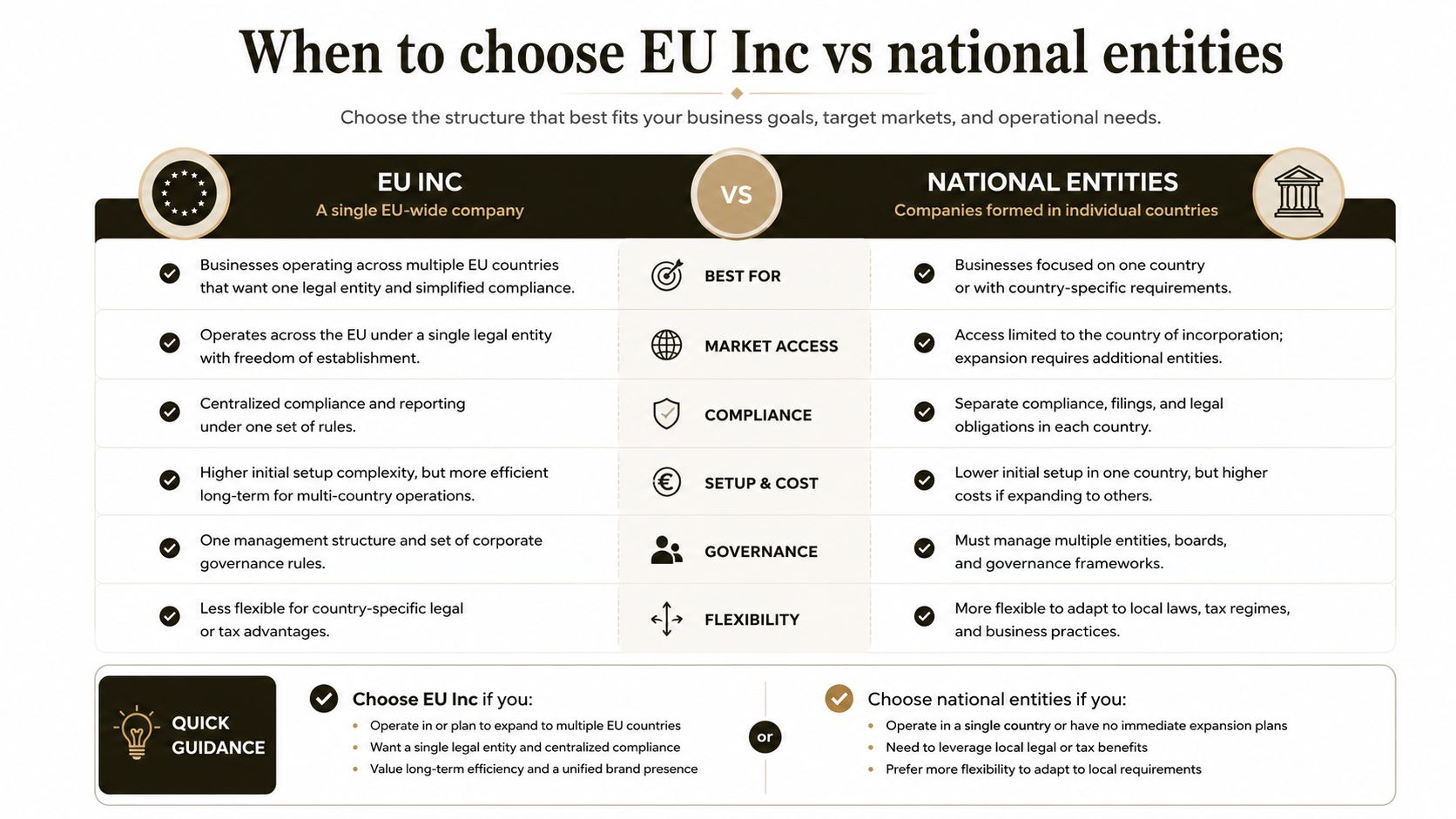
If your growth plan is pan-European, EU Inc is the more logical starting point. If your company is rooted in one market, a national entity is often simpler and more settled.
The most useful question is not “Which structure sounds modern?” It's “Where will the business operate in the next 12 months?” That answer usually tells you which route deserves your attention.