The wrong advice says to ask whether EU Inc. is mandatory. It isn't. The better question is whether staying national still makes sense once you plan to hire, invoice, or raise across borders. For a founder with real EU ambition, EU Inc. not optional can be the right conclusion even though the legal form itself is optional.
That sounds simple because it is. The Commission presented EU Inc. on 18 March 2026 as an optional, pan-EU company form designed to sit alongside national company laws, not replace them, with a single EU-level interface, 48 hours to incorporate, less than €100 for registration, no minimum share capital, and fully digital operations across the 27 EU member states. It is a proposed “28th regime”, so the whole point is choice, not compulsion. The Commission's EU Inc. announcement says the quiet part out loud.
The core issue is founder fit. Some teams should ignore it for now. Others should prepare as if it's coming the minute the law is live. And some, especially cross-border operators, should treat it as the default path once the launch window opens.
Optional sounds harmless. It also hides the core decision. A founder does not need a theory lesson about company law. They need a clear answer on whether one structure will save time, money, and pain compared with a national company.
EU Inc. is optional in law, but strategic in practice. That is the right framing. The Commission's own model is a regulation-based 28th regime, directly applicable across the EU as an optional company form, with a single disclosure event feeding the relevant registers under a once-only principle. The Commission's press release text makes the architecture clear.
The right question is whether EU Inc. is optional for you.
Start with where the company will operate. If the answer is one member state, a national form may still be enough. If you will hire, invoice, or expand across borders soon, friction starts to matter fast. If you want to build once and operate across the EU, or keep rebuilding entity by entity, that choice decides the economics.
Practical rule: if your growth plan crosses borders, the legal form stops being a paperwork issue and becomes an operating model choice.
That is why this topic splits into four founder profiles. A solo remote founder, an EU startup scaling across markets, a scale-up already juggling multiple entities, and a legal or advisory partner do not face the same answer. For one, EU Inc. is a convenience. For another, it is the cleaner strategic move. For a third, it may be a migration question. For the last, it is a new service line.
If you want the basics before you compare scenarios, start with the EU Inc. overview. Then read the rest with your own operating map in mind.
Think of EU Inc. as a business passport with one front door. It doesn't erase national company law. It gives founders a separate supranational route that works across the EU without forcing them to form a new company in every market.
That's the point of the “28th regime” label. It means a new optional layer, not full harmonization. Europe has never had one clean company-law lane. EU Inc. is designed to give founders one. The Commission says founders would use a single EU-level interface tied into national business registers, and the same information would move onward under a once-only principle so it doesn't need to be resubmitted for TIN and VAT registration. The Commission's legal proposal text spells out that structure.
The legal shape is simple enough to remember:
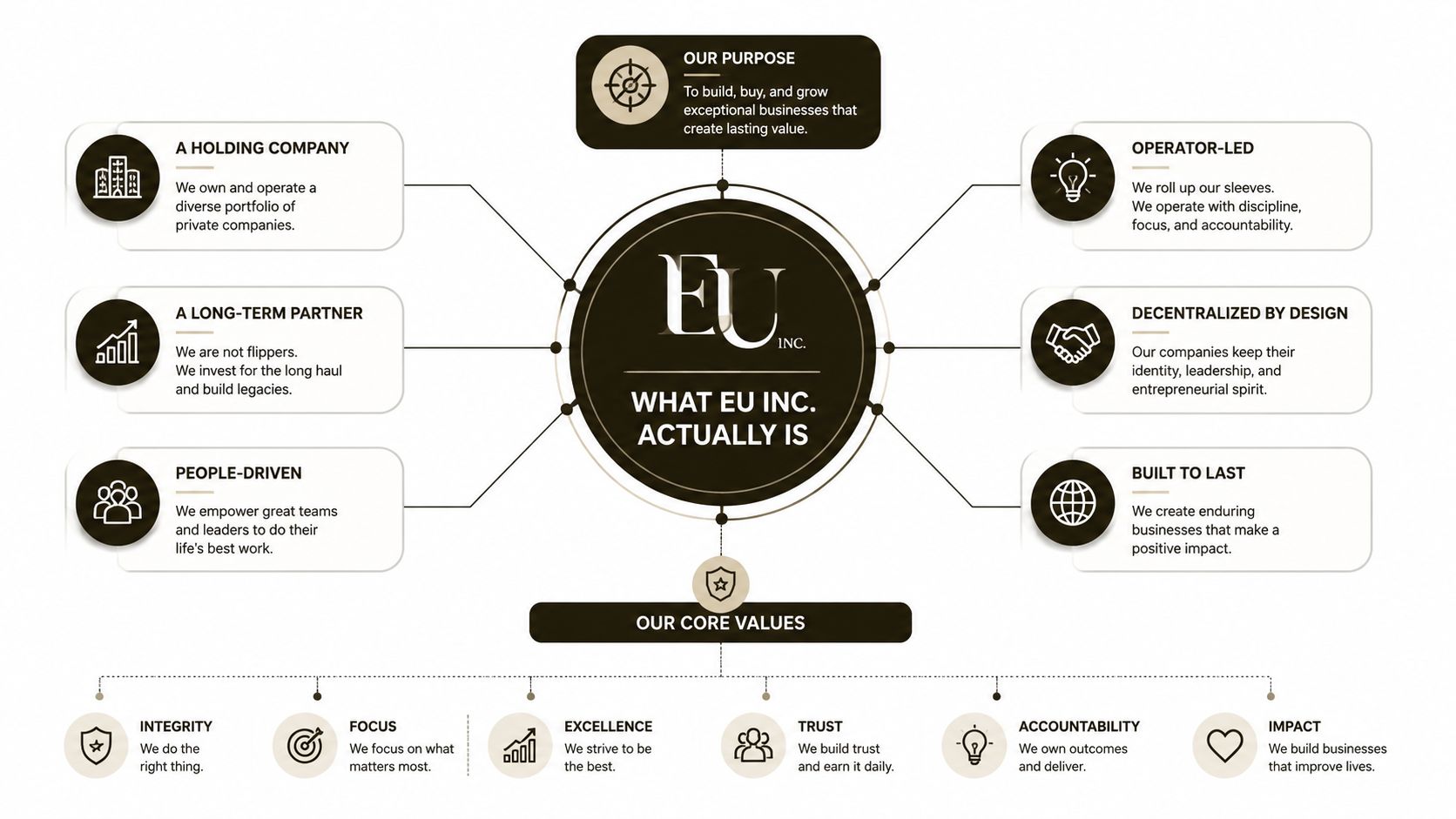
That's the shape founders need to keep in their head. Not a legal essay. A practical route to a single company that can be used across 27 countries.
The other thing worth saying plainly is timing. EU Inc. is still in the legislative pipeline. Business-law commentary points to a projected 2028 application date and unresolved political agreement, while the Commission's own messaging still treats the proposal as a live legislative project. Oxford Business Law Blog is useful on that uncertainty.
Some founders can ignore EU Inc. for now. Others cannot. The difference is not the legal form on paper, it is whether the structure removes friction from how you sell, hire, and operate across borders.
For a founder outside the EU, EU Inc. is the clearest fit. The proposal is open to non-EU residents, with no citizenship or residency condition, no notary, no local director, and a 100% digital process in the design. The EU Inc. product overview makes that access model explicit.
That matters because remote founders lose time on avoidable admin. They also lose flexibility when a local setup boxes them into one country while the business is trying to reach customers across the bloc. If your first real market is Europe, a national shell can become a poor fit fast.
Action this week: map your first three target markets and decide whether you want one entity or a country-by-country stack.
This is the group where EU Inc. starts to look like the default choice. If your company will hire in more than one member state, invoice in more than one member state, or move from market to market without pausing for local incorporation work, a single entity is cleaner than a pile of separate ones.
The practical test is simple. Ask whether your current setup creates avoidable local filings, duplicated payroll work, or contract friction every time you expand. If the answer is yes, EU Inc. is doing real work for you before it even launches.
This case is different. You already have national companies, contracts, payroll, and maybe reserves spread across several places. EU Inc. does not erase that complexity. It raises a conversion question, a continuity question, and a legal execution question, all at once.
That is the part competitors underplay. Moving from a live structure into a new European form is not a branding exercise. It is a change management exercise with legal consequences. If you are in this bucket, start with a comparison memo, not a filing plan.
For advisors, EU Inc. is a service line you need ready. Clients will ask about it the same way they ask about national incorporation, VAT setup, and employee equity. If you advise founders, your intake process should already know how to screen for fit, gather documents, and explain what changes once the form is available.
You also need a clean internal checklist for implementation risk. The law may be designed for speed and digital filing, but clients will still want a practical answer on documents, timing, and cross-border consequences. That answer should be ready before launch, not after the first request lands.
Bottom line: EU Inc. is not a generic upgrade. It is the right move when your operating model is already European, or when your next move depends on being able to act that way without setting up more local entities.
Founder profileVerdictMain actionSolo remote non-EU founderStrategicCheck whether one EU entity covers your first marketsEU startup scaling cross-borderFavoredCompare the cost of one company against multiple national setupsExisting multi-entity scale-upOptionalBuild a migration memo before any restructuring decisionLegal or advisory partnerRequired as a servicePrepare your client intake and filing pathway now
If you are in the first two rows, treat preparation as urgent. If you are in the third, document the conversion risks before you move. If you are in the fourth, get your process ready before founders start asking.
The headline terms are useful, but they are not the primary risk. The primary risk is execution. Until the law is finished and member states wire up their systems, the difference between a clean promise and a working filing process can be wide.
A fast filing clock only matters if the whole chain works. The EU-level front end, the national register, identity checks, and payment handling all have to talk to each other without friction. If any one of those steps slows down, the promise stops being a promise founders can rely on.
The fee cap is attractive, but it is only the public filing fee story. Founders should still expect separate costs for legal review, accounting, tax setup, and any cross-border housekeeping that sits around the incorporation. A low statutory fee does not make the full setup cheap.
The proposal's no-minimum-capital rule is one of its clearest advantages. It also depends on the final political text surviving the legislative process without dilution. Founders should read that as a live policy question, not a closed deal.
This is the promise founders will care about most because it cuts straight to friction. It also has the most room for variation in implementation. A digital, no-notary design is the direction of travel, but national practice still has to catch up, and that gap is where delays usually appear.
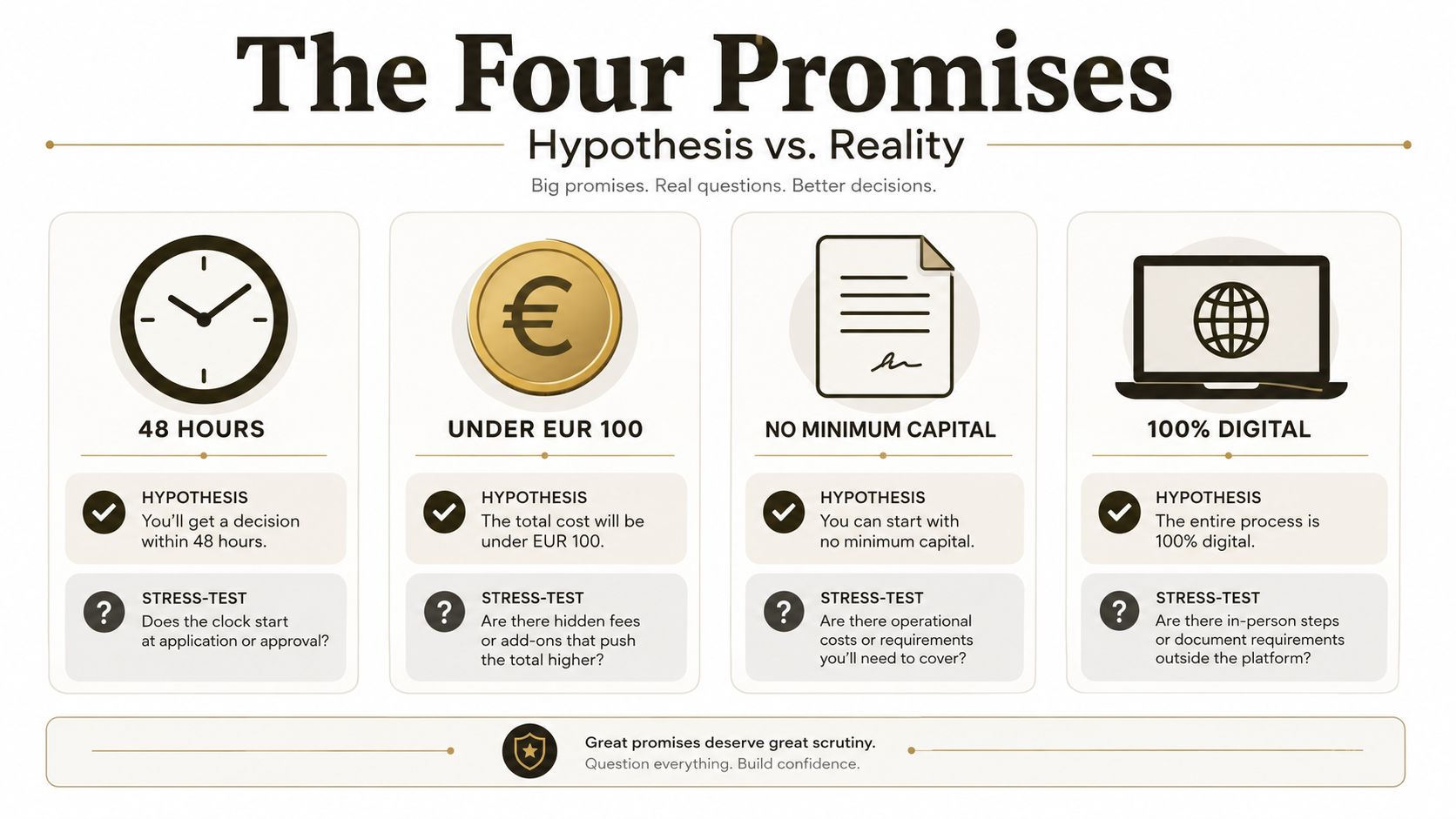
The point is simple. EU Inc. is being built with clear speed and simplification goals, but founders should treat the rollout as a process with moving parts, not as a finished operating system. The legislation still has to clear, the infrastructure still has to work, and the practical details still have to match the political pitch.
Plan for that gap now. Keep budget for advisory work. Assume member states will move unevenly. And do not tell your team the process is settled until the filings are working.
If EU Inc. looks right for your business, use the time before the expected Q1 2027 launch window to sort the details that slow founders down later. The work is not hype. It is getting the setup ready for a cross-border launch that will not fall apart on filing day.
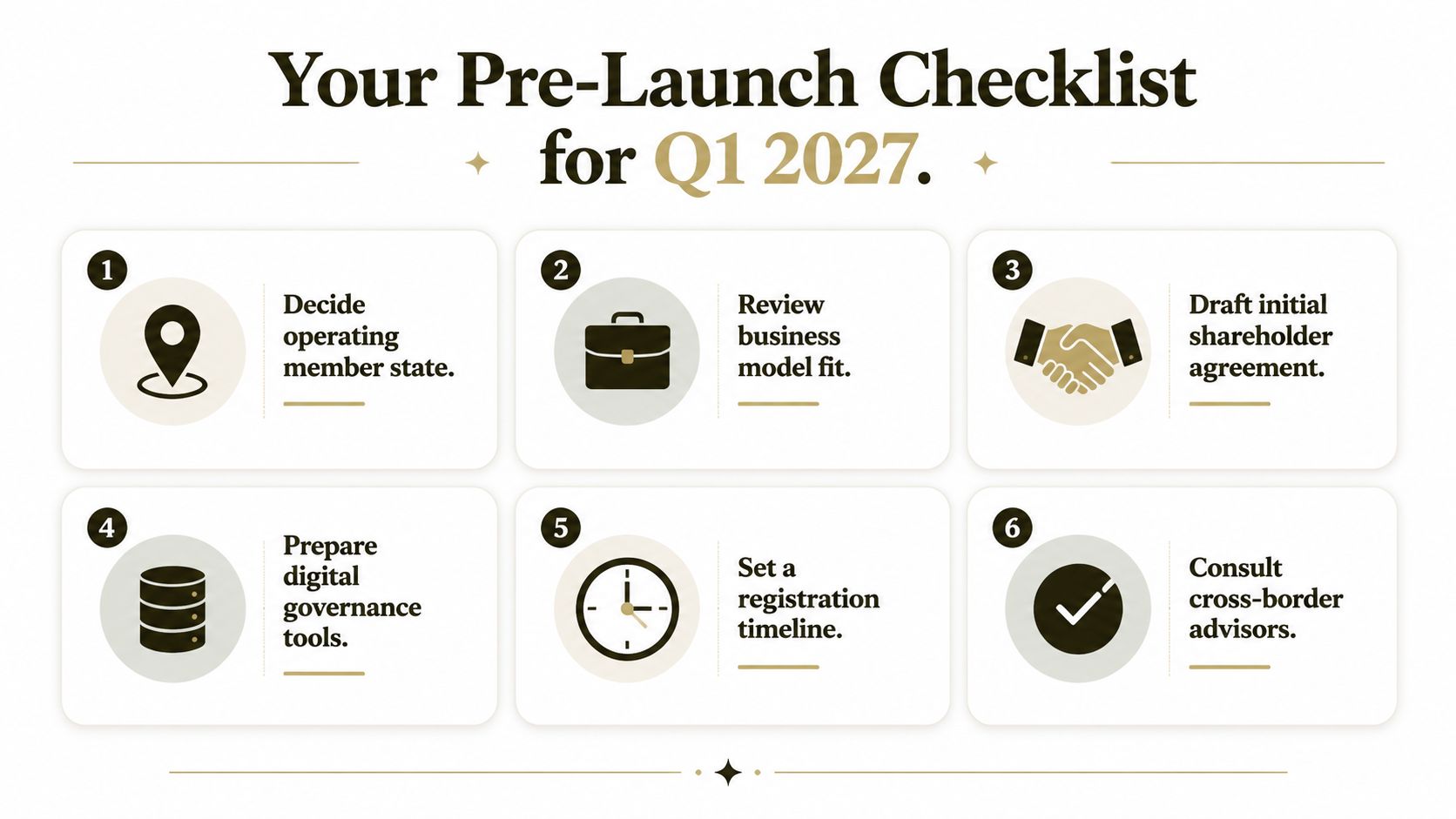
Choose the member state that fits your tax position, management footprint, and day-to-day operations. For EU Inc., that choice is not cosmetic. It shapes which filings, registries, and local admin steps will touch your setup first.
Run trademark checks in your main markets before you commit to a company name. If you are building across borders, a name that looks available in one place can still create friction elsewhere, and rebranding after filing burns time you do not get back.
Get the founder documents ready in digital form before launch opens. That means articles that can be filed cleanly, shareholder register templates, and beneficial owner declarations that match the data you will hand over later. If your team is spread across countries, make sure the pack is consistent across languages and signatories, not patched together at the last minute.
The Commission's once-only idea is meant to reduce repeated data entry, so your internal records should already show which identifiers you will need, where they come from, and which filing step relies on each one. Commission legal text Treat this as a data-mapping exercise, not a form-filling exercise. If your accounting, payroll, and incorporation files do not speak the same language, launch day will expose it fast.
Do not improvise here. A tax adviser who understands multi-country operations should already know how your structure, VAT position, and local registrations fit together before filing opens. That is especially true if you expect customers, contractors, or founders in more than one member state.
If a launch queue exists, get into it early. Filing on day one is better than discovering the process only after the first rush has already filled the intake channel.
The EU Inc. by renn platform is one option for waitlist intake and digital setup, with a focus on founder details, filing coordination, and TIN and VAT flow management. That workflow matters because launch readiness is mostly about removing avoidable delays before they show up.
If you are serious, treat the checklist like a live project, not a note.
EU Inc. doesn't arrive alone. That's important. The larger opportunity is the stack around it, especially EU-FAST and EU-ESOP.
EU-FAST is the standardized EU investment document concept, similar in spirit to a SAFE-style instrument. The reason founders should care is cost and speed. The proposal is framed as cutting round legal costs by 50 to 80%. The verified EU Inc. background note is the place to watch on that point.
EU-ESOP matters for the same reason, just on the hiring side. If you're bringing on engineers or senior operators across several member states, equity gets messy fast. A common EU template reduces the amount of bespoke drafting and review work you need every time you hire.
A founder who only looks at EU Inc. in isolation misses the bigger picture. The company form matters. So do the financing documents and employee equity rails around it.
That combo is why cross-border founders should pay attention now, not later. If you're building an EU startup with investors, employees, and customers in multiple countries, the legal stack starts to compound. A single company form plus standardized financing and equity tools is a much better operating base than a patchwork of national fixes.
Stop asking whether EU Inc. is optional in the abstract. Ask whether it is optional for your business model.
For a solo founder selling into Europe from outside the EU, the answer is no, not if you want a clean setup before you scale. For an EU startup that is already moving toward multi-country hiring or invoicing, it is the default to keep on the table. For a company with several national entities, the right move is patience plus planning, because conversion and reorganisation rules still need to settle. For advisors, this is a real client offering, not a footnote.
The test is simple. If your company is built to stay local, a national form that is cheap and already understood should stay in place. Forcing a pan-EU structure onto a business that will never leave one member state only adds complexity.
If your plan crosses more than two EU markets, the cost of ignoring EU Inc. starts to show up in legal work, entity maintenance, and repeated fixes. The form is still being shaped, and business-law analysis points to a possible 2028 application date with unresolved design tradeoffs. Oxford Business Law Blog
So the decision rule is blunt. If your next stage is local, stay local. If your next stage is cross-border, prepare for EU Inc. now, because waiting for the last draft means paying more later.
A lot of founders ask the wrong first question. The better one is whether EU Inc. changes anything in the place where their company is run. It does not change your tax residency by itself. Corporate tax still applies at national level where you operate, and that has to shape the plan before anyone treats the new form like a shortcut. The company form is a legal wrapper, not a tax escape hatch. If your management team sits in one member state, your staff and invoices sit in another, and the economic activity sits somewhere else again, local tax authorities will still care about substance, not branding.
Existing companies have a different problem. Conversion rules are still unsettled, so a founder with a German GmbH should not assume there will be a clean migration into EU Inc. A more realistic path may be a subsidiary or a broader reorganisation, and that is a heavier exercise than a simple conversion. It means checking shareholder approvals, creditor concerns, employee rights, and whether the current cap table can survive the move without forcing a fresh round of legal work. If the structure is already messy, EU Inc. will not fix it. If a founder has multiple classes of shares, legacy option grants, or side letters tied to local law, those issues need to be mapped before any switch is discussed. A conversion that looks simple on paper can trigger avoidable consent work in practice.
System readiness is the other place founders get caught out. If a member state is slow to bring its filing tools online, the practical move is to use the first live interface that exists and keep the records aligned across jurisdictions. The whole model depends on connected national systems, so launch timing will not be identical everywhere. That creates real operational risk for teams that wait for their own country to catch up. A founder who plans to incorporate, issue shares, or update governance on day one should check which registry is live, who can file there, whether local counsel can submit on behalf of the company, and what happens if a director appointment or share transfer has to sit in a queue. If the backend is not ready, your launch plan needs a fallback, not optimism.
Treat these questions as implementation work, not theory. Tax treatment, conversion mechanics, and system readiness decide whether EU Inc. is merely available or usable for you. Keep the company-law question separate from the tax question, and do the setup work early instead of assuming the form will sort itself out later.