EU Inc removes the notary requirement by using eIDAS-compliant electronic identity and qualified electronic signatures, while routing registration data through BRIS for EU-wide recognition. In the best-case path, founders are looking at 48 hours, less than €100, and no need for a bank account, lawyer, or notary.
The surprising part is that the notary is only one piece of the friction. In much of Europe, the pain is the combination of local formality, uneven register quality, and country-by-country repetition. If you've ever tried to incorporate across borders, you know the pattern. You finish one stack of documents, then repeat the same story in another country with a different form, a different office, and a different deadline.
The first thing founders feel is not the legal theory. It's the calendar.
You book a notary appointment, gather ID, prepare articles, and still end up with a company that only really works in one jurisdiction. For anyone building across the EU, that creates a strange mismatch. The business is regional, sometimes continental, but the incorporation process is still local. That's why the EU Inc no-notary angle matters. It targets the part of the process that consumes the most time without giving founders much strategic value.
A practical workaround today is often a power of attorney template when someone can't appear in person or wants a representative to handle part of the setup. That helps inside the old system, but it does not remove the old system. It only reduces the friction.
Practical rule: if a process still depends on physical presence, it is already expensive, even before the official fee appears.
The unevenness is real. The CEPEJ study on notaries reported an average of 13.9 notaries per 100,000 inhabitants across Europe in 2020, with some jurisdictions far above that level and others below it. France saw the largest increase between 2018 and 2020 at +33%, while England and Wales recorded the largest decline at -11%. That spread matters because it shows the infrastructure is not uniform. A founder does not experience “Europe.” A founder experiences the local notary market, and that market changes a lot from place to place. CEPEJ's 2020 notary study
EU Inc is meant to cut through that. The proposal says incorporation should be possible fully online within 48 hours for less than €100, with no minimum capital requirement and no need for a bank account, lawyer, or notary. That is not a cosmetic change. It changes how a company enters the EU market. EU Inc proposal overview
EU Inc isn't a replacement for every national company law in the EU. It's an optional EU-level company form that sits alongside the 27 national company laws. That distinction matters, because a lot of commentary makes it sound like Brussels is trying to erase national systems. It isn't. The proposal adds a new route for founders who want a single company form that works across the bloc.
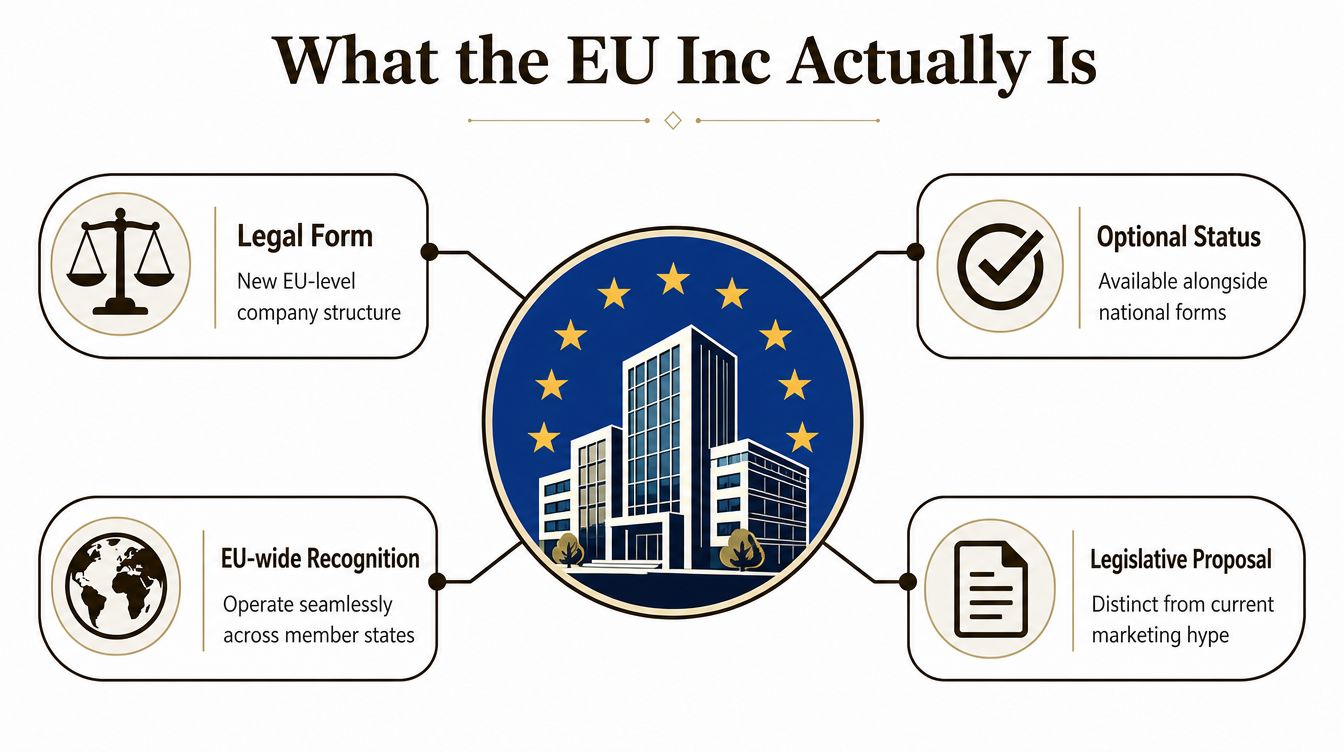
At the center is a simple promise. Register once, operate across all 27 member states. That means one legal form, one filing flow, and recognition that doesn't stop at the border where the incorporation happened. It doesn't mean your tax, employment, or insolvency rules suddenly become EU-wide. It means the company form itself is meant to travel.
The proposal also sets out some hard parameters. Incorporation is meant to work fully online within 48 hours for less than €100, with no minimum capital and no need for a bank account, lawyer, or notary. The framework is built around an EU-wide interface linked to national registers, with a later central EU register planned, so founders submit information once rather than repeating filings country by country. EU Inc practical analysis
FeatureTraditional National IncEU IncNotary requirementOften required in person or through local formalitiesNo notary step in the proposed workflowMinimum capitalVaries by countryNo minimum capital requirementRegistration feeVaries widelyLess than €100 maximum statutory feeTime to registerOften slower and country-specific48 hours on the standardized fast-track routeCross-border validityUsually tied to one countryDesigned for recognition across the 27 member states
The value is not only speed. It's reduction of repetition. If the company form is recognized EU-wide, the founder stops re-litigating basic setup questions in every market. That's the point of the design. It removes one entity-level bottleneck before you ever start dealing with local operational rules.
The no-notary claim only makes sense if you look at the machinery underneath it. EU Inc replaces a human gatekeeper with a digital chain that's supposed to be good enough for legal validity and compliance.
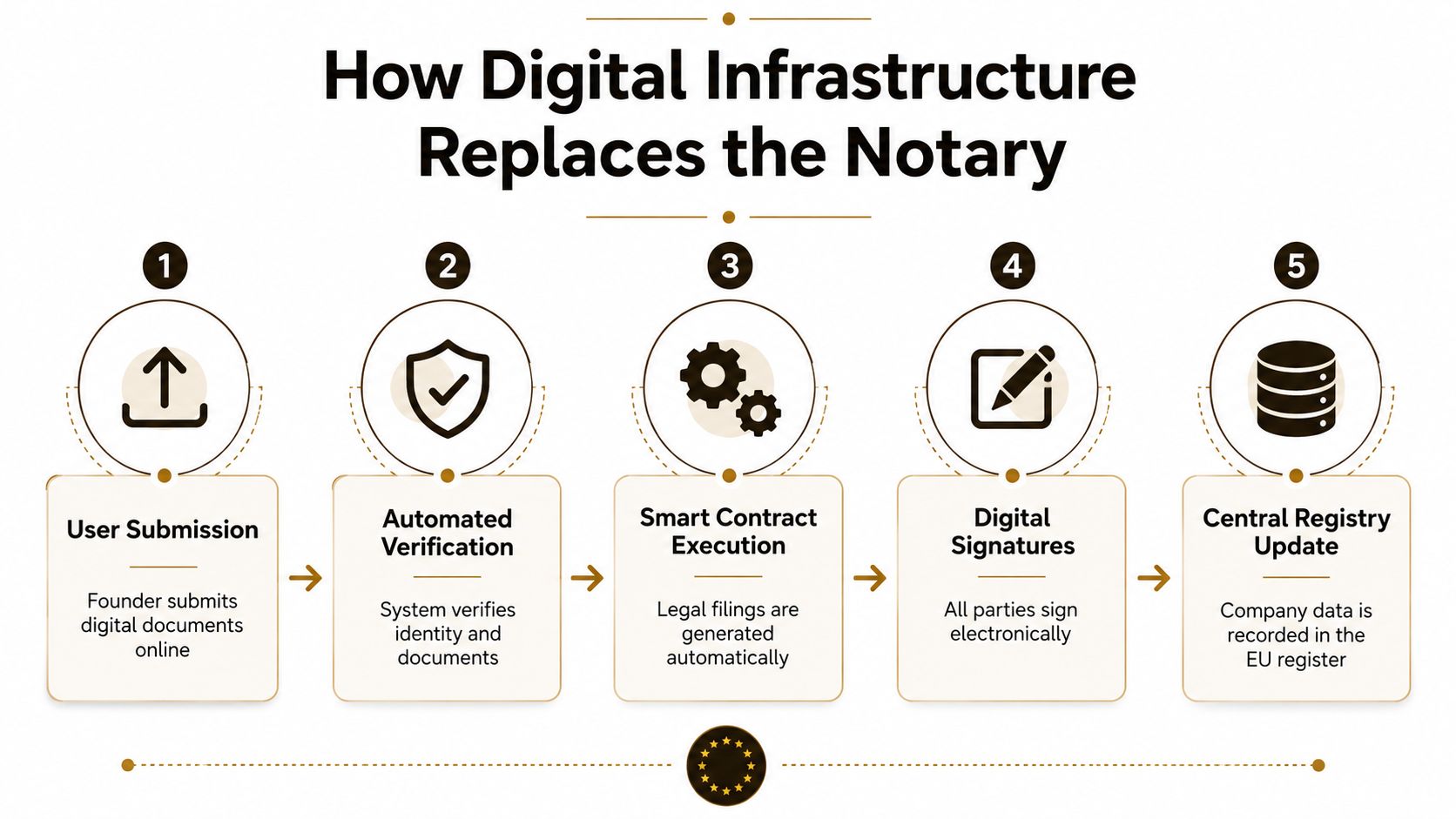
The proposal is built on eIDAS-compliant electronic identity and qualified electronic signatures. That means the system relies on digital identity checks and legally recognized signatures instead of a face-to-face notarization appointment. In the traditional model, the notary verifies the person, the papers, and the formalities in one physical step. In the EU Inc model, those checks are split across software and register logic. EU Inc digital revolution overview
A lot of speed comes from this. Standard templates reduce ambiguity. Automated compliance checks reduce back-and-forth. If the founder uses the EU's standardized forms through the central interface, the fast-track route is designed for 48 hours and a maximum statutory fee of €100. If bespoke articles are used, the proposal allows a slower 5-working-day route. The trade-off is obvious. Standardization speeds review. Customization takes longer because the system has to validate more legal variation. Practical analysis of the proposal
Standard templates are not a compromise for lazy founders. They're the reason the digital route can move at all.
The framework routes company data through BRIS, the Business Registers Interconnection System. That matters because it prevents duplicate filing in every country. A founder submits once, and the registration is meant to be recognized EU-wide. That's very different from the old pattern, where each national registry wants its own paperwork and its own proof chain. EU Inc proposal recap
For teams building tools around incorporation, document signing is the same bottleneck everywhere. A useful reference point on the mechanics of legally valid e-signing is the coverage from Closer Innovation Labs Corp. on legal eSign. The key point is simple. The signature has to be more than a click. It has to stand up in a cross-border legal environment.
EU Inc only works if the registration path is predictable. The practical sequence matters more than the headline.
A founder starts on the waitlist before launch. That intake captures the details that matter later, including the intended company profile and registration preferences. Once the national registration systems are live, the application can move through the EU interface. The point is to avoid the usual stall where the structure is ready but the file sits because one local system still needs a different format.
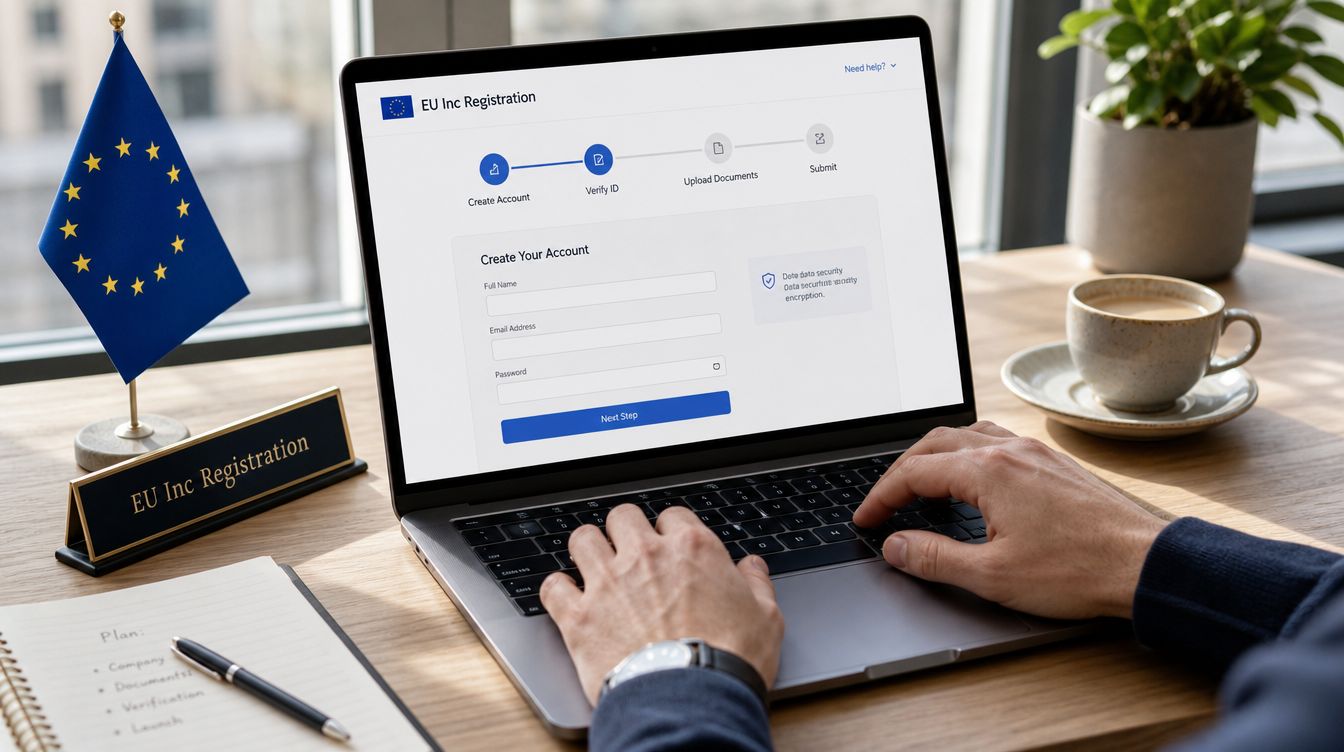
The speed promise depends on how the company is set up. Standardized templates are meant to support the fast-track route, with registration designed to finish in 48 hours for a maximum statutory fee of €100. If founders choose customized articles, the process shifts to a 5-working-day route. That trade-off is deliberate. Standardization keeps the workflow machine-readable and easier for the system to process, while customization adds legal variation that has to be checked. Practical analysis of the proposal
The process also tries to remove some of the usual post-incorporation friction. The registration path is meant to coordinate TIN and VAT issuance as part of the same flow. That matters because founders rarely need a company on paper alone. They need an entity that can invoice, hire, and trade without waiting on separate administrative steps.
EU-FAST and EU-ESOP matter here too.
I'd read those tools as a clear signal of intent. The proposal is not just about opening a company. It is also trying to cover the next financing and hiring steps, which is where a lot of cross-border incorporation systems usually break down.
The no-notary promise is strong. The follow-through is not always as clean.
The biggest gap is that removing the notary doesn't remove the rest of the state. Member-state AML, tax, and representation checks still exist. The draft says EU Inc would prohibit ex ante notarial verification for matters notaries currently check in some systems, while still relying on automatic transmission of registration data to tax, transparency, and social-security authorities. That means the incorporation event can be digital, but the administrative consequences still touch national systems. BNotK's analysis of the draft
Some founders hear “no notary” and assume “instant company.” That's not the right mental model.
The practical consequence is simple. EU Inc removes a major bottleneck, but it doesn't flatten every downstream process. The founder gets a better formation path, not a fully harmonized operating environment.
The infrastructure itself also depends on member-state execution. The proposal can set the rule. The local register still has to process it. That's why transposition readiness and register quality matter. A digital form is only as fast as the authority on the other end of it.
And that's the honest trade-off. The no-notary workflow can be a real improvement. It just doesn't turn every country into the same administrative machine.
EU Inc helps most when the company form is the obstacle.
That matters more than the headline suggests. A founder who wants to operate across several EU markets can use one entity and one filing path instead of repeating incorporation work country by country. The catch is that the older layers do not disappear. Tax, insolvency, and labor law remain national, and the registered office and head office still have to be in the EU. The structure is pan-European, but the operating rules still change with each member state. Commentary on the proposal's trade-offs
Founder rule: use EU Inc when the company form is the problem. Do not expect it to solve local employment or tax architecture.
That distinction shapes the decision. If the next move is cross-border sales, a single company form removes a lot of entity management overhead. If the next move is hiring in several countries, restructuring, or preparing an exit, the national layer comes back fast. The proposal does allow fully digital share transfers and broader lifecycle coverage, but that still is not the same as a Delaware-style setup where one predictable legal system does most of the work.
A second misconception should be cleared up early. EU Inc has no special tax rate. Corporate tax still applies at the national level where the company operates. The legal wrapper changes. The tax system does not. If someone pitches EU Inc as a tax arbitrage tool, they are selling the wrong thing.
The question is practical. Does the business need a company that can launch quickly, or one that can scale cleanly through multiple rounds and countries? EU Inc is strongest when both answers are yes. It is weaker when the company only needs one local market and does not benefit from a wider EU structure.

EU Inc is still in the legislative process, with an expected launch in Q1 2027. That is the honest frame. It is a projection, not a promise, and the rules can still shift before the final text is locked.
Non-EU founders should pay attention now, because the proposal is meant to be open to them too. The framework points to no citizenship, residency, notary, or local director requirements, with a process that is meant to be 100% digital. For founders who want a European company without moving into Europe first, that is a real change.
Start with the basics.