
Under the EU Inc proposal, a founder can register with €1 of minimum capital, and the draft also allows the company to sit at €0 for its entire life. The trade-off is simple, creditor protection moves from paid-in capital to director-run balance-sheet and solvency tests.
That is the story behind eu inc minimum capital. The headline number is small on purpose, but the legal design behind it is what changes how founders enter the EU market.
The first thing to understand is that €1 minimum capital is not a marketing slogan. It is the floor in the Commission's proposed EU Inc framework, and the Commission also says the company can be formed for less than €100 and within 48 hours through a single EU-level interface Commission proposal summary. That changes the entry point from “lock money into a legal shell” to “file fast, digitally, and start operating.”
If you are used to older European forms, the instinct is to ask how much cash must be frozen in share capital. Under EU Inc, that instinct is the wrong starting point. The proposal's draft Article 62 says the company is not required to have a minimum amount of capital, does not need to build up capital or legal reserves over time, and may keep capital at €0 throughout its lifetime draft legal framework.
That means the founder's real obligation is not to deposit a big amount on day one. It is to respect the new safeguards when money leaves the company. Schoenherr's analysis describes those safeguards as a balance sheet test and a 12-month solvency test, which shift the protection burden onto directors rather than on a statutory capital buffer Schoenherr practical analysis.
Practical rule: if the company can't pay its bills and still pass the director tests, the low capital headline stops helping very quickly.
The €1 figure matters because it removes a psychological and legal barrier. A founder does not have to tie up cash before the business has even proven itself. The European Parliament described the proposal the same way, as a fully digital form that can be set up online within 48 hours with no minimum capital European Commission proposal PDF.
For a startup, that is a big shift. The company form becomes easier to enter, easier to standardize, and easier to scale across borders later. The cost of formation stops being a capital test and starts looking much more like an administrative registration step.
The value of €1 minimum capital becomes clearer when you line it up against the forms founders already know. The contrast is sharp, especially if you have ever compared a German GmbH to a cross-border vehicle.
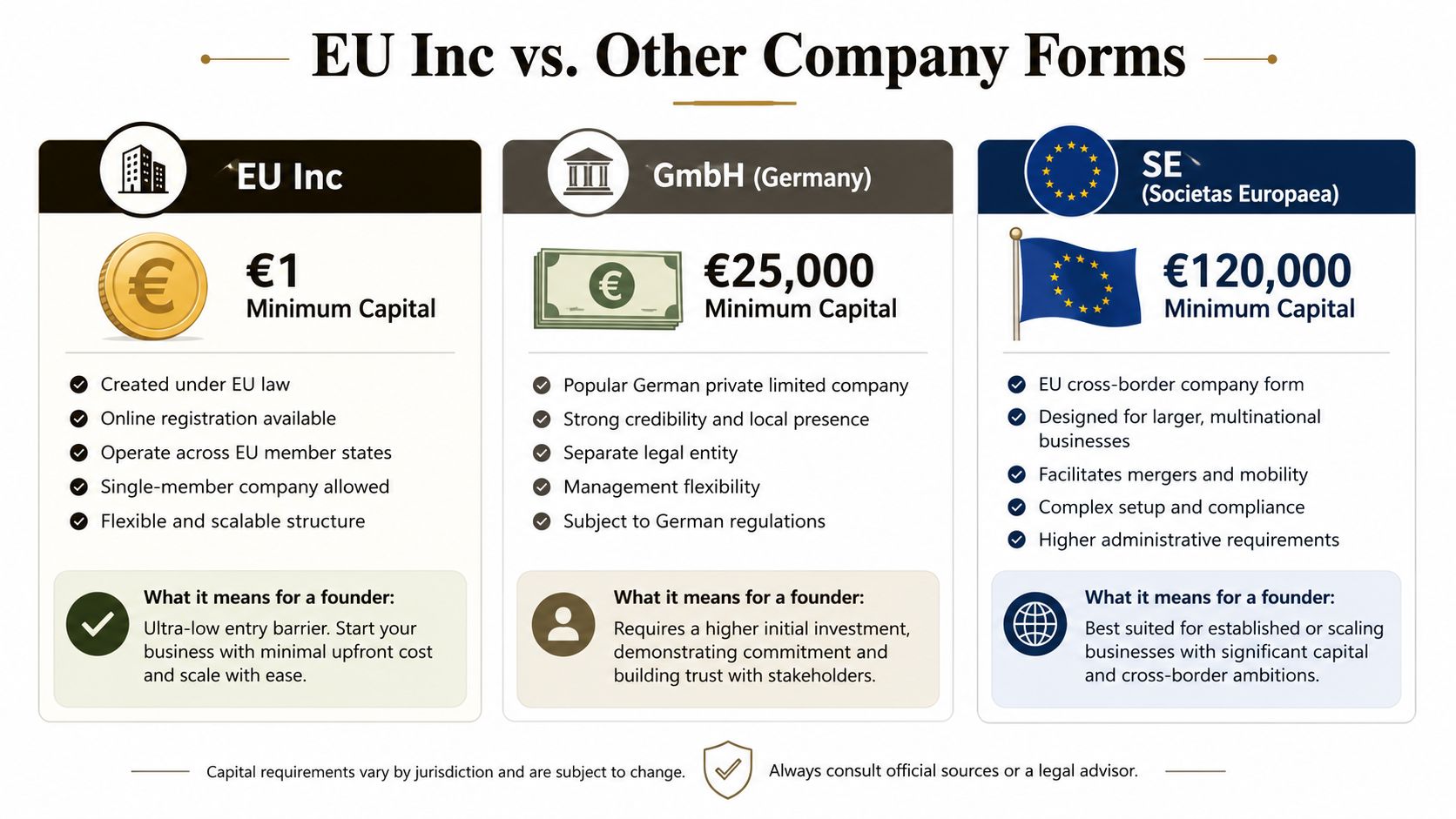
For many founders, the headline difference is obvious. €1 is radically easier than €25,000 or €120,000. But that is only part of the story.
In jurisdictions where the local minimum is already symbolic, the better question is not whether EU Inc is cheaper in absolute terms. It is whether one entity can work across all 27 EU member states with a single digital registration path. The Commission frames EU Inc as an optional “28th regime”, so it sits alongside national law instead of replacing it European Commission proposal PDF.
The key advantage is consistency. A founder who wants to sell, hire, and invoice across borders often cares more about one recognizable structure than about saving a few euros on paper capital.
That is why the eu inc minimum capital debate matters. It is not just about affordability. It is about whether Europe can offer a startup-friendly entry point without forcing founders into a heavy national structure before they have traction.
The headline reason is simple. The Commission is trying to make EU Inc feel like a company form built for quick setup, not a structure that forces founders to leave money idle before they can even start trading Commission proposal summary.
Traditional minimum capital rules serve two purposes at once. They tell outsiders that the company has some backing, and they give creditors a small cushion if things go wrong. In practice, that cushion is often a rough proxy for real protection. A founder may have to lock funds into the company even when those funds would do more useful work in product development, hiring, or early sales.
EU Inc changes the timing of the protection check. The money does not need to sit in place from day one. Instead, the proposal ties protection to what directors do when value leaves the company. In practice, that means a director cannot treat a distribution like a routine admin task. Before approving a payout, they have to ask whether the company can still meet its obligations and whether the accounts still support the transfer.
A simple example makes the shift clearer. If a startup has a healthy bank balance after a funding round, that does not automatically mean a dividend is safe. Directors still need to ask whether upcoming supplier bills, payroll, and tax payments can be met after the money goes out. If those obligations are tight, the distribution should wait. That is the practical trade-off behind the €1 model. Founders get a lighter start, but management takes on more responsibility when the company spends or distributes cash.
The larger problem is fragmentation. Founders often have to choose a legal form before they can fully choose a market, and that adds friction, cost, and delay. The proposal is meant to reduce that by giving founders one optional EU form they can use across borders, instead of forcing them to build around different national starting points European Commission proposal PDF.
The capital change fits that design. If incorporation is digital, fast, and does not require a capital lock-up, the legal form starts to look like working infrastructure for growth. It stops acting like a gate that founders must pass through with cash tied up on the other side.
A creditor protection model only works if directors apply it carefully in daily decisions. That means checking whether a planned payment would leave the company unable to cover near-term liabilities, and stopping a distribution when the answer is doubtful. It also means treating board approvals as real judgments, not rubber stamps. The point is not to let capital disappear. The point is to move protection from the beginning of the company's life to the moments when the company's money is about to leave the business.
Key insight: abolishing minimum capital does not remove protection. It shifts the protection test from paid-in money at incorporation to director judgment before cash goes out.
That is why the €1 rule matters. It is the policy choice that lets EU Inc stay light at formation while still asking founders and directors to act responsibly once the company starts operating.
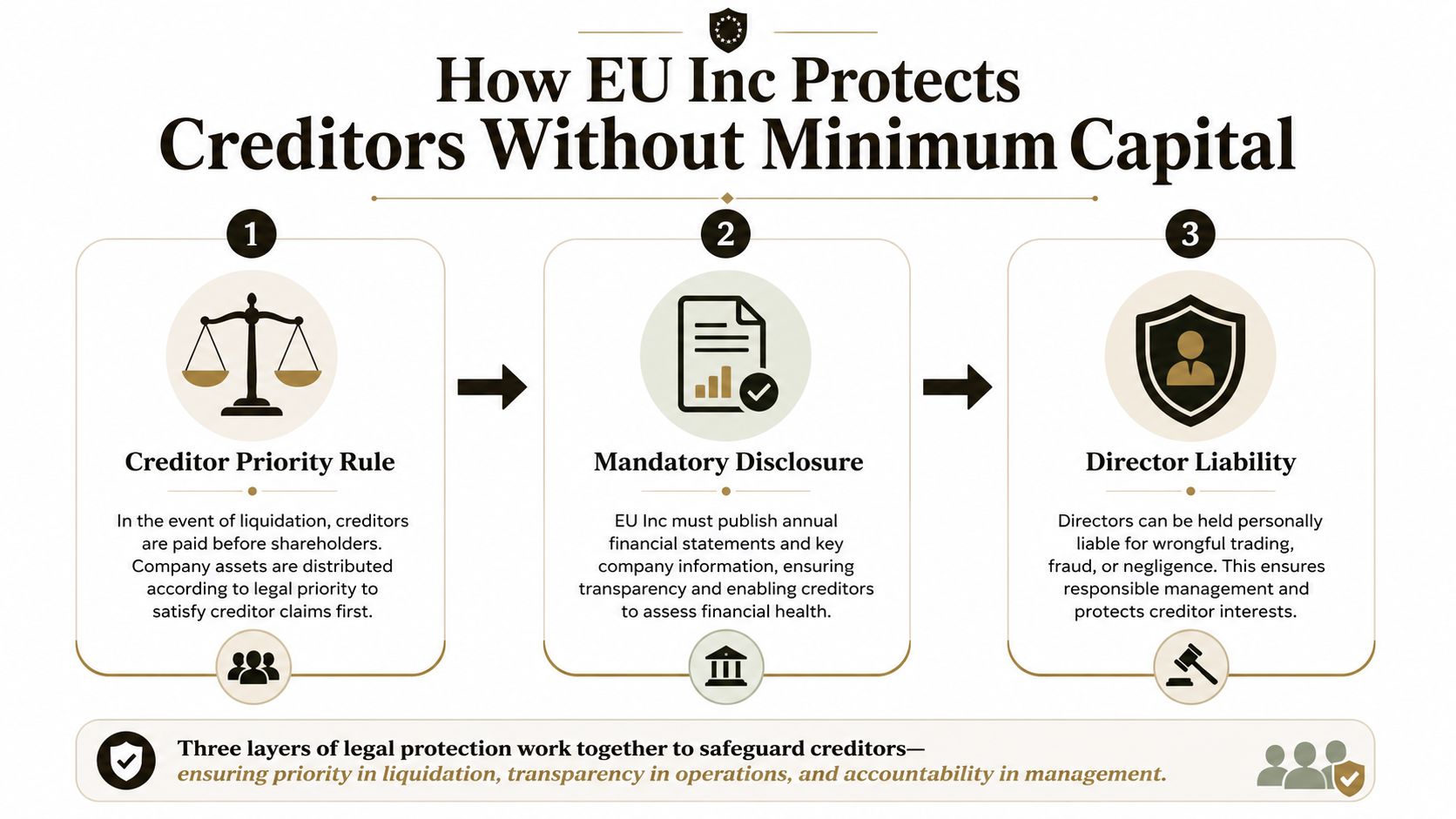
Once you remove the old capital floor, you need other safeguards. EU Inc replaces the upfront buffer with rules that make directors watch the company's finances more closely whenever money leaves the business.
The draft framework also preserves flexibility through non-par-value shares by default Schoenherr practical analysis. That matters more than it sounds. If shares do not need a fixed nominal value, the company does not need to build its structure around a rigid capital denomination.
That makes later financing cleaner. Capital can be increased later through share issuance or conversion of reserves, instead of being trapped inside an old nominal structure draft legal framework.
The payoff is speed and flexibility. The cost is governance discipline. If a director certifies a distribution wrongly, the risk shifts from theory to personal exposure. That is exactly why the form feels lighter at incorporation and stricter at the point of payout.
A low capital form is not a low-responsibility form. It just moves the responsibility somewhere more useful.
For founders, that's the working model to keep in mind. The company starts lean, but directors carry the burden of getting the financial checks right.
The capital number is only one part of the decision. Founders also care about speed, fees, and whether one entity can serve the whole market.
A useful outside example of the same broader workflow problem is the AI legal tech project listing on SubmitMySaas, which sits in the same ecosystem of legal-process automation and shows how founders are looking for faster, lighter setup tools.
EU Inc does not create a special tax rate. Corporate tax still applies at the national level where the company is tax resident or otherwise operates. That matters because a fast incorporation form is not the same thing as harmonized taxation.
The clean takeaway is this. If you want one structure to start light and operate across borders, EU Inc is the new option to watch. If your use case is local and your current national form already feels simple enough, the benefit may come more from reach than from capital savings.
A €1 floor sounds like it solves funding friction. It doesn't. It only solves the incorporation friction.
Bank onboarding still happens. Investor due diligence still happens. Employee equity still needs clear documentation. Tax registration still happens under national rules in each place where the company is active. Those frictions don't disappear just because the legal shell got lighter Bruegel analysis.
Clifford Chance notes that the reform is designed to lower entry barriers, but it also shifts the questions to governance and creditor-protection mechanics rather than the nominal capital figure itself Clifford Chance brief. Bruegel goes further and argues that the harder problem is post-incorporation scaling, not first registration Bruegel analysis.
That is the nuance many founders miss. Zero capital can help a very early-stage team that is cash constrained. But a scale-up often cares more about whether the regime reduces fragmentation after launch, including tax administration, banking, hiring, and financing instruments.
If you are thinking about EU-FAST style investment documents or EU-ESOP employee equity, the underlying regime matters because those tools depend on a workable company law base. The research background suggests the EU Inc ecosystem aims to standardize those instruments, but the broader legal and tax picture remains incomplete in the current proposal.
Good framing: the €1 rule lowers the door threshold. It does not build the whole house.
For founders reading this, that is the balanced verdict. The rule helps at the start. It does not remove the need to get banking, tax, and financing structure right. If you're comparing options, use the low capital number as one input, not the whole decision.
A practical reference point for founders exploring process and monetization questions is the PDFWix revenue practices page, which is useful context when you're comparing legal-tech support models around setup and filing work.
The founder experience is meant to feel simple from the first click. You submit company information once through an EU-level interface, and the system coordinates the rest of the registration flow Commission proposal summary.

The launch is still in the legislative process, so this is a projection rather than an active live-registration regime. Public materials point to Q1 2027 as the expected launch window, but no founder should treat that as a guarantee until the law is finalized and national systems are ready publisher information.
Once the framework is live, the process is designed to avoid notary appointments and in-person steps. The proposal also points to automatic assignment of identifiers during registration, including the TIN and VAT numbers, so a founder is not stuck repeating the same data to multiple authorities publisher information.
After that first filing, the rest looks like ordinary company administration, just more digital. If the regime is implemented as intended, that is where tools like EU-FAST for standardized investment documents and EU-ESOP for employee equity would become relevant, because they sit on top of the same 28th-regime base.
Later in the process, the promise is not just speed. It is that one entity can be used for invoicing, hiring, and cross-border operations without re-incorporating country by country. That is the practical value of the low capital rule. It lets the founder stay focused on launching the business instead of funding the legal shell.
Yes, for first registration, the proposal says the regime is open to both EU and non-EU founders, with no citizenship or residency preconditions, and no local director, notary, or physical presence requirement in the framework described by the publisher publisher information. The bigger friction after incorporation is still bank onboarding, tax, and local compliance.
No. EU Inc is still in the legislative process, so the number is a proposal, not a finished rule. The Commission has set out the concept clearly, but Parliament and Council negotiations can still change the details European Commission proposal PDF.
No. There is no special EU Inc tax rate in the proposal. Corporate tax still applies at the national level where the company is tax resident or operates.
Investors usually care less about the nominal capital figure than about governance, creditor protections, and how the equity stack is documented. That is why the low-capital model is paired with balance-sheet and solvency checks, and why standardized instruments like EU-FAST matter more than the headline €1 number alone.