
You're preparing for the day when one clean filing beats a stack of country-by-country incorporations. That matters if you're scaling from one market into several, or if you're setting up remotely and want the paperwork sorted before launch. The upcoming EU Inc is designed for that exact pressure point, a single company form with a digital workflow, and the current proposal points to a Q1 2027 launch window, not something live today. If you want the broader mechanics first, the EU Inc how it works guide is the right place to start. If you already know you want in, you can join the EU Inc waitlist and get ready before registrations open.
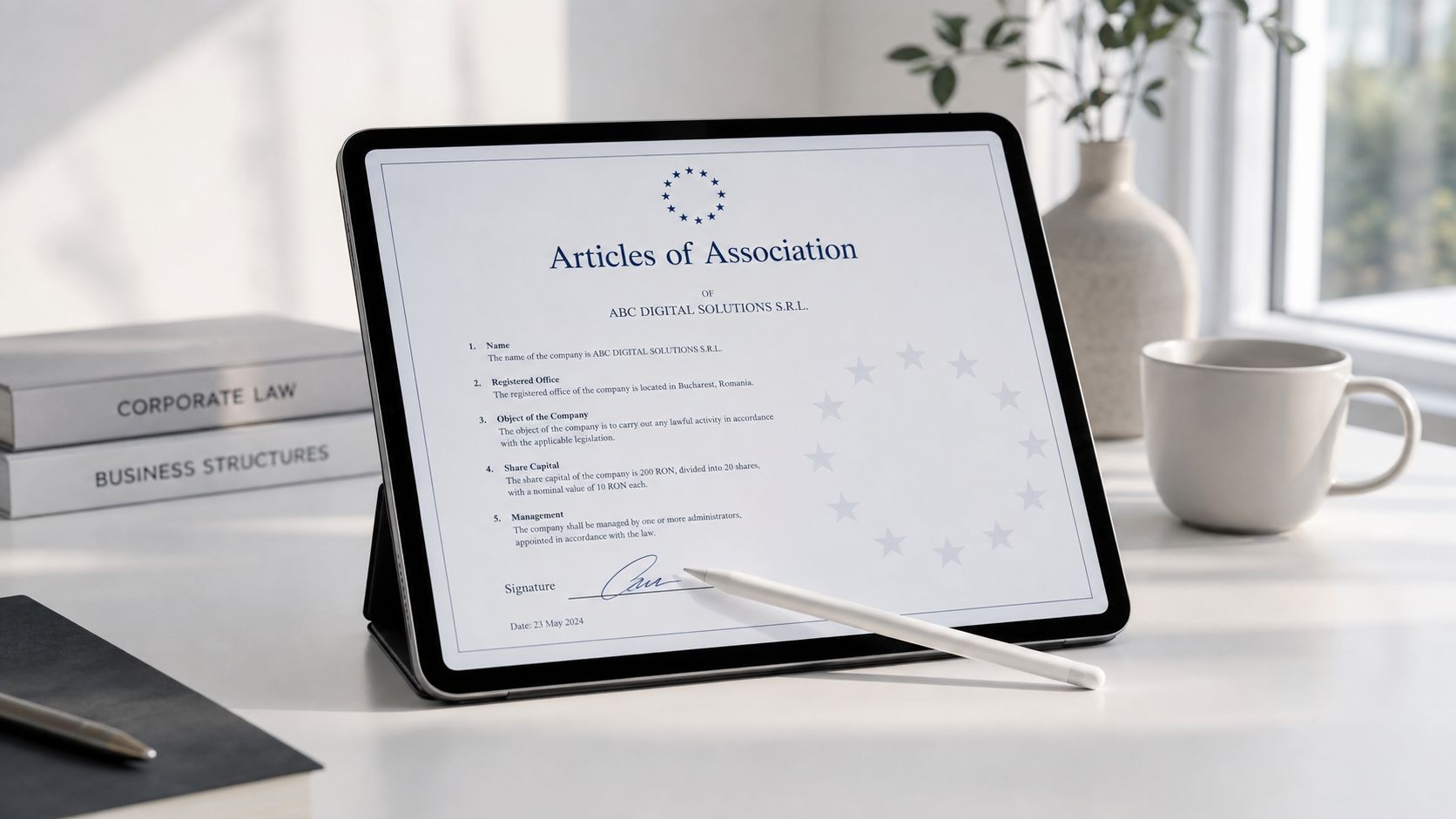
The articles of association are the backbone. They set the rules for ownership, governance, director powers, share mechanics, and the internal logic your company will live by once the entity exists. Under the Commission's proposal, the EU Inc articles must cover the legal form, company name, registered office and Member State, object, capital amount, total shares issued, nominal value if any, first-share subscription, founding shareholders, first directors, and the start and end date of the financial year, so this is not a loose template document, it is a real operating map for the company (Commission proposal annex).
For founders, the practical win is clarity. If you're raising money, bringing in a cofounder, or planning for future option pools, the articles should anticipate those moves now, not after a messy amendment round. A bad set of articles feels harmless on day one, then turns into friction when someone wants to sign, vote, transfer shares, or settle a dispute.
A strong set of eu inc documents should make the next round easier, not harder. If you expect investor involvement, it helps to align the articles with standard financing terms from the start, especially if you may use EU-FAST style documentation later for standardized EU investment paperwork. And if you know there will be multiple founders in different countries, define decision thresholds clearly, because vague approval rules slow companies down fast.
Practical rule: write the articles so they still work when the company has more people, more countries, and more money than it does on incorporation day.
The other reason to take this seriously is the document format itself. A legal analysis of the proposal says the articles are meant to be digital, machine-readable, and stored as structured data, with language requirements that allow the registration state's official language and a language customary in international business and finance, which means English can be used where accepted, but isn't forced everywhere (A&O Shearman analysis). That is good news for cross-border teams, because machine-readable drafting is easier to verify, transmit, and reuse than a scanned PDF full of redlines.
A founder's first real proof point is the certificate of incorporation. It tells banks, accountants, clients, and counterparties that the company exists as a legal entity. The registration extract does the heavier lifting, because it shows the details people usually check before they open an account, sign a contract, or file a compliance review. For EU Inc, the draft framework points toward standardized incorporation records and public disclosure fields, including the legal form, registered office, and jurisdiction of registration, so the file is meant to move across borders more cleanly than a stack of local filings (EU Council draft framework).
That matters because the first friction after incorporation is rarely the incorporation itself. It is proving, over and over, that the entity is real and that the register matches the document you are sending. When those details line up, banking, contracting, and onboarding move faster. When they do not, everyone asks for another copy, another confirmation, or another explanation.
This is the document you will keep returning to. A bank may ask for it. A supplier may ask for it. An adviser will often want it before they can start practical work on the file. Save it right away, keep several copies in your deal folder, and send the version that matches the register exactly.
The wider EU Inc proposal also shows why the certificate matters so much. The formation process is meant to be fully digital, with a target of 48 hours once complete documents are submitted and intended costs under EUR 100 in the blueprint, but those figures relate to the formation workflow, not to every step a founder will face after incorporation (EU Incorporated). In practice, the certificate is the bridge between getting approved and doing business.
This is the document that stops people from pretending they didn't understand what they signed up for. The founder and director declaration of consent confirms that the people forming the company, and the people running it on day one, agree to the roles, responsibilities, and obligations in the articles. That matters because directors aren't decorative names on a form. They carry legal duties.
A clean consent file also protects the company. If each founder has clearly accepted the role, there's less room for later arguments about who approved what, who had authority, or whether someone was pushed into the job without proper knowledge. That sort of confusion is expensive, and it's easy to avoid if the signatures are collected properly before submission.
The current proposal architecture is explicitly digital, and expert commentary says no notary presence is required for this document, with digital signatures accepted in the workflow. That's a meaningful shift for founders who are used to slowing down for physical appointments. It also makes remote teams easier to handle, especially when signers are spread across different countries and time zones.
A signature without context is weak. Before anyone signs, brief them on what the role means. A first director should know what they're responsible for, what they can approve, and where the company's internal controls start and stop.
If a founder is surprised by the obligations later, the problem started before incorporation, not after it.
Use qualified electronic signatures where possible, because they give the strongest legal footing in a digital filing environment. Keep timestamped records of when each person signed, too. That gives you a clean audit trail if the submission is ever questioned.
This also helps when investors are looking closely at governance. If you're planning to pair EU Inc with standardized financing docs, such as EU-FAST style instruments, early clarity on who controls the company avoids friction later. The consent file doesn't just satisfy the register, it tells future partners that the founding team understands the structure they're building.
A registered office and business address declaration does one practical job. It gives the company a legal place to receive notices, service of process, and official mail, so authorities, courts, tax offices, and creditors know where to reach it. In practice, this is the address that keeps the company findable when someone needs to deliver a formal document.
EU Inc makes that setup lighter than the usual incorporation route. The proposal says founders do not need a local director, physical presence, or local agent in any member state, and the filing flow is designed to be 100% digital for EU and non-EU founders alike. That matters if you are founding from Lisbon, Warsaw, or outside the EU, because you can structure the address around operations instead of around a mandatory local contact person.
A stable address beats a polished one.
A home office, coworking space, or virtual office can work if the provider is allowed to receive legal notices on the company's behalf. The true test is whether the address can handle service properly, not whether it sounds impressive in a pitch deck. If you expect the company to move often, you create amendment work and unnecessary delay each time the registered details change.
The framework also says the company must have its registered office plus central administration or principal place of business in the Union, so the address choice still has boundaries (EU Inc proposal text). That is the trade-off for founders. The model gives more flexibility than many national setups, but it still keeps the company anchored in the Union.
Founders often expect a single EU form to solve the tax side too. It does not. EU Inc does not come with a special tax rate. Corporate tax still sits at the national level where the company operates, and the proposal does not turn tax into one EU-wide rate. That separation matters, because the legal wrapper may be standardized while the tax treatment stays local.
The practical win is administrative, not fiscal. The EU's single-market competitiveness materials keep pushing digital simplification, harmonized administrative processes, and multilingual, machine-readable documentation to reduce cross-border friction and compliance costs across the 27-member market (2026 Single Market and Competitiveness Report). For founders, that should mean the tax ID and VAT setup is built into the incorporation flow, instead of becoming a separate round of country-by-country chasing after launch.
Your TIN and VAT number are not documents you file away and forget. They are the identifiers that let you invoice, hire, report, and deal with suppliers without repeatedly proving the company exists. Once they are issued, put the details in writing, then send them straight to your accountant and bank.
The cleanest way to handle it is to treat the tax file like part of launch readiness, not an afterthought.
Scope still matters. The proposal and the surrounding commentary make clear that labor, social security, wages, codetermination, and taxation remain governed by local rules, even if the company itself is formed through a single EU-wide procedure. So the tax identifier gets you started, but it does not erase the local obligations that follow.
The registration form can be central. Your tax life won't be.
The statutory disclosure and transparency filing is the record that puts the company on the public register. It shows the outside world that the entity exists, what it is called, where it is registered, and which core details sit behind it. For founders, that visibility is part of the deal, because banks, customers, and vendors often want to verify the company before they move.
The draft framework points toward standardized incorporation records and public disclosure fields, and the central EU interface is meant to support application templates and multilingual filing guidance, which tells founders that the process is designed to work across borders without turning every filing into a country-by-country puzzle. That still leaves room for errors, so the filing has to be checked with care. Once a detail is published, fixing it can mean a separate amendment.
Check every name, every address, and every officer entry before submission. Small spelling errors become annoying fast, especially if the published record is what clients, banks, and counterparties use to verify the company.
Publish less at home, more in a professional setting. If privacy matters, a coworking or virtual office address is usually cleaner than a private residence.
Beneficial ownership information may be included where applicable, so the company should be ready for transparency even if the publication mechanics differ by case. That is normal in the EU setup, and it is one reason founders should review the public data before the filing goes live. If the external record is wrong, your team ends up explaining a mistake that could have been prevented in ten minutes.
The filing process also affects how you store and share documents later. A Formcarry legal DPA can be useful if your team uses digital tools to move sensitive company data, because it keeps the paper trail clear when files are collected, stored, or shared across systems. That does not remove the need for manual review. It just means the clean version is easier to reuse when the register, your advisors, and your internal records all need to match.
Founders often treat this document as a formality. That is a mistake. It confirms that you know what happens after incorporation, and after EU Inc goes live, the subsequent workload shifts to operating rules. The proposal and expert commentary make the split clear, employment, tax, social security, wages, codetermination, and day-to-day compliance remain national, even if the company is formed through the EU route.
A compliance and annual reporting readiness certification belongs in the pre-flight checklist for that reason. It is a written check that your reporting, accounting, and governance setup matches the countries where you operate. Without it, the company may still form cleanly on paper, but the first filing cycle can turn messy fast, with late returns, inconsistent records, and penalties that were easy to avoid.
Start with the places where the business will do work. Sit down with your accountant early and map the jurisdictions that will matter once you begin invoicing, hiring, or using contractors. Cross-border sales can trigger local reporting rules sooner than founders expect, and so can a small team split across different markets.
A practical readiness check usually comes down to a few concrete moves.
A founder also needs to think about data handling, because compliance files rarely stay in one inbox. If your team uses digital tools to collect or move sensitive company records, a Formcarry legal DPA helps keep the processing terms clear when data is stored, shared, or routed between systems. That does not replace manual review. It just makes the documents easier to reuse when your register, accountants, and internal records all need to line up.
The policy debate points to a second reality. Under the EU interface, the underlying registers still sit in national systems, and implementation quality can vary across member states, so the promised speed and cost savings will not feel the same everywhere (the 28th regime proposal analysis). Readiness matters because a clean incorporation file is only the start. A company without a reporting process is still exposed.
Good founders prepare for the first compliance cycle before the first invoice lands.