You're setting up to sell, hire, and invoice across Europe, and the pitch sounds clean. One company. One digital filing. One fee that looks small enough to ignore. Then you hit the first national-law issue, and the clean story gets messy fast.
This is why EU Inc criticism matters. The promise is simple, a 48-hour online registration for €100 and a form that works across 27 member states. The problem is that the company shell can look unified while the operating rules still split by country. If you're a founder, that difference is everything.
The best way to think about EU Inc is not “Will this replace national law?” It won't. Think, “How much friction does it remove, and how much survives underneath?” The answer is where the debate gets serious. And if you're planning cross-border growth, you need the honest version before you pick your structure.
A non-EU founder can look at EU Inc and see a shortcut. Register digitally, avoid a local director, skip the notary, and get a company that is supposed to work across the bloc. That sounds like a real fix for the usual EU setup headache, where founders often end up stitching together different entities just to cover sales, hiring, and invoicing.
But the first snag is legal, not procedural. Critics say the draft leaves gaps to national law, so the “28th regime” can still turn into 27 different versions in practice EU perspectives on the 28th regime criticism. That matters because the single market already spans 27 member states and more than 60 different company formats, so a partial fix can still leave founders stuck with fragmented rules, court interpretations, and compliance work EU perspectives on the 28th regime criticism.
There's a second trap, and it's more common. Founders hear “EU-wide company” and assume tax becomes EU-wide too. It doesn't. There is no special EU Inc tax rate, and corporate tax still follows national rules where you operate, which is why the tax story is simpler on paper than in practice.
Practical rule: Treat EU Inc as a different incorporation path, not as a replacement for local tax, labour, or operating law.
The legislation is still moving, so timing matters. The Commission presented the draft on 18 March 2026, and the current political expectation points to a possible Q1 2027 launch, not a finished system today. If you need certainty now, you shouldn't plan as if the final rulebook is already locked.
EU Inc gets attention because the upside is obvious. Founders want a single company form, less admin, and a faster path into new markets. The criticism is just as obvious once you read the draft closely. The regime may simplify the incorporation moment while leaving the rest of the business lifecycle messy.
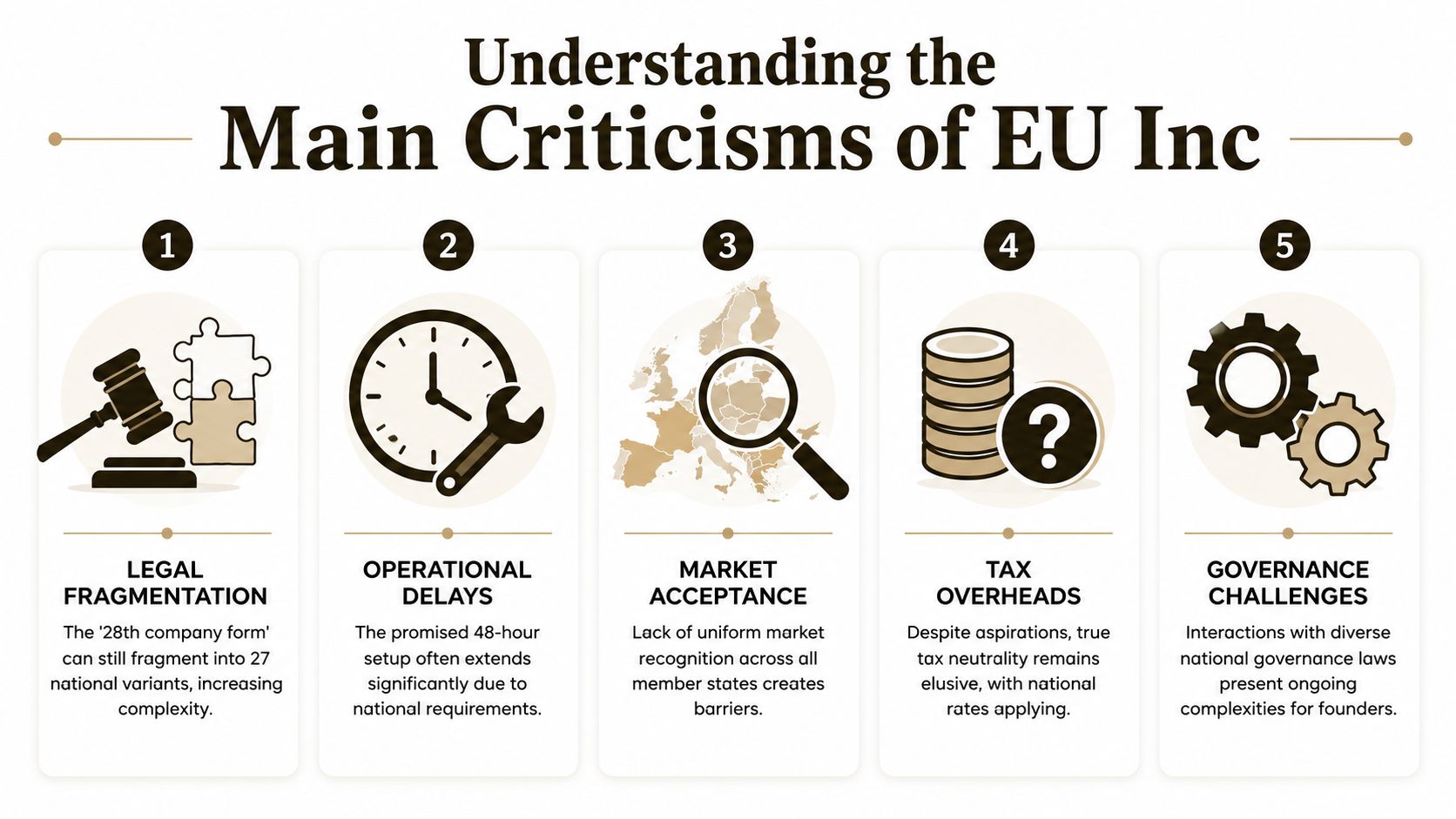
The most important takeaway is that these criticisms are not overlapping complaints about style. They attack different layers of the same product. One layer is incorporation speed. Another is legal scope. Another is whether the company can operate without falling back into national rules immediately after registration.
That's why the 48-hour line is useful but incomplete. It describes the front door, not the whole building. If your business model is simple, that may still be enough. If your structure is investor-heavy, multi-country, or people-intensive, the criticism starts to bite.
The right question isn't whether EU Inc is faster. It is. The right question is whether it stays simple after day one.
The deepest flaw is structural. Article 4 is doing too much work and not enough work at the same time. It tells you EU Inc is meant to be a common regime, but it also pushes unresolved issues back into the law of the registration state Oxford OBLB on EU Inc structural flaws. That means the company form is only partly unified.
Oxford's OBLB is blunt about the problem, issues not covered by EU Inc fall back to the registration-state law, which limits harmonization to a narrow core Oxford OBLB on EU Inc structural flaws. That matters because corporate law is full of edge cases. Governance disputes, transfer restrictions, voting mechanics, and other unresolved questions don't disappear just because the headline form is EU-branded.
You can see the practical risk immediately. A founder registers in one member state expecting one rule set. The first legal dispute lands, and the answer comes from local law. A second founder uses the same EU Inc template in a different state and gets a different interpretation. That is exactly how 27 versions of a supposedly single form creep in EU perspectives on the 28th regime criticism.
The legal criticism is not that EU Inc does nothing. It clearly does something. It is that the something stops too early. If you care about certainty, that's the point that should worry you most.
For a founder, the rule is simple. Don't confuse a single filing interface with a single legal system.
The shiny part of EU Inc is the digital front end. The draft says founders can register online within 48 hours for a maximum fee of €100, and the headline is powerful because it strips out the usual incorporation friction. But the operating reality is more demanding.
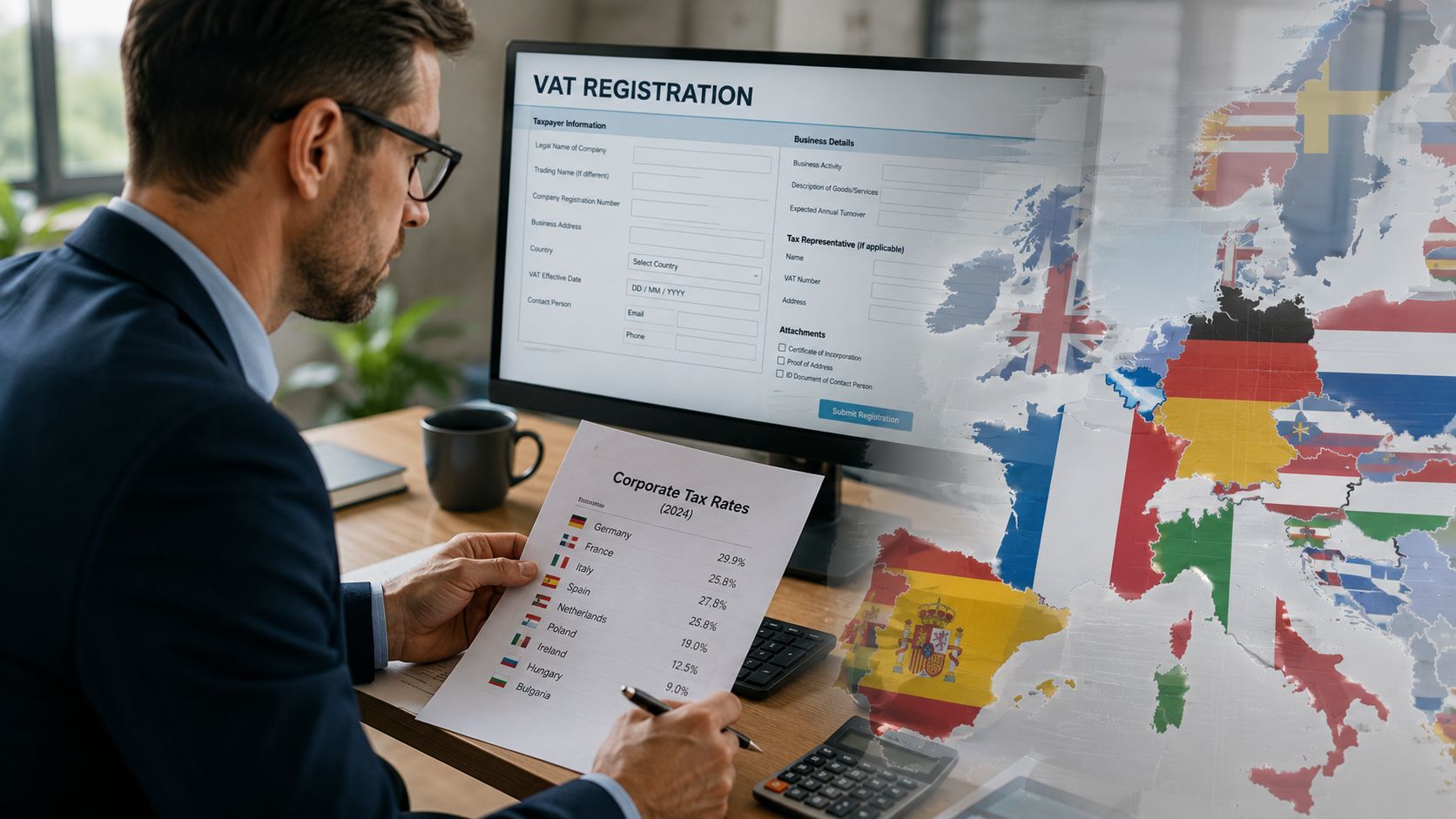
There is no special EU Inc tax deal. Corporate tax still applies at national level where you operate. That means the regime may simplify the shell, but it does not abolish the tax footprint. If you hire in one country, invoice in another, and manage from a third, you still need to think through local tax exposure.
Reuters captured the central complaint well, companies still have to comply with different labour, tax, and other national rules in each country where they operate. This is why the tax misconception matters. People hear “EU-wide” and mentally fill in the blanks with “EU-wide tax.” That's wrong.
The draft also draws a line between the default template path and custom structures. Neutral coverage notes that if you move beyond the template, approval can stretch to five working days and still needs national authority review rather than automatic EU-wide registration CEPA on EU Inc templates. That's not a disaster. It's just proof that the friction moved, it didn't vanish.
The incorporation workflow may still be clean. But the rest of your setup won't be frictionless if you need:
Practical rule: If your plan depends on non-standard governance, assume the “48-hour” path won't be your path.
The smart move is to treat EU Inc as an incorporation tool, not an operating shortcut. That keeps the math honest.
The policy debate is not theoretical. Bruegel says the “for-all” design risks adding another layer without cutting national compliance burdens, and Clifford Chance warns that digital speed doesn't remove ongoing legal overhead Bruegel on EU-wide incorporation. That is the cleanest summary of the institutional split. Supporters like the speed. Critics focus on what remains after speed.
The political timetable adds pressure. The Commission presented the draft on 18 March 2026, consultation ran through 25 June 2026, and the Council wants agreement by the end of 2026, with first incorporations expected from 2027 or 2028 Reuters, Trending Topics on EU Inc timing. That timeline tells you two things. First, the current design is still negotiable. Second, the criticism is landing while the policy is still alive, which is exactly when it should.
Worker groups are pushing a different concern. They worry that founders could use the structure to select more permissive labour environments, which turns a startup tool into a regulatory-arbitrage channel Social Europe on worker-rights concerns. That criticism is not about paperwork. It is about incentives. If the model rewards the lightest regime, labour protections become the first thing founders shop around.
The result is a split debate:
Those are different objections, but they point in the same direction. EU Inc is not being criticized because it is too ambitious. It is being criticized because the ambition may outstrip the legal machinery that supports it.
If you're advising a founder, that's the signal to watch. Not the branding. The enforcement path.
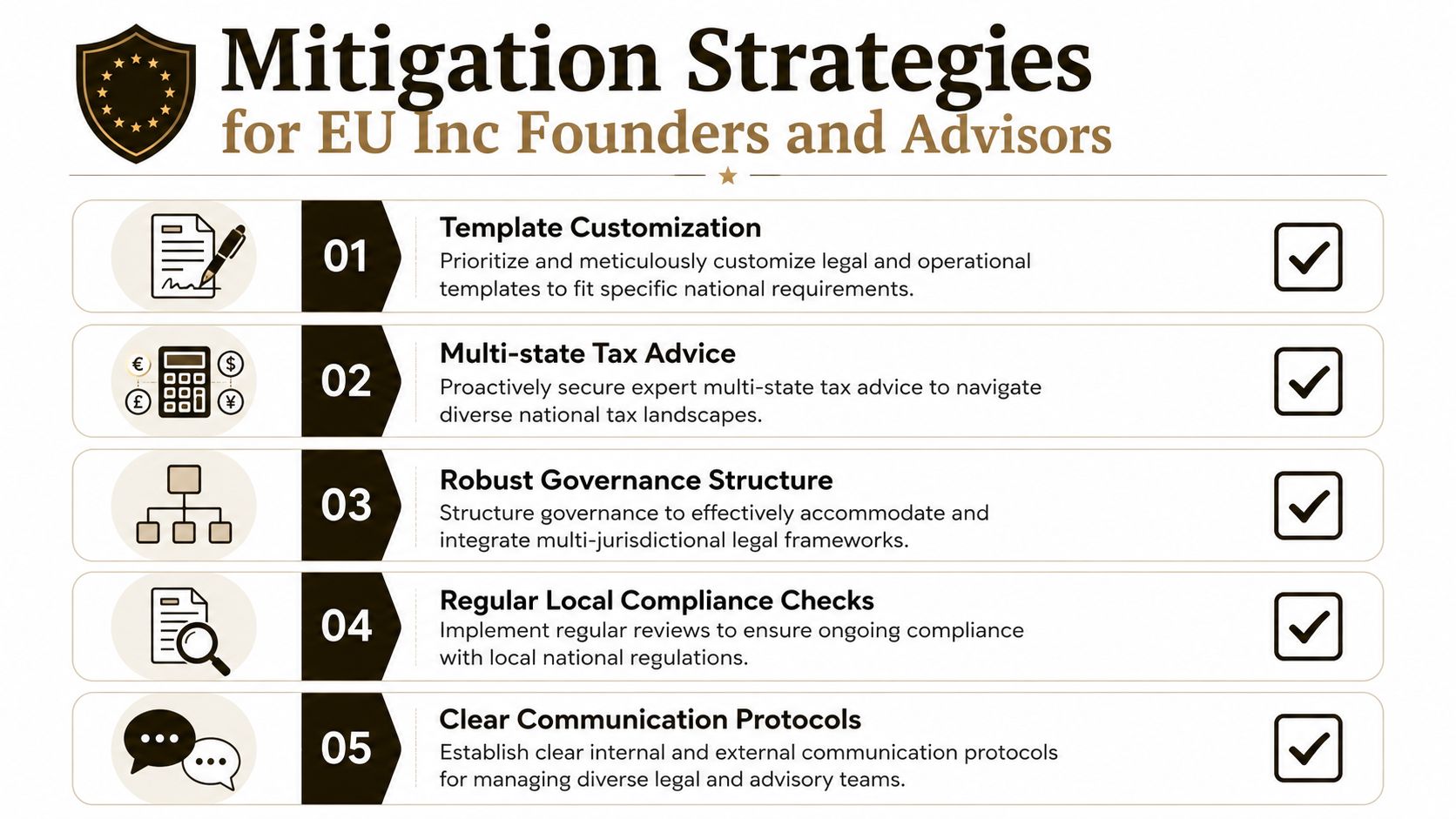
You don't need to avoid EU Inc. You need to use it with your eyes open. The right response to the criticism is not fear. It's preparation. If the regime lands close to the current draft, the winners will be the teams that understand where the template ends and the actual legal work begins.
If you're comparing paths, a platform like The EU Inc. setup and filing flow can help you understand the incorporation workflow before launch. That still doesn't replace counsel, but it gives you a process view instead of a sales pitch.
Ask three questions before recommending EU Inc:
If the answer to the last question is “full operating complexity,” EU Inc is not a complete answer. It's a front-end simplifier. Useful, yes. Sufficient, no.
Don't buy the shell and forget the rules underneath it. That mistake gets expensive fast.
That's also where a lot of founders will misunderstand the product. They'll optimize for registration speed and underweight the burden of local filings, tax setup, and governance tailoring. The smart play is to plan for both at once.
EU Inc makes sense when your business needs a clean entry point into the EU and your structure is close to standard. It's attractive for founders who want a single entity, remote incorporation, and a simpler setup story. It is less attractive when your company already has complexity baked in, like investor controls, special governance rights, or a multi-country workforce.
The biggest decision point is not nationality. Non-EU residents can register, and the framework is designed to be fully digital, with no citizenship, residency, notary, or local director requirement in the draft mechanics [EU Inc key mechanics]. The bigger question is operational shape. If your business will touch multiple labour systems, tax systems, and filing systems, the legal simplification will only go so far.
A useful way to compare options is this:
The founder mistake is to treat registration cost as the main variable. It isn't. The actual cost is the legal and operational load after formation. That's where fragmented rules, local tax handling, and labour compliance show up.
The good news is that the proposal is still in legislative process, so the final version can improve. But you should plan against the draft, not against the best-case press release. If you need certainty for fundraising or hiring, use the current draft as a signal, then confirm the final rules with counsel before you commit.