
You're probably at the point where the name looks easy, until you test it against a real EU filing path and it starts to fall apart. That's the trap with an EU Inc company name. The brand sounds settled, the domain is half-bought, and then one conflict in another member state can sink the whole plan because the form is meant to be recognized across all 27 EU member states once adopted, not picked country by country EU Inc proposal overview.
If you want the blunt version, treat the name like the filing, not like the logo. A weak name costs time, legal fees, domain work, and momentum. A strong one gives you room to move fast once the framework is live, with the Commission targeting a 48-hour digital incorporation process, below €100 in total registration costs, and no minimum share capital requirement Commission proposal PDF.
A founder I know picked a clean, memorable name, built the site, ordered the deck, and filed locally. The rejection came later. The name was close enough to existing entities and marks in other places to create a problem the team never checked.
That is why the name comes first for EU Inc. The whole point of the regime is a single company form recognized across the EU, so you are not clearing one registry. You are clearing a cross-border path. If the name fails in one relevant market, the filing can stall before you have even started operating.
Founders pay twice. They pay once for the original branding, then again for the rework. That includes the site, legal documents, pitch materials, inboxes, and the awkward explanation to customers that the company changed its name before launch.
Practical rule: do not fall in love with a name before you know it can survive a cross-border check.
The smart move is to shortlist names that can survive legal review, trademark review, and domain review together. If a name only works because it sounds good in a brainstorm, it is not ready. If it works because it clears the filing constraints, it is usable.
There is another reason to treat the name as a first-class decision. The proposal is built around a standardized digital flow where founder data is entered once and then propagated through the system under the once-only principle EU Inc proposal PDF. That means sloppy naming does not stay local. It travels.
The founders who win here do not pick a name late. They pick it early, pressure-test it hard, and only then build the brand around it.
The name has to do three jobs at once. It must be distinct, legally compliant, and followed by “EU Inc.” The suffix is not decoration. It is part of the legal identity.
That is why the suffix does not rescue a weak name. If the core name is too close to an existing entity, awkward under naming rules, or likely to cause confusion, adding “EU Inc.” will not fix it.
The proposal's workflow is built to move founder data through the EU-level interface once, then pass it onward through the once-only principle. That is the same reason naming mistakes get expensive fast. A messy name does not stay local. It affects the rest of the filing flow, including handoffs for TIN and VAT identifiers.
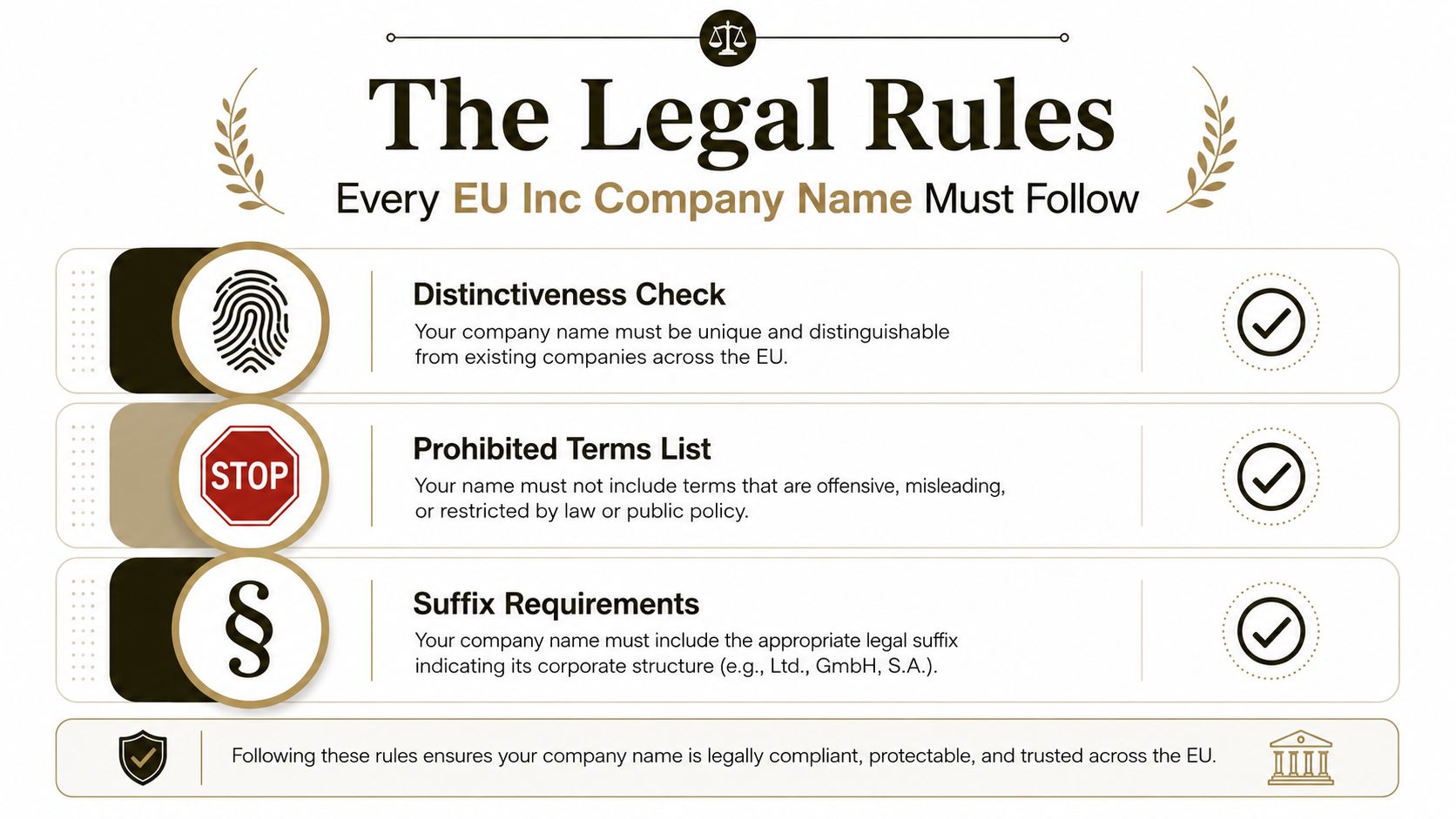
Do the search in layers. Start with your home market, then widen to the member states where you plan to sell, hire, or invoice first. That order matters because a name that looks open in one country can still collide with an older entity or mark somewhere else in the EU system.
The framework is built on a central EU interface using BRIS, with company data moving automatically to business registers and competent authorities under the once-only principle EU Inc proposal overview. That is the environment you are preparing for. You are not just checking a local register. You are checking whether the name can survive a connected, cross-border setup.
The useful distinction is between a clean-looking name and a legally safe one. Identical conflicts are obvious problems. Similar-sounding names, close translations, and sector overlaps are more dangerous because they look harmless until someone challenges them.
A name that passes a quick search can still fail once you run it through trademark logic.
That is why I would never treat the search as a checkbox. It is a filter. If the name only survives because you ignored one layer, it was never safe.
If you want a practical companion for the domain side of this work, the guidance on form domain configuration tips is useful because it forces you to think about naming and web presence together instead of as separate chores.
Trademark and domain checks are not admin work. They're risk control. If you skip them, you can end up with a company name that looks legal on paper and still gets you into trouble the moment customers, investors, or counterparties start using it publicly.
The best order is simple. Check trademarks first, domains second, social handles third. If the trademark is blocked, the domain doesn't matter. If the domain is gone, your launch story gets clumsy fast. And if the social handles are inconsistent, the brand starts looking improvised.
A .com might already be taken by a live competitor or an inactive owner who still holds the mark. A country-specific domain can make a pan-EU company feel local in the wrong way. And a trademark search can turn up an apparently dormant holder who still has enough rights to make your launch painful.
That's why founders should think in classes, not just words. The relevant Nice classes depend on what the company does, so the same word can be harmless in one category and risky in another. If you're unsure whether to file a defensive trademark before launch, that's a legal judgment call worth confirming with counsel in the relevant jurisdiction.
If the conflict shows up in week one, move on. Don't negotiate with the name. If it shows up late, you're choosing between a delay and a brand rewrite. Either way, the fix is expensive compared with an early search.
For teams building software and customer-facing tools, the naming issue usually overlaps with web architecture too. A company that expects the name to appear across forms, landing pages, and onboarding flows should keep that consistency in mind from the start. The point is not to over-engineer the launch. It's to avoid a split identity across legal docs and public assets.
The timing answer is simple. EU Inc is still in the legislative process, so the name is not available for live filing yet. The Commission submitted the draft on 18 March 2026, and the proposal is still moving through the EU's ordinary legislative procedure, not a registry you can use today EU Inc proposal overview. The Commission's public target points to Q1 2027, but independent legal commentary suggests the first practical openings could slip to end-2027 or 2028 if agreement only lands by the end of 2026 EU Inc proposal overview.
That means one thing in practice. You cannot file yet, but you should treat the name as an asset to reserve mentally and operationally right now.
Reservation here does not mean a formal state portal unless one is created later. It means lowering the odds that someone else grabs your strongest name before the system opens. Do the work early, while there is still room to adjust.
The Commission's planned mechanics still shape the strategy. A fully digital process, 48 hours, under €100, and no minimum share capital mean the filing itself should move quickly once the system opens Commission news release. That speed only helps founders who already handled the name checks before launch.
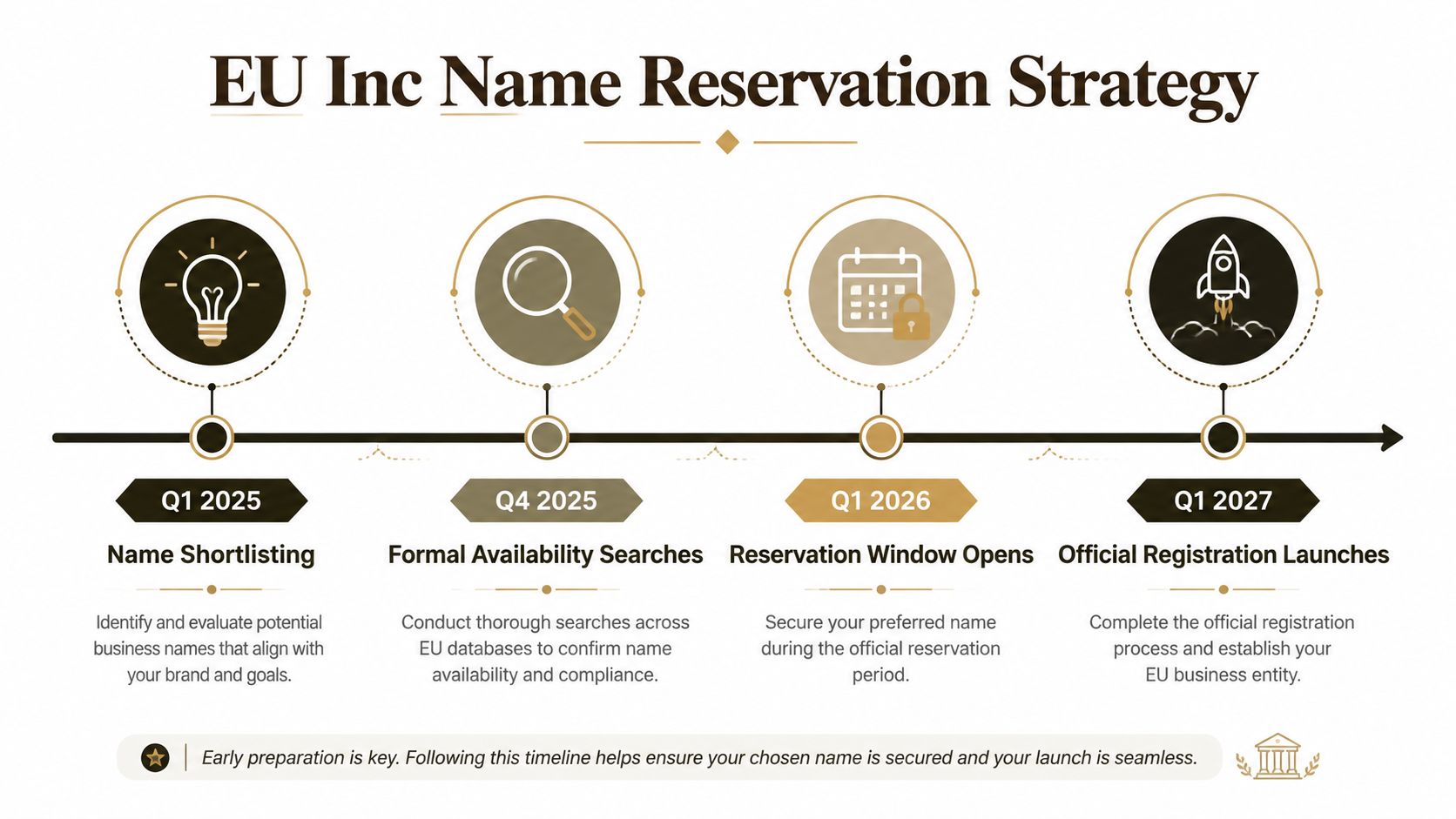
My advice: start the search now, not when the launch announcement drops. Then launch day is paperwork, not panic.
If you are outside the EU, treat the name work as your problem from the start. You do not get to assume a local advisor will catch every conflict across every market. EU Inc is also designed to be open to non-EU founders with no citizenship or residency requirement, no notary, and no local director requirement GT Law analysis. That makes disciplined pre-filing checks your responsibility, even if the company is remote.
The structure is meant to be 100% digital. A founder in Singapore, New York, or Dubai can do the name prep without flying anywhere GT Law analysis. Use that advantage properly, and do not let distance become an excuse for sloppy screening.
Service partners who register clients at scale should stop improvising. They need a fixed naming rubric, a parallel trademark sweep, and a clear escalation path for conflicts that appear after the company-register check but before launch. The name review belongs in intake, not as a late-stage rescue.
One option for teams that want a guided path through the waitlist and launch workflow is The EU Inc. by renn, which coordinates a digital incorporation process and captures founder details ahead of launch. That kind of setup is useful when you want the name decision, the filing data, and the operational handoff to line up cleanly once registrations open.
There is also a tax reality founders keep missing. EU Inc has no special tax rate. Corporate tax still applies at the national level where you operate. Once the name is fixed, the country you base the business in still matters a lot.
Use this as a working list, not a wish list.
Start with three to five candidate names. Keep the list tight, because a bloated shortlist turns into hesitation, and hesitation kills momentum. Then run a sweep across the relevant registers in all 27 markets and drop any name that collides in a key jurisdiction. A name that only looks available in one country is not ready for an EU-wide filing path.
Clear the EUIPO position and the relevant Nice classes before anyone gets attached to a favorite. A clean company-name search is not enough, and founders who stop there usually pay for it later. Check the trademark layer in parallel, then check domains and social handles at the same time, because brand consistency falls apart fast when the name, website, and public profiles point in different directions.
The domain plan should be simple and realistic. Secure the main version you can use, then make sure the rest of the branding does not fight it. If the obvious handle is gone, decide quickly whether the fallback still looks credible or whether the name should be replaced.
File a defensive trademark where the facts justify it, and confirm the jurisdiction details with counsel before you treat it as settled. Document the final name and one backup in writing. When launch day arrives, you want a decision on the page, not a room full of second guesses.
Track the legislative timeline closely. The regime is still moving, so any Q1 2027 plan needs a buffer, as noted in the EU Inc proposal overview.
The cleanest founders do one thing well. They decide early, then they stop shopping for a better answer.