
EU Inc checklist for founders starts with a simple win. One company, valid across 27 EU member states, a 48-hour registration target, a maximum €100 registration cost, and no minimum share capital requirement, according to the European Commission's March 2026 announcement (European Commission announcement on EU Inc). That is the appeal for a founder who wants to move fast and keep entity management clean.
The timing matters too. The Commission published the proposal on 18 March 2026, so this is still a legislative process, not a live registration regime yet (EU Inc proposal text). Independent material tied to the initiative points to a Q1 2027 launch window, so you should treat this as a prepare-now, file-later setup, not a finished product (EU Inc founders page).
If you're a non-EU founder, this matters even more. The proposal is built for remote formation, with no citizenship or residency gatekeeping in the way founders often fear. And if you're registering clients at scale, the partner track deserves attention now, because the prep work is the difference between a smooth day-one filing and a bottlenecked launch.
banking options for EU founders
The European Commission says EU Inc is built to make cross-border company setup easier across the Union, and that is the reason to get your details into the queue before launch day (European Commission announcement on EU Inc). If you wait until the system opens, you will be filing at the same time as everyone else, which is exactly how avoidable delays start. For a non-EU founder, the setup is still attractive because the model is meant to work without a local citizenship or residency requirement.
Submit the basics early. The filing flow is built around founder details, company name, registered office, and business activity, with the proposal materials indicating that the form is meant to go through an EU-level interface rather than forcing you to build separate structures country by country.
A good waitlist prep pack is simple, and that is the point. It gives you cleaner data on day one and fewer corrections later.
Practical rule: The founder who prepares the data first usually gets the cleanest launch-day filing.
The waitlist is about data capture, not marketing noise. When national systems open, you want your company profile ready to autofill, not reconstructed from scratch while your team waits on documents and spelling corrections.
If your brand already has live operations, lock the same name across your domain, trademark search, and incorporation draft now. That avoids one of the dumbest delays founders face, the late realization that someone else already owns the wording you wanted.
The fastest way to slow down an EU Inc filing is a sloppy review step. Once the registration window opens, check every field before you confirm it. A wrong company name, a bad registered office, or mismatched founder details turns into avoidable cleanup later, especially once banks, accountants, and counterparties start matching records.
The proposal is built to be digital and standardized, but that does not mean casual. The Commission's materials show that EU Inc. is meant to simplify incorporation across the bloc while still working through national legal infrastructure for validation. Treat the review screen like a legal sign-off, not a browser form. That matters even more for non-EU founders who cannot lean on a local director or a notary to fix mistakes after the fact.
Do not rush this step because you are excited. One clean review now is cheaper than a correction request later.
Remote founders need a stricter process. If you are not physically local, you cannot rely on a quick walk-in fix, so the first submission has to be exact. Your banking, tax, and contract setup will all follow the same legal identity, which makes this review step a hard control point, not a formality.
The image below shows the kind of confirmation screen you should expect to scrutinize carefully.
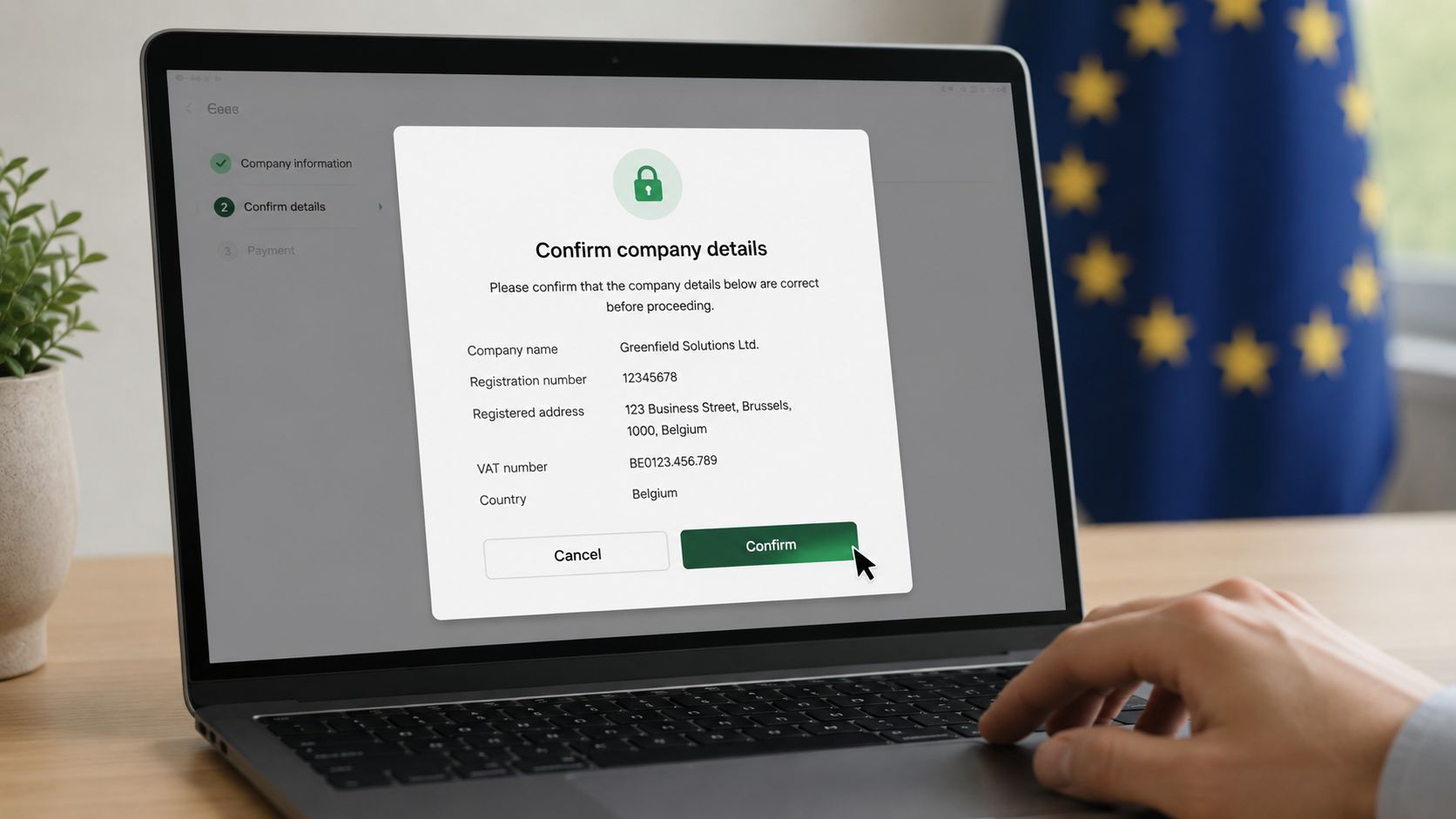
Speed matters here because the filing should move through the platform without manual admin. Once the system is live, the application is sent automatically, so you are not printing forms, emailing attachments, or waiting for an office to open. That matters for non-EU founders who have to keep investors, launch timing, and hiring plans aligned without relying on a local director or a notary to clean up mistakes later.
Keep the filing workflow tight from the start. The Commission's aim is a fast registration process, and the wider EU Inc materials are designed to reduce cross-border incorporation friction at scale (European Commission announcement on EU Inc). Treat any timing target as a planning assumption, not a guarantee on the day. If the national system slows down, your roadmap still needs room for delay.
Once the filing goes through, protect the paper trail.
A founder who treats the reference number like a throwaway email is setting up avoidable problems. It becomes the anchor for amendments, status checks, and later correspondence.
Keep the reference number in your finance folder, your legal folder, and your founder operating doc. One copy is not enough.
For advisors, the control point is coordination. If you are supporting multiple clients, keep your internal tracking aligned with the platform's status updates. Otherwise, the client gets a clean filing while your team is still searching inboxes for the confirmation.
The cleanest EU Inc. filing is the one you prepare before you ever open the upload screen. The system is meant to cut out the old routine of printing, signing, notarizing, and mailing a stack of papers. In practice, the standard pack still has to be tight: articles of association, founder declarations, and any shareholder agreement your ownership structure requires.
Do the legal thinking first, then let the platform handle the formatting. If you have multiple founders, uneven equity splits, or investor rights that need to be locked in, draft the shareholder agreement before launch day. Governance gets messy fast if you try to invent it after the entity already exists.
The proposal materials point to a process built for digital filing, with no notary appointment and no in-person step, which is exactly why document readiness becomes the main bottleneck (EU Inc proposal text, EU Inc founders page). For non-EU founders, that matters even more. You do not have a local director or notary to clean up sloppy uploads, so your file pack has to be right the first time.
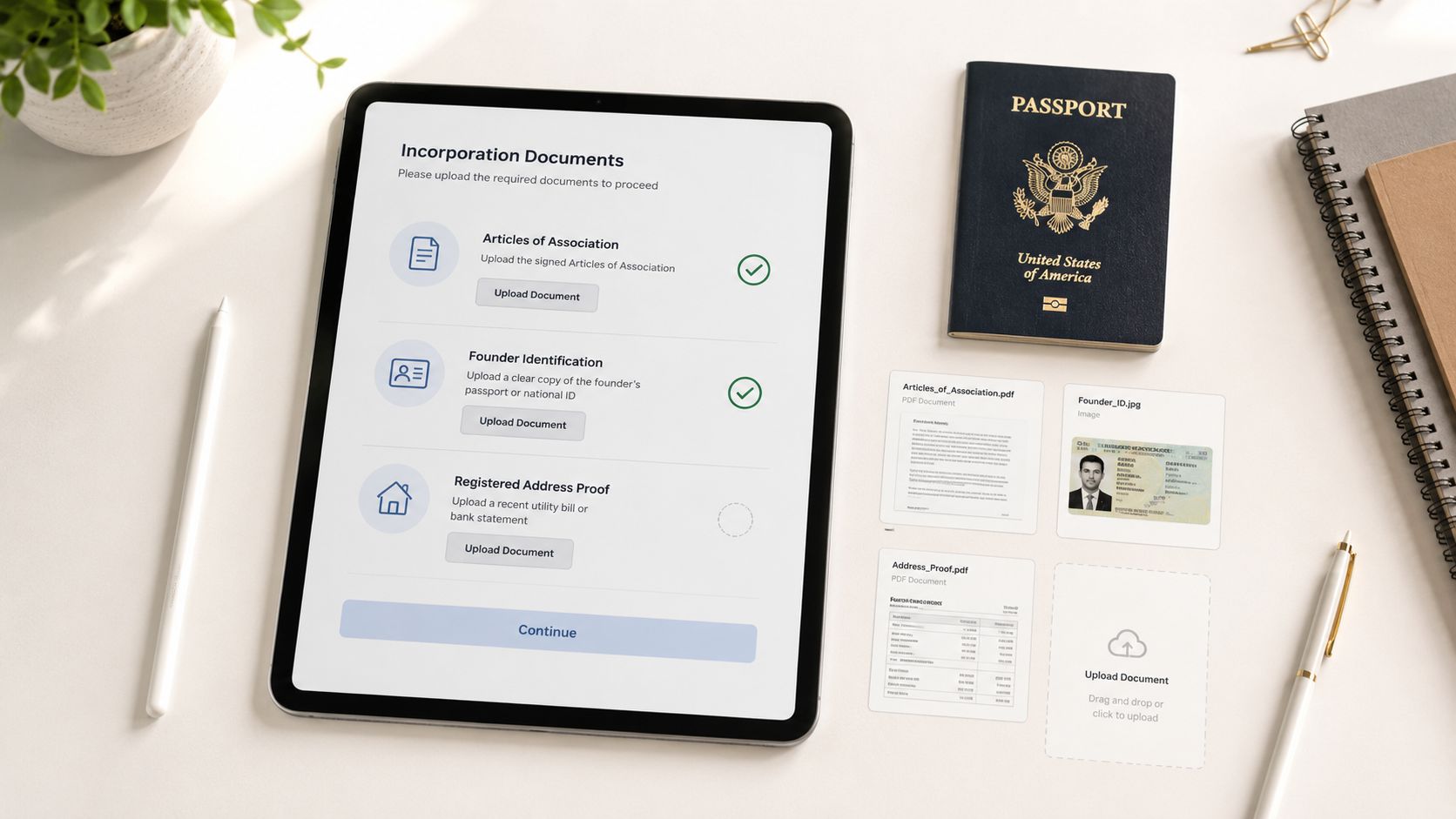
If a document would make a bank officer pause, fix it now. Banks are rarely kinder than company registries.
For a non-EU founder, remote formation either stays efficient or starts to wobble. The lack of notary reliance helps, but it does not excuse mismatched names, weak scans, or missing signature pages. If you also want to line up investor readiness while you prepare the file set, the Gritt.io founder investor tools can help you keep that workstream organized.
Tax IDs should not become a second project after incorporation. Under the EU Inc. workflow, the TIN and VAT number are meant to be handled inside the same registration flow, so the tax side is coordinated while you set up the company rather than chased later through separate filings.
That matters because the usual sequence is slow and messy, incorporation first, tax numbers later, then a gap where invoicing, banking, and compliance all stall. EU Inc. is designed to shorten that gap into one registration route, and the Commission frames the proposal as part of the core infrastructure for cross-border company formation, not a narrow startup shortcut (EU Inc impact assessment).
If you are a non-EU founder, that coordination matters even more. You do not have a local director or notary to tidy up incomplete tax paperwork, so the identifiers, records, and accounting setup need to be correct from the start.
A clean incorporation file still leaves you stuck if the tax numbers are missing from your records. Banks ask for them, customers ask for them, and your invoicing stack needs them before you can trade with any confidence.
Gritt.io founder investor tools
Your entity is not operational until the numbers exist in your records and in your accounting stack.
EU Inc. does not change your tax rate. Corporate tax still applies at the national level where you operate, so the company form does not reduce the bill on its own. Treat that as a planning rule, not a footnote, because misunderstanding it leads to bad budgets and avoidable tax friction.
One entity should do the work of several. For non-EU founders, that matters even more because you are not relying on a local director or notary to clean up a scattered structure later. A single legal entity lets you hire, invoice, and sign contracts across the EU under one corporate roof, instead of building a separate company stack every time you enter a new market.
Set the operating map before you expand.
A single entity does not remove local rules. It stops you from multiplying entities for ordinary business. You still need to handle country-level employment, privacy, and tax obligations correctly, and you should line up support if your hiring structure becomes more complicated.
Use the one-company model to reduce entity sprawl, not to ignore local compliance. That is the clean line.
Treat this like an operating decision, not a branding exercise. If your first sales push is Germany, France, and the Netherlands, your plan should show how one company serves those markets without forcing three separate legal setups. That is the point of this structure, and it is the point of the checklist too.
Run the numbers before you file. The Commission has framed EU Inc as a way to cut administrative friction across the EU, so the key question is whether your current setup still makes sense once you compare it with a single-company model. For a non-EU founder who cannot rely on a local director or notary, that comparison matters even more, because every extra entity usually adds another layer of setup, coordination, and ongoing admin.
Start with your own rollout plan, not a generic cost estimate. If you expect to enter three markets or five, compare one EU Inc registration with the older route of building separate companies country by country. That older route means separate incorporations, separate bylaws, separate filings, and more hours lost to maintenance. EU Inc is designed to reduce that burden, with a statutory registration fee capped at €100 in the Commission's announcement (European Commission announcement on EU Inc).
Do not stop at legal fees. Add accounting overhead, the friction of multiple filings, and the cost of keeping entity records current. That is where multi-entity structures start eating margin.
If your expansion plan needs repeat country setups, the real cost is administrative drag, not just the incorporation fee.
Equity planning belongs in the same spreadsheet. If you expect fundraising or employee grants later, set the structure correctly now so you are not rebuilding governance after the fact. For founder-facing equity tools, the same readiness mindset applies to EU-FAST or EU-ESOP, but your case still needs proper legal and tax review before you lock anything in.
Good incorporation workflows don't just end with a certificate. They show you what happened, what's pending, and what you still need to send to other providers. EU Inc's monitoring framework is built to track new companies, conversions, cross-border reorganizations, and fast-track usage, which tells you the system is meant to behave like corporate infrastructure, not a one-off form (EU Inc impact assessment).
For you, the practical job is simpler. Watch the dashboard, save every milestone, and treat completion as a package, not a single email. Once the registration is done, you should have the certificate, the assigned identifiers, the articles, and the company status summary ready to share with banks, customers, or partners.