
You're trying to get a company across the line in more than one EU market, and the messy part isn't the business idea. It's the admin. One country wants a notary. Another wants a local representative. A bank wants a different identity check. Tax registration drags into its own lane. If that sounds familiar, the EU Digital Identity Wallet matters to you because it's being built as the identity layer that can cut through that fragmentation.
For founders, the point is simple. If the wallet works the way the EU says it should, it becomes the common trust rail for incorporation, onboarding, and later day-to-day access to public and private services. The mandatory acceptance timeline is the signal, public services must accept it when requested from December 2026, and certain regulated private-sector providers, including banks and payment firms, must accept it by December 2027 according to Arthur Cox's company law note on the EU Digital Identity Wallet. That changes how fast a company can move once the surrounding systems are ready.
The European Commission's target is that 80% of the EU population will have a European Digital Identity Wallet by 2030 (Signicat report). Independent market research also forecasts 83 million digital ID wallets in circulation by the end of 2025 and 169 million by 2026 in the same report. That's not a niche rollout. That's infrastructure becoming normal.
A non-EU founder hits the same wall over and over. The company is ready. The market is clear. Then the setup process starts asking for physical presence, local filings, and a stack of identity proof steps that don't talk to each other. That's the cost of cross-border formation, not just legal fees. It's time, travel, and delay.
The wallet matters because it is designed to become the shared identity layer underneath those steps. The European Commission frames it as a way for people to authenticate to services and share only the specific data requested, which is exactly what founders need when different authorities ask for different pieces of the same story. The practical issue is not whether the wallet app exists. It's whether registries, banks, and verification providers can all accept the same credential flow without forcing you back into paper and in-person checks.
The shift is from fragmented onboarding to a single digital identity path. That is what makes the wallet relevant to EU company formation, not just consumer logins. Once public services are required to accept it from December 2026 and regulated private-sector providers from December 2027, the wallet stops being a side project and becomes part of the operating environment for founders who want to move quickly across borders (Arthur Cox).
The biggest business payoff is cleaner execution. A founder who can authenticate once, disclose only what's requested, and push the right data into registration and banking flows is not fighting three separate identity systems. That is how you get closer to fast, single-entity operations instead of country-by-country sprawl.
Practical rule: treat wallet readiness as an incorporation input, not a nice-to-have privacy feature.
This matters even more if you're planning to build around a single EU company rather than multiple local entities. The publisher behind this article, The EU Inc. by renn, is built around that single-entity model and says it coordinates fully digital incorporation, TIN and VAT assignment, and a launch-window waitlist. That kind of workflow only works if the identity layer underneath it is usable.
The wallet won't erase every legal step on day one. But it can remove the clunky parts that slow founders down most, especially where incorporation, tax registration, and bank onboarding currently happen in separate silos.
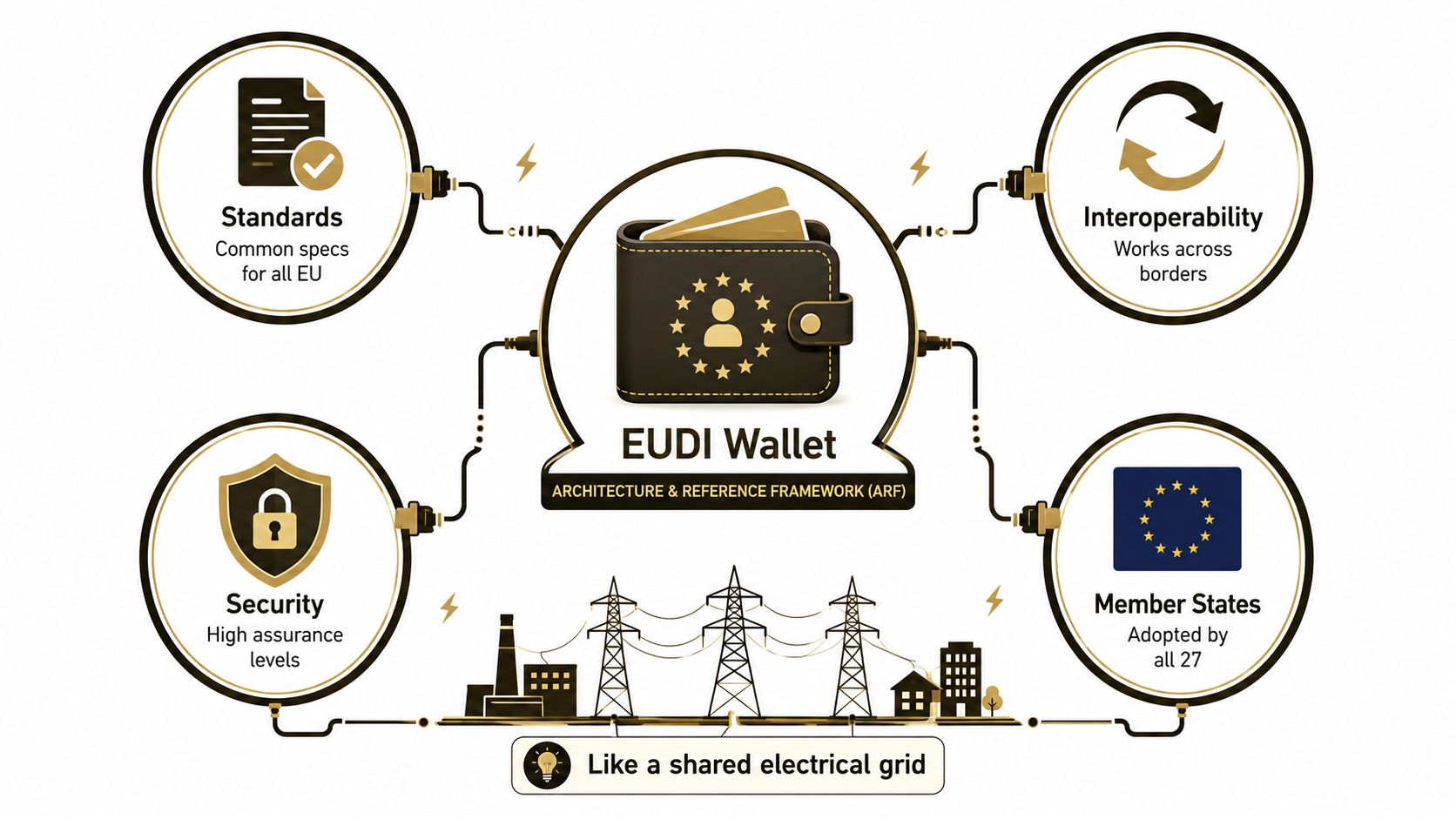
The framework works as a shared grid for issuers, wallets, and service providers. The Architecture and Reference Framework, or ARF, sets the common architecture, standards, protocols, and information formats that make cross-border use possible. That is the interoperability layer. It keeps the ecosystem aligned because participants follow the same technical rules, rather than each vendor building a closed stack.
The European Commission says the reference implementation is modular and reusable across multiple projects, which matters for providers and relying parties that need to support cross-border credential exchange without rebuilding core components each time. The practical effect is lower integration friction and fewer excuses for slow adoption. National and private implementations can connect to the same baseline without forcing every party into a custom setup.
The wallet architecture separates the user device, the wallet instance, and the secure cryptographic functions. For legal-person wallets, the user device may be a cloud server instead of a phone. That matters because the wallet still has to reach a secure cryptographic device to manage keys and carry out operations, which creates a defined trust boundary for authentication and electronic signatures.
That boundary is what founders often miss. A wallet is more than a UI. It is a security model built around how keys and signatures are managed. If your registration flow depends on that model, your vendor, your registry, and your trust provider all need to support the same assumptions about identity, keys, and signing.
The EUDI wallet toolbox includes OpenID4VP, OID4VCI, ISO/IEC 18013-5, and remote qualified electronic signing, rQES. Those standards are the hooks that let wallets support proximity and remote flows across the EU.
Here's the plain-English version:
For incorporators, the takeaway is direct. Interoperability depends on a shared technical layer. If your service provider cannot speak that layer, wallet readiness will not get you very far yet.
The compliance gap sits here. A wallet can hold identity credentials, but company formation still fails if the registry, notary, KYC provider, or bank cannot read the same standards at the same point in the flow. That is the difference between a useful credential and an onboarding process that closes. For teams mapping entity paperwork, the stale documentation detection guide is a sensible reference point, because expired or inconsistent documents still break cross-border onboarding even when the wallet itself works.
The wallet becomes commercially useful when it stops being a login method and starts moving incorporation data. That means digital preparation of documents, identity checks, selective disclosure, and automated submission into the registration flow when national systems go live. For an EU company formation process, that's where the difference between theory and execution shows up.
The wallet's selective disclosure feature is the feature founders should care about most. It lets you share only the specific data requested by a registry or verification provider. That is a cleaner fit for company onboarding than sending a full packet of identity copies everywhere. It also reduces the number of places where stale or inconsistent documents can creep in, which is why a tool like Halo AI's stale documentation detection guide is worth having in the background if your team handles large amounts of entity paperwork.
A practical flow for an EU digital identity wallet company setup is straightforward:
That flow is only useful if the service provider can adapt its authentication logic and update its systems to accept wallet-based credentials. The hard work sits on the provider side, not in the wallet app itself.
The wallet can move the data, but your operating model still has to be clean. If your incorporation workflow is relying on inconsistent source documents, you create downstream problems in tax, banking, and beneficial ownership records. That's why wallet-based onboarding should be paired with strong document control and filing discipline from day one.
The wallet lowers friction. It doesn't fix bad records.
For EU Inc. specifically, this matters because the model is built around a fully digital process, no notary appointment, no in-person step, and coordinated TIN and VAT issuance as part of registration. A founder should be checking whether the provider can support that flow, not just whether they mention digital identity in marketing copy. If they can't, you'll still end up with a patched-together process.
Not every wallet solution is equally useful for company formation. National wallets are often the most mature for local use. Private wallets can be flexible. The EUDI Wallet is the one built to matter cross-border. For incorporators, the right question is not “which wallet is best”, it's “which wallet can handle a company setup without breaking when the transaction crosses a border”.
Italy is a good example of why local strength isn't enough. The Commission's masterclass materials say the SPID system reached 41.5 million active identities by October 2025, about 83% penetration of the reference population, and generated 1.3 billion annual accesses. Italy also had 48.4 million valid physical IDs and 9 million users activated on CieID digital credentials (European Commission masterclass PDF). That is strong national infrastructure. But strong national infrastructure is not the same as broad cross-border incorporation readiness.
The European Commission reports that only 14% of EU public service providers allow cross-border authentication, while 59% of EU residents already have access to trusted and secure eID schemes across borders (Commission masterclass PDF). That gap is the whole problem. Access exists, but acceptance is still uneven.
Look for these signs before you trust a provider with incorporation flows:
A provider that only works in pilot settings is not enough for incorporators. You need something that behaves like infrastructure, not a demo.
Founders should be ruthless. A wallet partner is not a branding choice. It's a transaction risk decision. If the partner can't handle non-EU founders, digital filing, and multiple jurisdictions, you're buying yourself a future support mess.
The first test is simple. Can the partner support a 100% digital process for founders who are not EU citizens or residents, without local director, notary, or physical presence requirements? If the answer is no, they're not a fit for a company formation workflow built around the EU Inc. model. If the answer is yes, ask how they verify identity, what fallback path they use, and how they handle launch timing.
One useful option in this category is The EU Inc. by renn. It offers waitlist intake, automated submission when registration opens, digital document preparation, TIN and VAT coordination, and partner onboarding for firms that want to register clients at scale. That's the kind of operational package worth comparing against any other incorporation route, because it treats identity, filing, and post-filing work as one workflow.
Do this early: if you expect to launch around the EU Inc. timeline, get your documentation reviewed now, not after the filing window opens.
Cost matters too, but don't get distracted by headline fees alone. Compare the legal work needed, the filing steps involved, the fallback process if wallet acceptance is delayed, and the amount of manual coordination your team would still have to run. That is where real overhead lives.
The biggest gap in wallet content is exclusion. The framework is centered on EU citizens and residents. It does not fully solve the case of the founder, director, or beneficial owner who is outside the EU, lacks local credentials, or needs to complete incorporation before becoming resident. The Bosch Stiftung brief says this plainly, and that limitation matters for international founders who assume the wallet is a universal identity layer. It isn't.
A second gap is governance. The Commission materials describe a member-state-led model, which means national wallets and trust infrastructure remain central. That gives you a patchwork rollout, not a single global standard on day one. The result is variation by jurisdiction, which is exactly what founders were hoping to escape in the first place.
When wallet-based authentication is not yet available, you need a fallback path. That fallback should be documented before you rely on the wallet for any serious filing or onboarding process. If it isn't, your team will discover the gap at the worst possible moment, usually when a transaction is already in motion.
The other operational issue is the amount of legal and engineering work needed to make wallet operations usable across multiple member states. The wallet app itself may look simple. The integration work around it is not. Service providers, registries, and verification vendors all need to align on data formats, acceptance rules, and trust logic.
For security teams, this is also where caution matters. If a wallet ecosystem is rolled out too quickly without clear controls, the damage from a breach can spread across many relying parties. The Mywallet Co breach report is a reminder that identity systems are only as strong as their operational hygiene. Strong architecture doesn't help if access control, recovery, or document handling is sloppy.
That's the honest view. The wallet is a major upgrade, but it's not an excuse to stop checking the legal and operational details that keep an incorporation process usable.
If you're a non-EU founder, join the waitlist now, prepare your identity and company documents early, and confirm whether your preferred incorporation partner can handle digital submission the moment registration opens. If you're an EU startup planning multi-country operations, map which of your target services already accept cross-border authentication and which still need fallback flows. If you're a scale-up, ask your legal and finance teams to compare the admin cost of one EU-wide entity against the overhead of maintaining multiple local entities.
The timeline is the part you should respect. EU Inc. is still in the legislative process, with an expected Q1 2027 launch. Wallet acceptance for public services starts in December 2026, and regulated private-sector acceptance follows in December 2027 according to Arthur Cox's summary of the acceptance timeline. The market is already scaling toward 169 million wallets in circulation by 2026, so waiting until the last minute is bad strategy, not prudence (Signicat report).
For the next 90 days, do three things. First, collect the documents your incorporation partner will need. Second, verify wallet acceptance in your target jurisdictions. Third, choose a provider that can explain its fallback process without hand-waving. That's enough to keep you out of avoidable delay.